San Saturnino: Pamplona's Historic Fortress Church
A Medieval Fortress in the Frankish Quarter
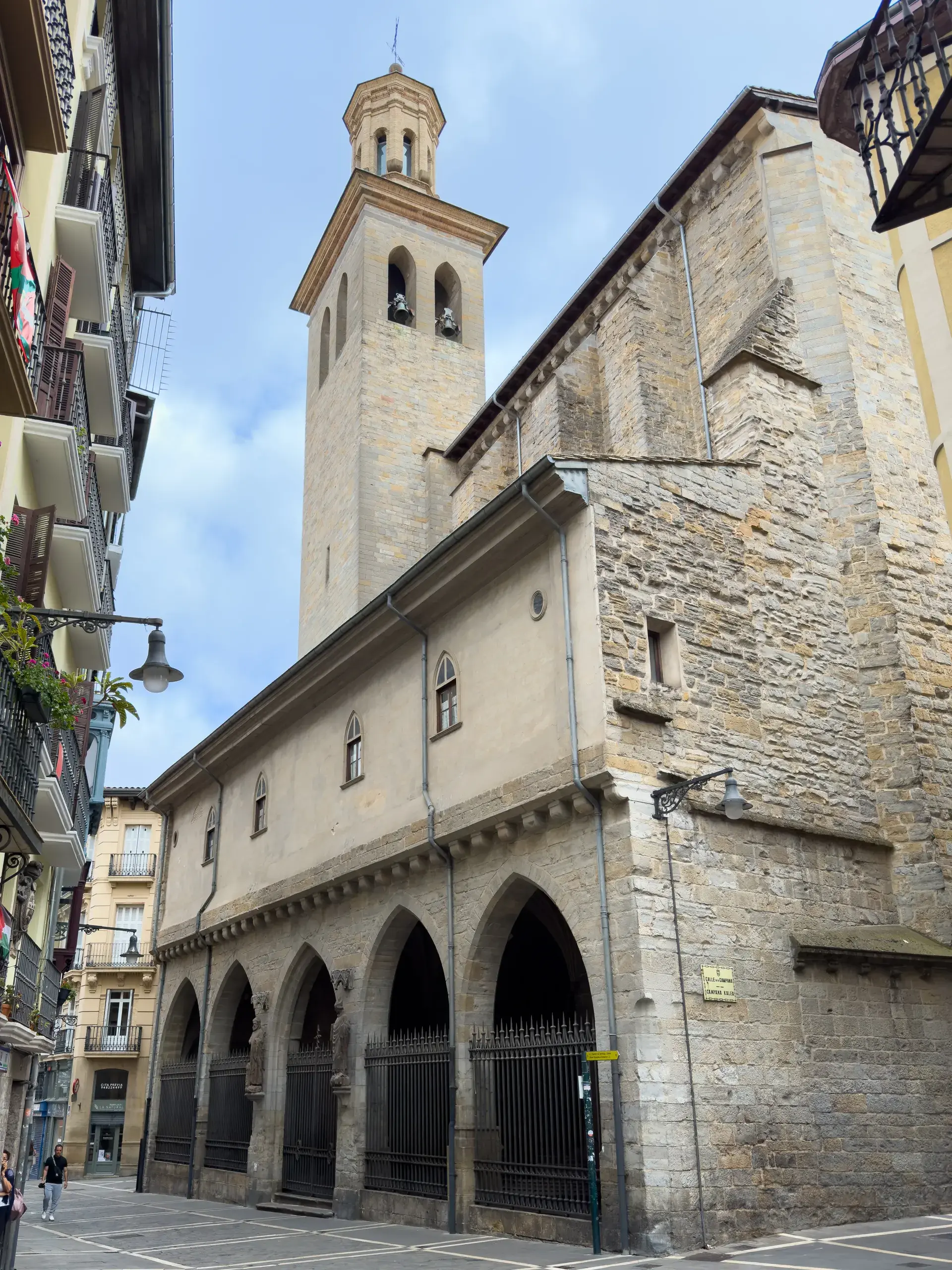
The Church of San Saturnino, locally referred to as San Cernin, stands at the junction of Calle San Saturnino and Calle Mayor in the Old Quarter of Pamplona. Constructed primarily between 1277 and 1297 over earlier foundations, the Gothic church was built to serve the Burgo de San Cernin, an autonomous settlement established in the late 11th century by French merchants, clerics, and craftsmen under King Alfonso the Battler and Bishop Pedro de Roda.
During the Middle Ages, Pamplona was divided into three rival boroughs: La Navarrería, San Cernin, and San Nicolás. These distinct quarters frequently engaged in armed clashes known as the Wars of the Burgos. Because of this persistent conflict, San Saturnino was engineered with a dual religious and military purpose. Flanked by two roughly 55-meter-high square towers that originally featured defensive parapets and battlements, the church functioned as a fortified stronghold to protect the Frankish population. The borough hostilities continued until King Charles III the Noble unified the divided city under the Privilegio de la Unión in 1423.
Architectural Profile and the Chapel of the Virgen del Camino
The exterior of San Saturnino retains the appearance of a medieval fortress, characterized by heavy block stonework and its imposing twin towers. Its 13th-century sculpted Gothic portal features detailed carvings depicting biblical scenes, the Passion of Christ, and figures including Saint Saturnin and Saint James the Pilgrim. Situated directly on Calle Mayor along the Camino Francés, the church served as an essential sanctuary for pilgrims traveling toward Santiago de Compostela, contributing to its recognition as a UNESCO World Heritage site and a Spanish Bien de Interés Cultural.
Inside, the church opens into a wide single nave roofed with sexpartite rib vaults, terminating in a polygonal apse flanked by chapels set between external buttresses. Around 1758, the Baroque Chapel of the Virgen del Camino was added to the complex, erected on the footprint of the former medieval cloister.
Civic Patronage and Historic Landmarks
Although Saint Fermín is widely known due to Pamplona's annual July festivities, Saint Saturnin of Toulouse is the sole civic patron saint of the city itself. Saint Fermín, alongside Saint Francis Xavier, is co-patron of the broader province of Navarre. Saint Saturnin's patronal feast is celebrated annually on November 29 with civic and liturgical processions centered at the church.
Several historical features link the church to the surrounding streets. Perched atop the clock tower is El Gallico de San Cernin, a rooster-shaped weathercock installed in 1795 that has become a secular emblem of Pamplona. The tower's clock bells chime across the Old Quarter, famously signaling the 8:00 a.m. launch of the rocket that initiates the daily bull runs during the San Fermín festival. Outside the church entrance, a stone disk embedded in the street pavement known as El Pocico marks the traditional well site where Saint Saturnin baptized Pamplona's earliest Christian converts, including Saint Fermín.
Contemporary Role and Access
San Saturnino remains an active parish church within the Roman Catholic Archdiocese of Pamplona y Tudela. The sanctuary hosts daily Masses, rosaries, baptisms, and weddings, alongside its central role in the patronal celebrations each November. Pilgrims and visitors can access the interior free of charge during designated morning and evening visiting hours.
FAQ
Is Saint Fermín the patron saint of Pamplona?
No. Saint Saturnin of Toulouse is the sole civic patron saint of the city of Pamplona. Saint Fermín, along with Saint Francis Xavier, serves as co-patron of the wider province of Navarre.
Why was San Saturnino built like a fortress?
During the Middle Ages, Pamplona was split into three warring boroughs: San Cernin, La Navarrería, and San Nicolás. San Saturnino was constructed with thick stone walls, two 55-meter defensive towers, and battlements to shield the French residents of the Burgo de San Cernin during recurring conflicts.
What is El Gallico de San Cernin?
El Gallico is a rooster-shaped weathercock installed atop the church's clock tower in 1795. Over the centuries, it has become one of Pamplona's most recognizable civic symbols.
What is the significance of the stone disk known as El Pocico?
Embedded in the street pavement outside the church, El Pocico marks the well where, according to local tradition, Saint Saturnin baptized Pamplona's earliest Christian converts, including Saint Fermín.