Minaret of San Sebastián: Ronda’s Nasrid Tower
Of the seven or eight mosques that once served Islamic Ronda, only one minaret remains standing today: the Minaret of San Sebastián (Alminar de San Sebastián). Situated in Plaza Abul Beka, just off Calle Armiñán in Ronda’s historic quarter of La Ciudad, this freestanding 14th-century tower stands as an enduring physical record of the city's medieval urban fabric and its subsequent religious transformation.
Officially declared a Spanish Historical-Artistic Monument in 1931, the tower provides one of the clearest architectural examples of Ronda's hybrid past, physically stacking a post-conquest Christian belfry directly atop a Nasrid minaret.
Architectural Transition Across Three Tiers
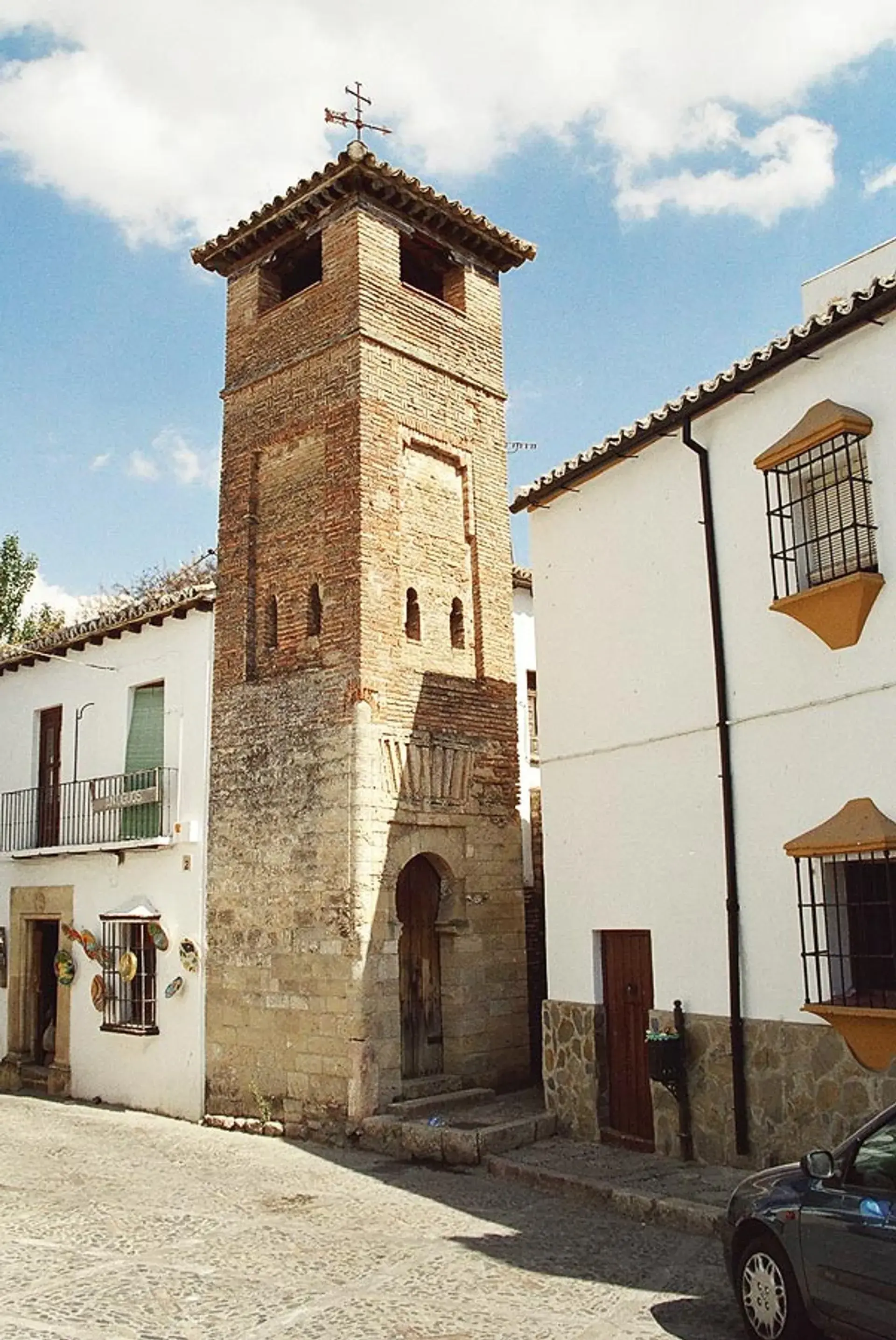
The tower is built on a square plan and rises in three distinct vertical sections. The lower two tiers date to the 14th-century Nasrid era, while the uppermost section belongs to the Christian period.
The ground tier is constructed from quarried stone ashlar masonry. Its west-facing entrance features a horseshoe arch framed by an alfiz molding and alternating voussoirs. Traces of dark emerald-green glazed ceramic ribbon loops remain embedded around the stone entrance lintel. Above this base, the second tier is made entirely of brick. Each exterior face presents a recessed rectangular panel pierced by two small horseshoe-arched light slits. Faint geometric outlines of original brick sebka (lozenge tracery) are still discernible within these panels, bounded above by a projecting decorative cornice that also retains traces of emerald-green ceramic ornamentation.
The third tier is a brick belfry constructed after the Catholic Monarchs captured Ronda in May 1485. Designed to house church bells, it features open arches on all four sides and is capped with a hipped roof.
Construction Quirks and Hidden Layout
A close inspection of the ground tier reveals an unusual structural anomaly: the stone ashlar masonry terminates at irregular heights across different faces of the tower. This abrupt transition is not the result of military damage, but rather a budget or material shortage during the Nasrid period. The original builders ran out of quarried stone blocks or funding mid-construction and continued building the rest of the tower in cheaper brickwork.
The interior arrangement also reflects the tower's original role within a larger religious complex. The street-level horseshoe entrance does not lead up to the top of the tower; instead, it opens solely into a compact, groin-vaulted chamber likely used for administrative or storage purposes. To reach the upper levels and deliver the call to prayer, the muezzin originally entered through an elevated doorway connected directly to the adjacent mosque building.
From Mosque to Church Belfry
During Ronda's Islamic period, the tower served a neighborhood mosque used by local merchants and middle-ranking families. Following the Christian capture of the city in 1485, the mosque complex was consecrated as the Church of San Sebastián.
Over the following centuries, the main body of the church deteriorated, fell into ruin, and was eventually demolished. The minaret was spared to serve as a freestanding bell tower. Today, it remains an exterior landmark along pedestrian routes through La Ciudad, positioned between the Puente Nuevo and Plaza de la Duquesa de Parcent. While its ground-floor interior chamber remains locked, the tower's layered masonry stands as an open-air testament to Ronda's transition between Islamic and Christian rule.
FAQ
Can visitors access the interior of the Minaret of San Sebastián?
No, the interior chamber at ground level remains locked. The monument is admired from the exterior within Plaza Abul Beka.
Why does the stone base end at uneven heights?
Nasrid builders ran out of quarried stone blocks or funds midway through construction, prompting them to switch abruptly to brick to finish the structure.
How did the muezzin reach the top of the tower?
The muezzin did not use the ground-floor door, which led only to a small vaulted room. Instead, access to the upper stairway was gained through an elevated doorway connected to the adjoining mosque.
What happened to the original mosque attached to the minaret?
After the Christian conquest of Ronda in 1485, the mosque was consecrated as the Church of San Sebastián. When the church later fell into ruin, it was demolished, leaving only the minaret standing.