University of Salamanca Plateresque Facade Guide
Masterpiece of Spanish Plateresque Architecture
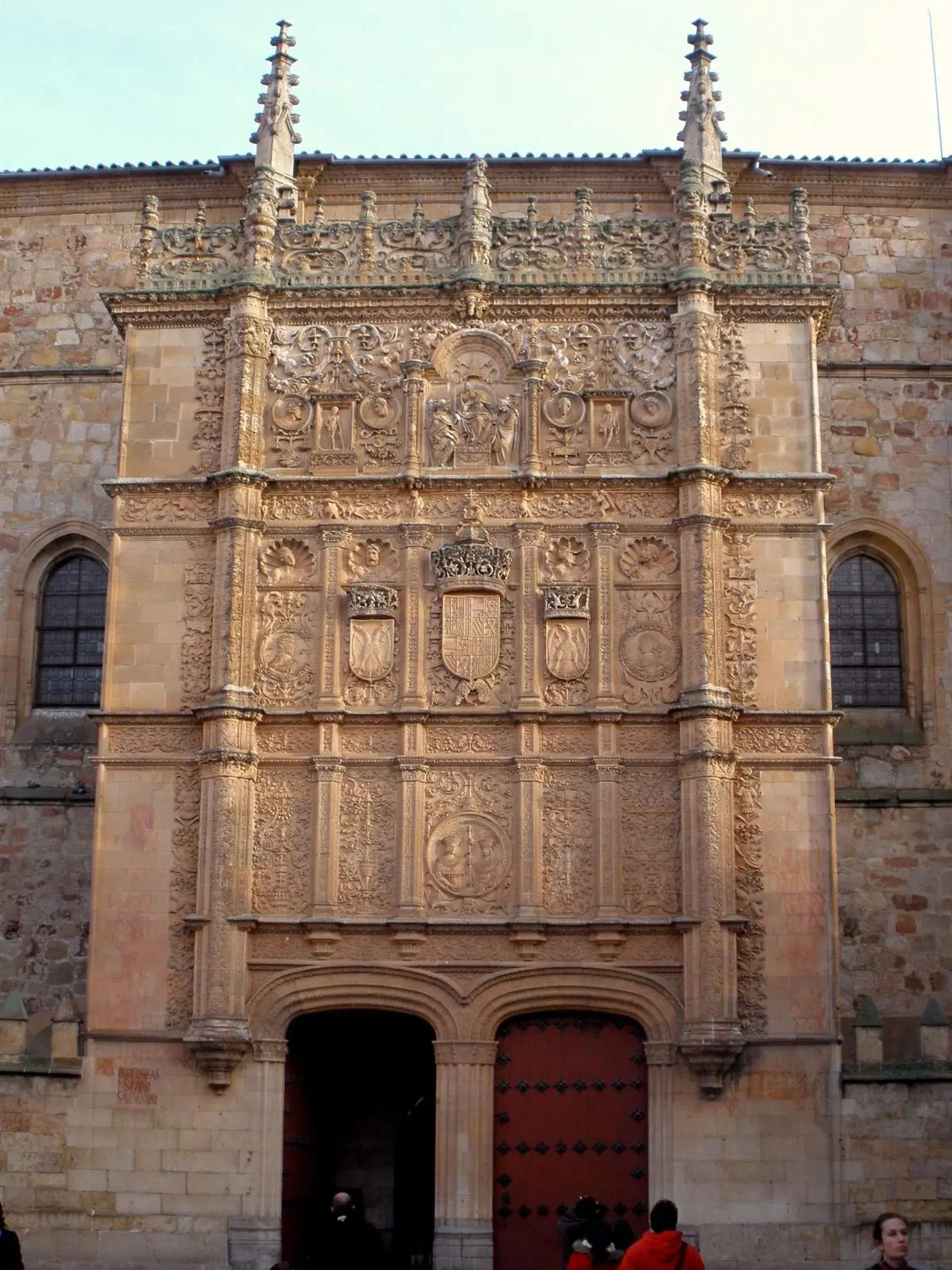
Completed between 1529 and 1533 during the reign of Holy Roman Emperor Charles V, the front of the Escuelas Mayores at the University of Salamanca stands as the preeminent example of Spanish Plateresque architecture. Often referred to historically as the Fachada Rica, the structure takes its name from plateresco, an early Renaissance decorative style celebrated for delicate, low-relief stone carving that mimics the intricate craft of silversmithing (platería).
The facade was sculpted by anonymous masters using Villamayor sandstone (arenisca de Villamayor or piedra franca), quarried near the city. When fresh from the ground, the porous stone is remarkably soft, allowing masons to carve dense filigree, undercut motifs, and complex reliefs. Over centuries of exposure to the elements, iron oxides in the stone oxidize, turning the masonry into the distinctive golden-ochre shade that defines Salamanca as "La Ciudad Dorada" (The Golden City).
Iconography of the Stone Altarpiece Screen
Rather than serving merely as an entrance, the facade functions as a fachada-retablo—an architectural screen composed like an ecclesiastical altarpiece. It is organized into three horizontal tiers divided vertically across five bays, articulating a comprehensive moral, intellectual, and political program.
- The Lower Tier: A central medallion portrays the Catholic Monarchs, Isabella I of Castile and Ferdinand II of Aragon, gripping a single royal scepter. Circling the portrait is an inscription rendered in classical Greek: "The Kings to the University and the University to the Kings." In an era when stone inscriptions across Europe were almost universally carved in Latin, this Greek phrasing highlighted the university's cutting-edge humanist scholarship.
- The Middle Tier: Dedicated to imperial authority, this level features the heraldic coat of arms of Charles V encircled by the collar of the Order of the Golden Fleece, flanked by the double-headed imperial eagle and the Eagle of Saint John.
- The Upper Tier: The highest tier displays a pope seated in council with cardinals, surrounded by classical and mythological reliefs that include figures of Venus and Hercules. An openwork stone cresting caps the entire composition.
The Symbolism and Folklore of the Frog
Among the dense relief of the lowest tier's rightmost pilaster rests one of Spain’s most famous architectural details: a carved amphibian perched on a human skull. While popular folklore often refers to the carving as a lucky charm, Renaissance humanists designed it as a memento mori.
In medieval and Renaissance iconography, the frog or toad symbolized carnal lust and corruption. Set atop a skull, the motif served as a moral warning to the young scholars entering the university, reminding them that spiritual decay and physical mortality follow a life of vice.
Over the centuries, student tradition recast the carving into an academic omen: finding the frog without assistance is said to guarantee good marks on examinations and the successful completion of a degree. The fascination with locating the amphibian eventually prompted author and university rector Miguel de Unamuno to remark critically: "The bad thing is not that they see the frog, but that they see nothing but the frog."
The Historic Setting of the Escuelas Mayores
Founded in 1218 by King Alfonso IX of León, the University of Salamanca is the oldest operating university in Spain and one of the earliest established in Europe. Pope Martin V confirmed its pontifical constitutions in 1442, and construction of the permanent Escuelas Mayores complex began later that century to serve as the institution’s core.
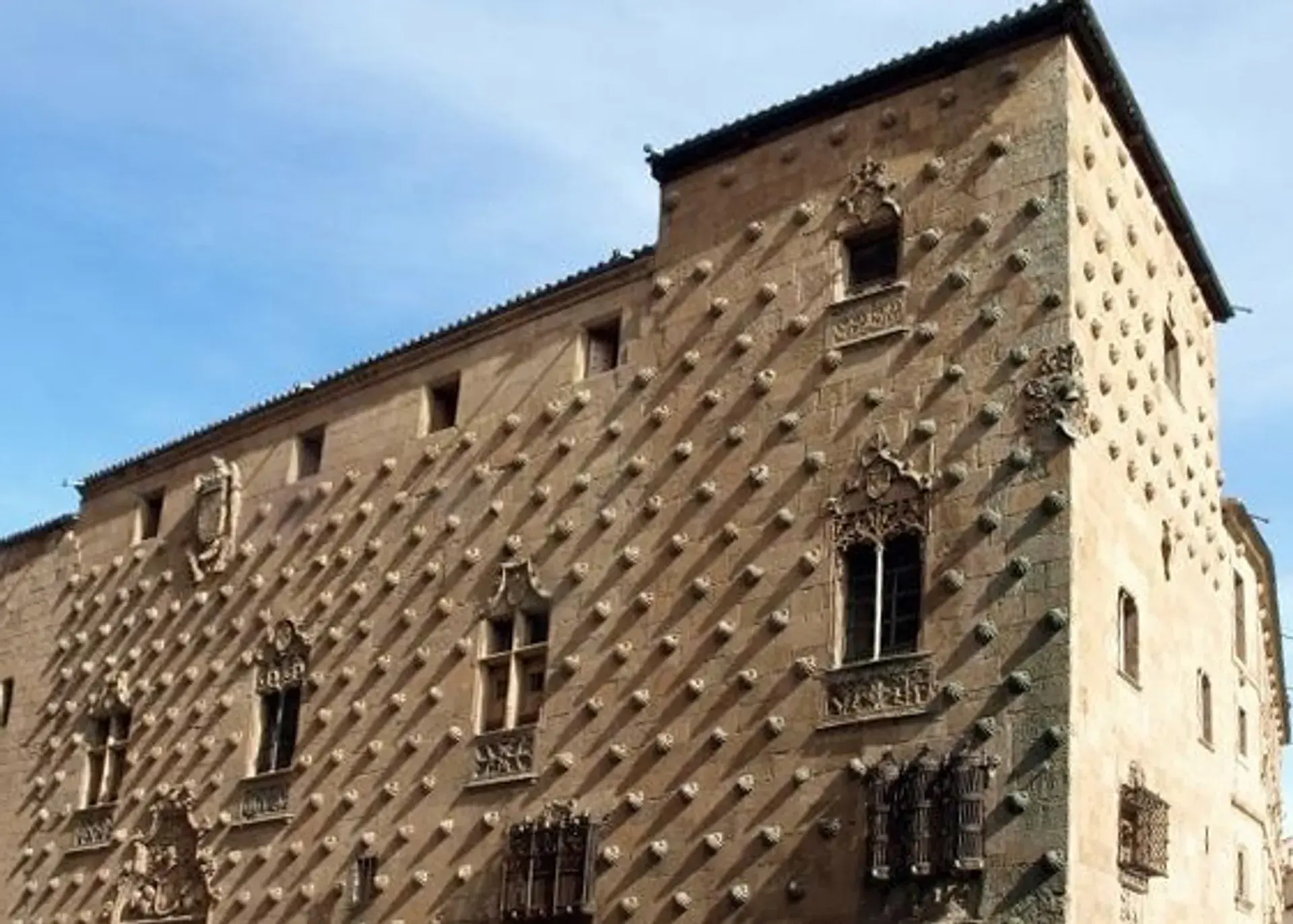
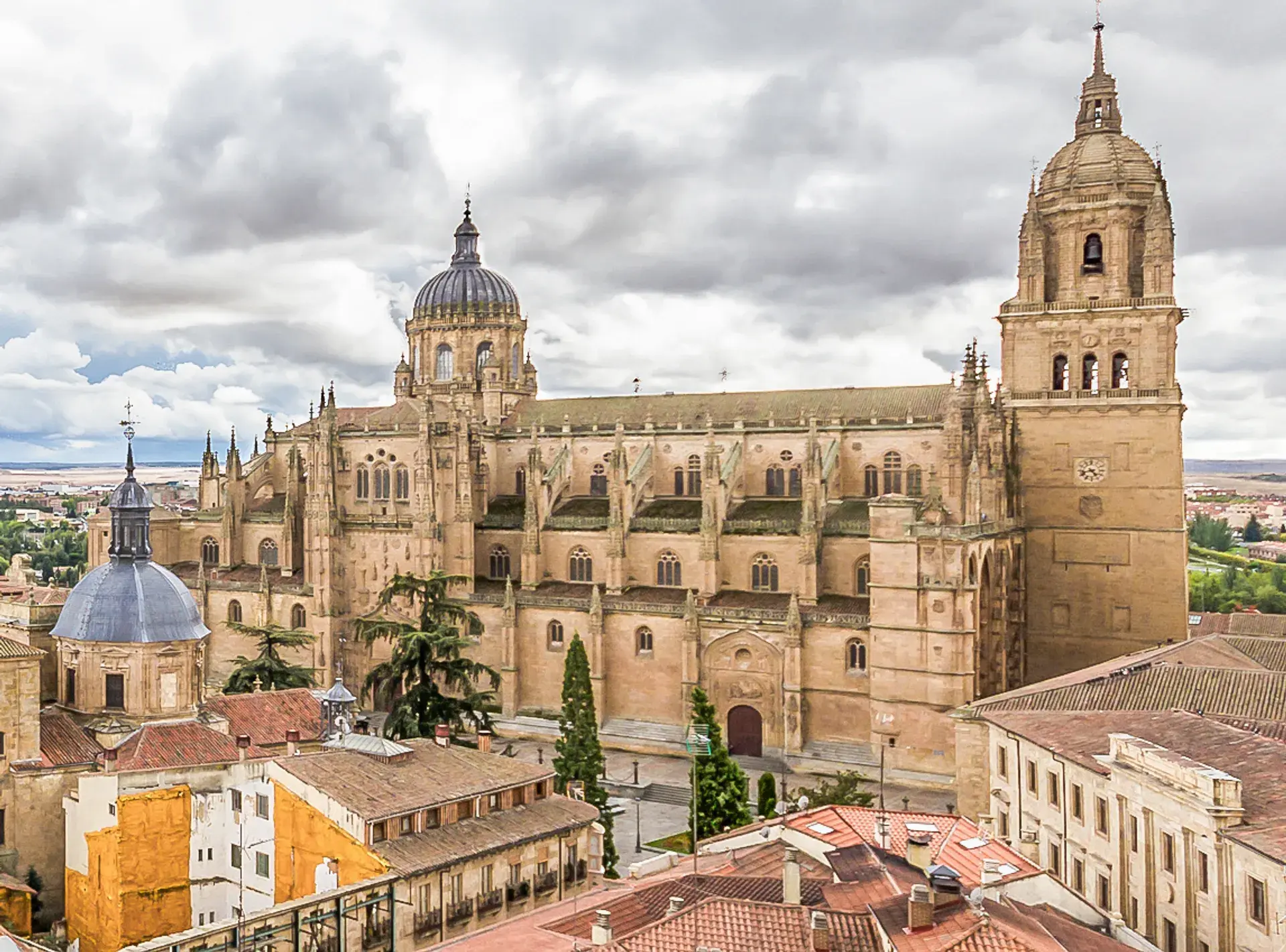
The facade opens onto the Patio de Escuelas, an enclosed public square anchored by an 1869 bronze statue of writer and academic Fray Luis de León, sculpted by Nicasio Sevilla. Beyond the facade, the Escuelas Mayores houses key ceremonial and historical spaces, including the university chapel, the Paraninfo ceremonial auditorium, the preserved 16th-century lecture hall of Fray Luis de León, and the historic general library (Biblioteca General Histórica). Positioned between the city's cathedrals and the Casa de las Conchas along the direct route to the Plaza Mayor, the building remains the historic nucleus of Salamanca.
FAQ
Why is there a frog carved on the University of Salamanca facade?
While modern lore considers it a good luck charm for students taking exams, Renaissance scholars incorporated the frog on the skull as a memento mori to warn students against carnal lust and vice.
What stone is the Plateresque facade made from?
It is carved from local Villamayor sandstone, an iron-bearing stone that is easily workable when quarried and oxidizes over time into a warm golden-ochre tone.
What does the inscription on the central medallion say?
The medallion showing Ferdinand and Isabella features a classical Greek inscription that translates to: 'The Kings to the University and the University to the Kings.'