Salamanca Cathedral: History, Architecture & Astronaut
Architectural Fusion: Two Cathedrals in One
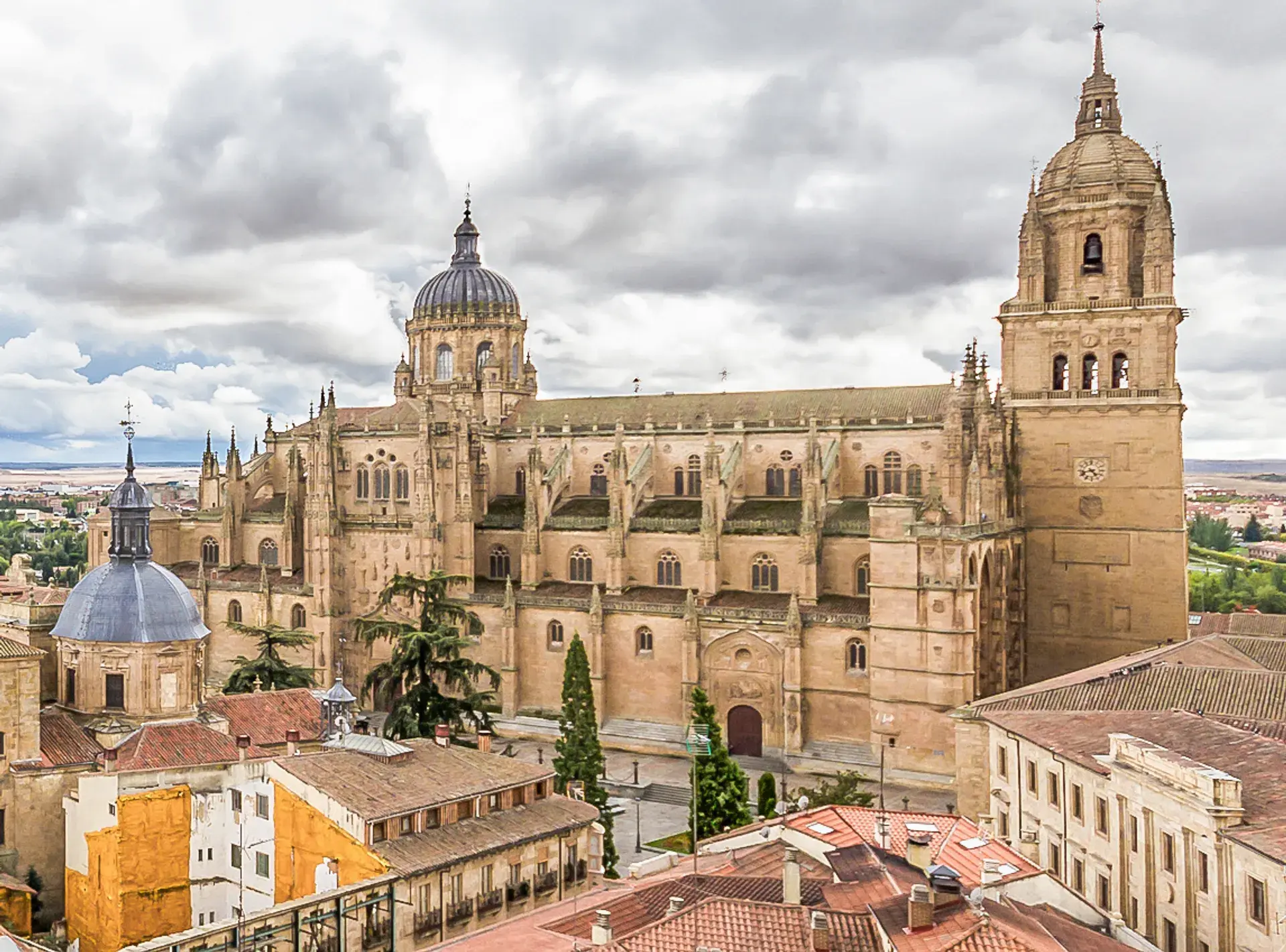
Salamanca Cathedral is a single architectural complex composed of two interconnected churches: the Old Cathedral (Catedral Vieja de Santa María de la Sede) and the New Cathedral (Catedral Nueva). Rather than demolishing the earlier medieval sanctuary to clear land, builders anchored the north wall of the Romanesque structure directly to the south wall of the rising Gothic church. This deliberate preservation resulted in an unusual architectural ensemble where centuries of construction remain joined under one roof. Inscribed as a UNESCO World Heritage Site in 1988 as part of the Old City of Salamanca, the complex is built primarily from golden Villamayor sandstone, which exhibits a distinctive amber tone that deepens in late-day sunlight.
Several renowned master builders directed the expansion of the complex over the centuries, including Juan Gil de Hontañón, his son Rodrigo Gil de Hontañón, Juan de Álava, and later members of the Churriguera family, Alberto and Joaquín Churriguera.
The Romanesque Old Cathedral and Torre del Gallo
Founded around 1120 under Bishop Jerónimo de Périgord during the repopulation overseen by King Alfonso VI of León and Castile, the Old Cathedral was completed by the 14th century in Romanesque and early Gothic styles. Its interior features low, heavy stone arches and shadow-filled naves that contrast sharply with the expansive halls of the adjoining church.
Among its most notable interior treasures is a 53-panel retablo attributed to Dello Delli and Nicolás Florentino. Outside, the Old Cathedral is crowned by the Torre del Gallo (Rooster Tower), a late 12th-century crossing dome with a 16-sided drum. The exterior of the dome is lined with distinctive limestone scalloping, cut in the shape of fish scales.
The Soaring Vaults of the New Cathedral
By the late 15th century, the prestige and growth of Salamanca’s university and urban population left the original cathedral inadequate for large diocesan gatherings. The cathedral chapter authorized the construction of a new church in 1491, with physical work beginning in 1513. Although the New Cathedral was not consecrated until 1733 and incorporated Plateresque, Renaissance, and Baroque elements across more than two centuries of work, the architects deliberately retained Gothic ribbed vaulting throughout the nave to maintain stylistic harmony with the medieval church.
The New Cathedral's star-ribbed vaults reach roughly 38 meters in height, creating a brightly illuminated and cavernous interior. Anchoring the exterior is an imposing bell tower that exceeds 92 meters.
The Modern Carvings of Puerta de Ramos
The New Cathedral's northern entrance, known as the Puerta de Ramos, contains one of the building's most famous anomalies. During a 1992 restoration project carried out for the regional exhibition Las Edades del Hombre, stone carver Jerónimo García followed the ancient tradition of cathedral restorers by incorporating contemporary 20th-century motifs alongside historical iconography.
Among the elaborate stone foliage on the portal, García sculpted a modern astronaut complete with a spacesuit, boots, helmet, and an air hose. Nearby carvings added during the same restoration include a smiling faun eating an ice cream cone, a lynx, and a crayfish.
Surviving the 1755 Lisbon Earthquake
On November 1, 1755, the catastrophic Lisbon earthquake struck during All Saints' Day mass. The tremors cracked the bell tower, damaged the dome, and caused structural failures in the Old Cathedral's cloister. To prevent collapse, the lower section of the bell tower was reinforced with massive sloped masonry buttresses and secured with heavy iron bands. Visible fractures and earthquake scars remain visible in the lower stonework and reinforced pyramid base of the tower today.
The city suffered no casualties during the disaster. In gratitude, a local tradition known as "El Mariquelo" was established: every year on October 31, an individual dressed in traditional charro attire climbs the exterior of the bell tower playing a traditional flute and drum to give thanks for the city's deliverance.
Urban Landmark and the Ieronimus Route
Positioned on Plaza de Anaya, Salamanca Cathedral acts as the primary landmark linking the historic university quarter with Calle Rúa Mayor, anchoring the city's main walking axis toward the Plaza Mayor. Viewed from across the River Tormes and the ancient Roman Bridge, the complex forms the central silhouette of Salamanca’s southern skyline.
In addition to functioning as an active seat of Catholic worship with daily liturgical services, the complex operates daily cultural tours. Visitors can purchase combined tickets to explore both cathedrals, cloisters, and chapels, or follow the permanent "Ieronimus" route. This route runs through interior triforium platforms, traverses the medieval Torre Mocha, and leads out onto the high catwalks of the bell tower terrace, where the resonance of historic bronze bells mixes with the strong winds sweeping across the Castilian plateau.
FAQ
Why are there two interconnected cathedrals in Salamanca?
When the 12th-century Old Cathedral became too small for the growing city and university, the cathedral chapter approved a new church in 1491. Instead of demolishing the original building, architects joined the north wall of the Old Cathedral directly to the south wall of the New Cathedral, preserving both.
Why is there an astronaut carved on Salamanca Cathedral?
The astronaut was carved onto the New Cathedral's northern entrance (Puerta de Ramos) during a 1992 restoration for the Las Edades del Hombre exhibition. Stone carver Jerónimo García added modern 20th-century symbols as an artisan's signature, alongside other contemporary carvings such as a faun holding an ice cream cone.
What impact did the 1755 Lisbon earthquake have on the cathedral?
The tremor struck during All Saints' Day mass, cracking the bell tower and damaging the dome and Old Cathedral cloister. The bell tower required reinforcement with sloped masonry buttresses and iron bands, and fracture scars from the earthquake remain visible in the masonry today.
What is the Ieronimus exhibition route?
The Ieronimus exhibition is a specialized visitor route through the cathedral complex that provides access to the interior triforium levels, the medieval Torre Mocha, and the upper terrace catwalks surrounding the bell tower.