Salamanca's Roman Bridge and the Ancient Verraco
Spanning approximately 358 meters across the River Tormes, the Roman Bridge of Salamanca stands as one of the city's most significant historical gateways. Featuring 26 arches, the bridge historically carried the Vía de la Plata, the critical imperial highway connecting Augusta Emerita (Mérida) and Asturica Augusta (Astorga). For centuries, it served as Salamanca's sole southern crossing over the river, functioning as a vital threshold for travelers and pilgrims following the Vía de la Plata toward Santiago de Compostela as they crossed from the open Castilian plain into the city's sandstone core.
Imperial Engineering and Flood Reconstructions
The bridge originated as part of Rome's military and trade network, integrating the pre-existing Vettonian settlement of Helmantiké into the empire. The structure preserves a distinct architectural divide resulting from centuries of environmental challenges. Its northern 15 arches date to the 1st century CE, showcasing Roman engineering built from cushioned granite blocks quarried in Los Santos. Beneath the deck, massive triangular granite cutwaters break the rushing currents of the Tormes.
Catastrophic river floods repeatedly compromised the crossing over the centuries. Significant devastation occurred during the Riada de los Difuntos in 1256 and the Flood of San Policarpo in January 1626, both of which washed away spans of the bridge. The resulting repairs created a visible divide: while the northern arches preserve their ancient Roman fabric, the southern spans—often referred to as the Hispana section—consist of later reconstructions built with stone sourced from Ledesma.
The Pre-Roman Verraco
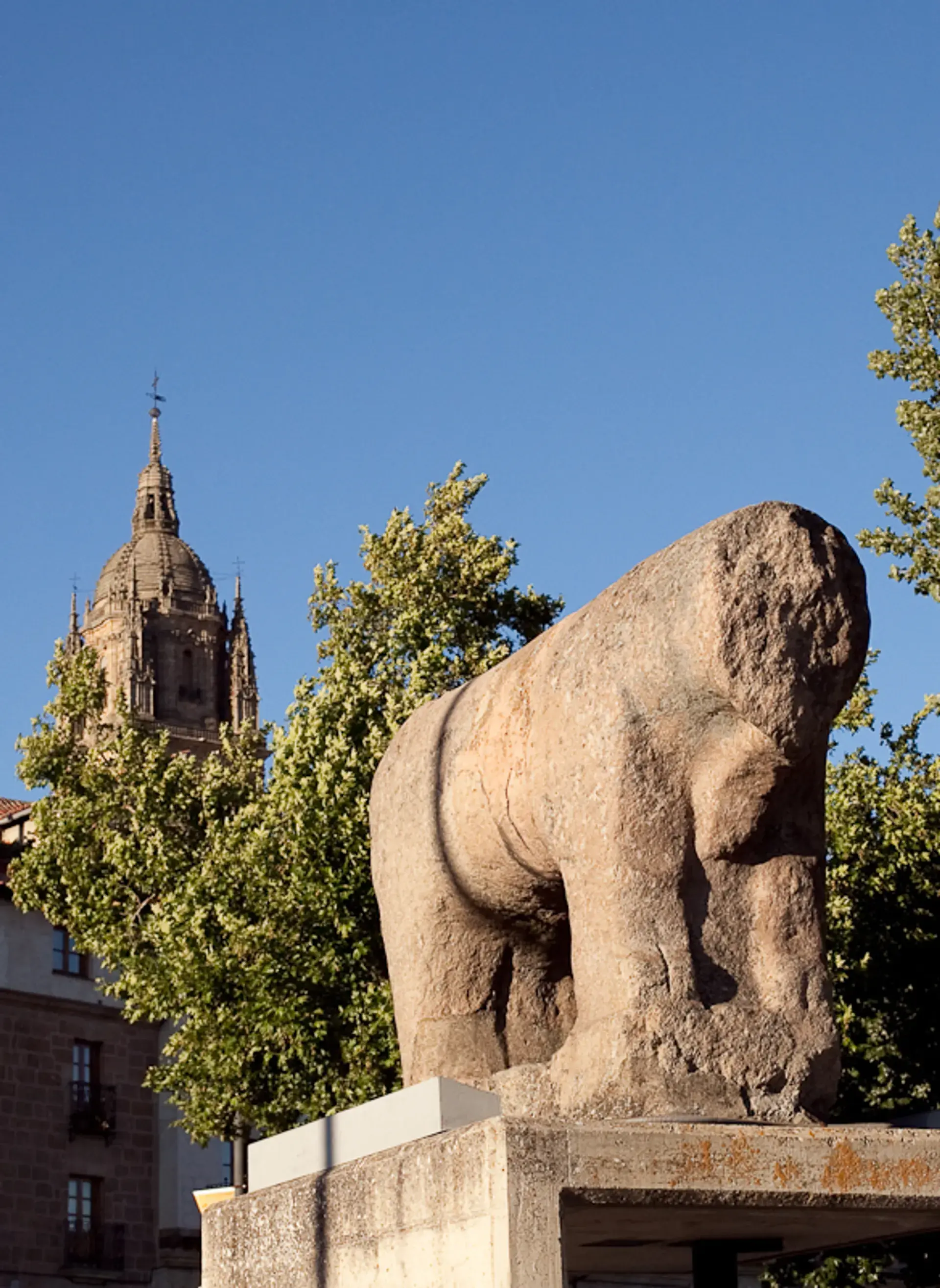
At the northern approach to the bridge stands the stone beast that gives the crossing its iconic profile: a headless pre-Roman granite statue known as a verraco. Carved by the Vettones between the 3rd and 1st centuries BCE, this sculpture represents a bull or boar and measures approximately 2.10 meters in length and 1.57 meters in height. It is recognized as Salamanca's oldest surviving monument.
In October 1834, the provincial governor José María Cambronero mistakenly concluded that the ancient sculpture was a 16th-century monument erected by King Charles I related to the Revolt of the Comuneros. Under this misapprehension, he ordered the verraco thrown from the bridge into the waters of the River Tormes. The sculpture was later retrieved, preserved in a museum, relocated near the bridge area in 1954, and finally reinstalled at the bridge entrance in 1993.
Literary Fame and Civic Symbolism
The verraco is widely renowned as the setting for the opening scene of the anonymous 1554 Spanish picaresque novel Lazarillo de Tormes. In the tale, a blind master instructs the naive boy Lázaro to press his ear to the stone beast to listen for a sound, only to violently slam the boy's head into the granite to teach him a lesson in worldly cunning. In 1974, a bronze sculpture created by Agustín Casillas depicting Lazarillo and his blind master was erected adjacent to the bridge.
The bridge and the granite beast also share deep ties to local identity and mythology. Both monuments have appeared together on Salamanca's municipal coat of arms since the 13th century. Local folklore long linked the bridge's origins to the mythical hero Hercules, with a later restoration attributed to Emperor Trajan.
Modern Preservation
Recognized for its national cultural importance, the bridge was declared a Monumento Histórico-Artístico in 1931 and designated a Bien de Interés Cultural in 1998. After carrying vehicle traffic until 1973, the bridge was permanently pedestrianized and now serves exclusively as a walking and cycling route into the historic center.
FAQ
Why does the bridge have two different architectural styles?
The northern 15 arches retain original 1st-century CE Roman granite blocks from Los Santos. Catastrophic river surges, including floods in 1256 and 1626, destroyed portions of the bridge, leading to the southern arches being reconstructed with stone from Ledesma.
What is the stone animal sculpture at the entrance of the bridge?
It is a pre-Roman Vettonian granite verraco, a stylized depiction of a bull or boar dating between the 3rd and 1st centuries BCE. Measuring roughly 2.10 meters long and 1.57 meters high, it is Salamanca's oldest surviving monument.
What role does the bridge play in Spanish literature?
The stone verraco is the setting for the opening episode of the 1554 novel Lazarillo de Tormes, where a blind master tricks young Lázaro into leaning against the stone beast before slamming his head into the granite. A bronze statue near the bridge commemorates the scene.