Catedral de Tarragona: History & Architecture Guide
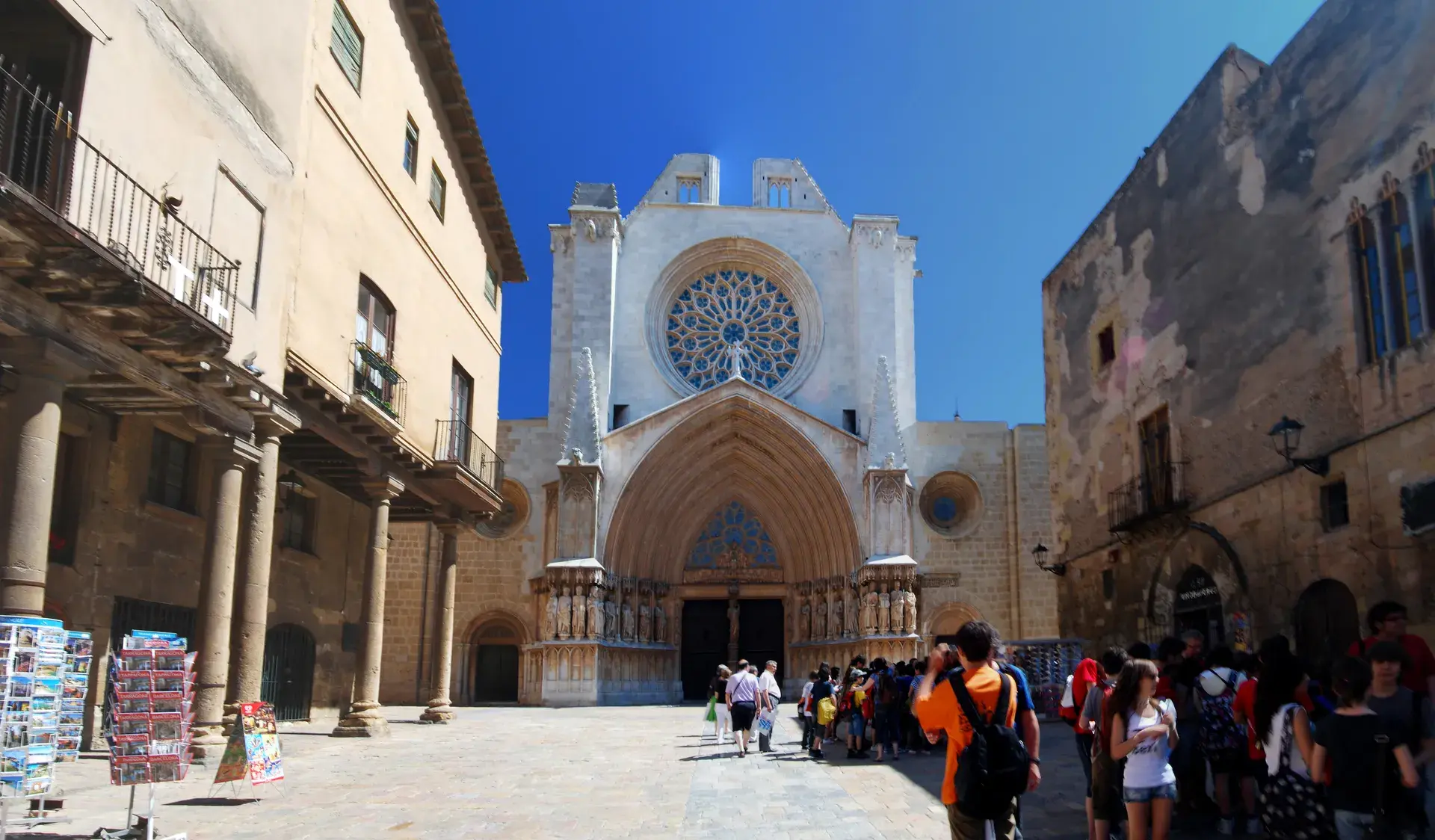
Marvel at the imposing Romanesque-Gothic facade and grand rose window of the Catedral de Tarragona as it dominates the highest point of the Old Town from Pla de la Seu. Known officially as the Primatial Metropolitan Cathedral Basilica of Saint Thecla, this commanding complex crowns the historic Part Alta. Declared a National Historic-Artistic Monument in 1905, it stands as an architectural bridge between the late Romanesque and early Gothic eras, reflecting centuries of spiritual and civic authority.
A Sacred Summit of Changing Civilizations
The ground beneath the cathedral represents continuous sacred use reaching back to the Roman Empire. The cathedral sits directly upon the elevated terrace that once held the sacred enclosure and imperial Temple of Augustus within the Provincial Forum of Roman Tarraco. In subsequent eras, this same summit was occupied by a Visigothic Christian basilica and, later, a 10th-century Moorish mosque.
Christian construction began in the late 12th century under Archbishop Bernat Tort and the Canons Regular of Saint Augustine. The initial build relied on massive, defensive Romanesque stonework with thick exterior walls and rounded apses. As work progressed through the 13th and 14th centuries, the building campaign embraced Gothic innovations, incorporating pointed rib vaults, decorative side chapels, and soaring vertical proportions.
The Truncated Façade and the Rose Window
Broad stone steps lead from the open expanse of Pla de la Seu to the cathedral's entrance. The monumental 14th-century Gothic portal features detailed carvings of prophets and apostles, flanked on either side by two earlier Romanesque doorways. Above this portal sits an 11-meter rose window, one of the largest in Catalonia, which casts shifting colored light across the shadowed, cavernous three-naved interior.
Above the rose window, the Gothic gable terminates abruptly in a flat horizontal line of bare stonework. Consecrated in 1331 while still partially unfinished, the cathedral's construction halted permanently with the arrival of the mid-14th-century Black Death. The plague decimated the regional workforce and depleted building funds, leaving the upper pediment frozen mid-construction.
Cloister Curiosities and Roman Heritage
The cathedral complex extends beyond the basilica's 100-meter Latin cross nave and 51-meter bell tower into an expansive Romanesque cloister. Sections of the cloister integrate structural 1st-century Roman walls from the original Temple of Augustus, where antique carved inscriptions remain visible in the masonry.
Among the sculpted capitals supporting the cloister arches is the famous "Procession of the Rats" (Processió de les rates). This medieval narrative carving depicts a band of rats carrying an apparently dead cat on a funeral bier, only for the cat to revive suddenly and devour them.
Artistic Treasures and Modern Visits
Inside the sanctuary, the high altar is dominated by a 15th-century alabaster retable sculpted by Pere Johan. The intricate relief panels depict scenes from the life and martyrdom of Tarragona's patron saint, Saint Thecla. The cathedral also preserves a 16th-century Renaissance organ with massive painted canvas doors (sargas) executed by Pietro Paolo da Montalbergo and Pere Serafí. For over a century, following the 1835 abandonment of Poblet Monastery, the cathedral even housed the mortal remains of King James I of Aragon before their return to Poblet in 1952.
Today, the cathedral remains the active seat of the Catholic Archdiocese of Tarragona, holding daily liturgical services. It also welcomes cultural visits throughout the year. Admission encompasses the central nave, the Romanesque cloister, the Diocesan Museum of Tarragona, the excavated Roman temple remnants, and the Gardens of Santa Tecla la Vella.
FAQ
Why is the main facade of the Catedral de Tarragona unfinished?
Although the cathedral was consecrated in 1331, the arrival of the Black Death in the mid-14th century stripped away the necessary labor force and financial resources, leaving the upper gable abruptly flat and incomplete.
What historical structures stood on the site before the cathedral?
The cathedral stands on the highest point of ancient Tarraco, directly atop the Roman Provincial Forum's Temple of Augustus. It was later succeeded by a Visigothic Christian basilica and a 10th-century Moorish mosque before medieval Christian construction began.
What is the Procession of the Rats in the cathedral cloister?
The 'Procession of the Rats' is a famous Romanesque stone capital in the cloister that illustrates a medieval fable: a group of rats carries a seemingly deceased cat on a funeral bier, only for the cat to awaken and attack them.