Plaça del Fòrum: Tarragona's Roman Square
The Seat of Provincial Roman Governance
Plaça del Fòrum is a historic public square located in the Part Alta (upper historic quarter) of Tarragona, Catalonia, Spain. The square occupies a portion of the ancient Roman Provincial Forum (Fòrum Provincial de Tàrraco), a monumental administrative complex commissioned around 73 CE under Emperor Vespasian. As the provincial capital of Hispania Citerior (later renamed Hispania Tarraconensis), ancient Tarraco oversaw a territory covering more than half of the Iberian Peninsula from this political, legal, and financial center.
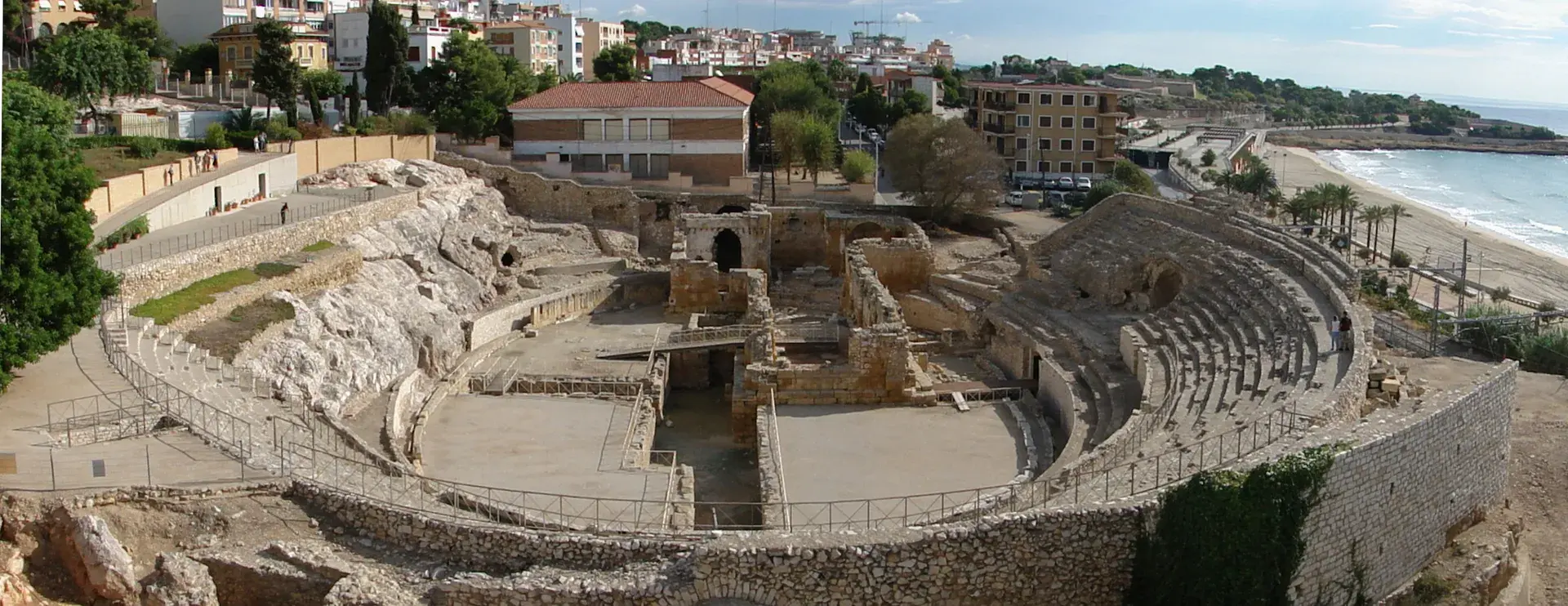
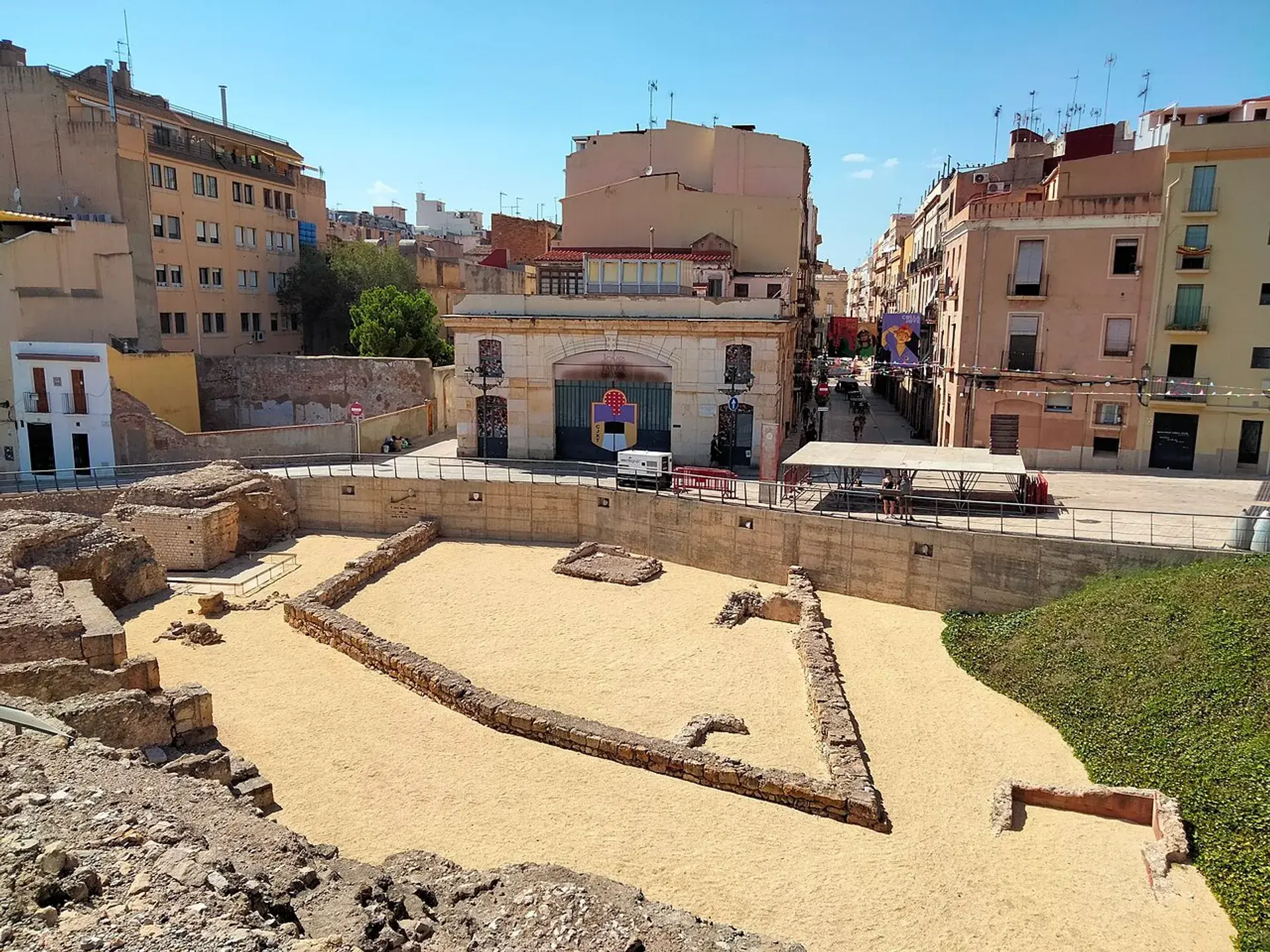
The Provincial Forum formed the central tier of an immense, three-level terraced complex engineered into the city's hillside. The highest summit accommodated the sacred imperial cult precinct, the middle tier held the Provincial Forum, and the lowest terrace housed the Roman Circus for chariot racing. Within the forum stood key administrative institutions, including the provincial treasury (arca), the imperial archives (tabularium), and the meeting facilities for the Concilium Provinciae Hispaniae Citerioris, an annual council composed of regional delegates. Its lower Representation Square (Plaça de Representació) spanned 318 by 175 meters, ranking among the largest public squares ever built across the Roman Empire.
Medieval Evolution and Inhabited Remains
Following the fragmentation of Roman central authority in the 5th century CE, the vast monumental complex lost its administrative purpose. Domestic housing began encroaching upon the forum's grand spaces, leading to the gradual dismantling of architectural features. Beginning in the 12th century, medieval settlers converted the open plaza into a compact network of narrow streets, alleys, and smaller squares bounded by the ancient Roman enclosure.
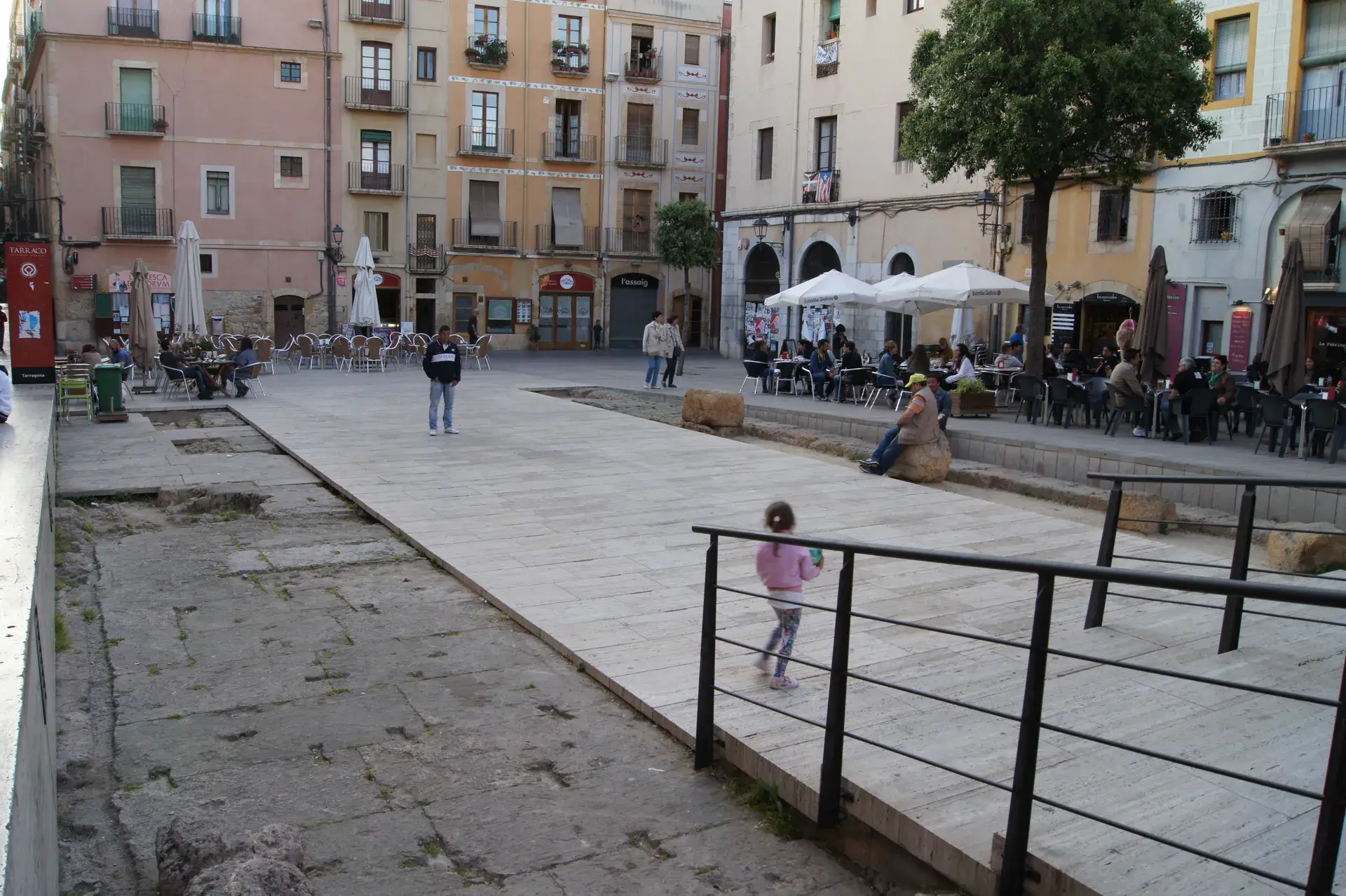
Today, an angular section of monumental ashlar masonry (mur angular) from the forum's perimeter portico remains standing directly in Plaça del Fòrum. Rather than surviving as an isolated excavation, these colossal limestone blocks serve as direct exterior walls and structural foundations for occupied private apartment buildings along Carrer de la Merceria and Carrer de Sant Llorenç. The surviving structures form an integral component of the Archaeological Ensemble of Tárraco, inscribed as a UNESCO World Heritage Site in 2000.
Urban Clues and Two Distinct Forums
Although the modern square is an intimate civic space, it represents only a small fraction of the original plaza, which was large enough to encompass nearly all of modern Tarragona's Part Alta. Subtle architectural markers in the pavement illustrate this vanished scale. In and around the square, two-toned paving stones delineate the ancient footprint: lighter-toned pavers track the buried alignment of the subterranean portico wall, while darker stones identify the open interior space of the Roman forum.
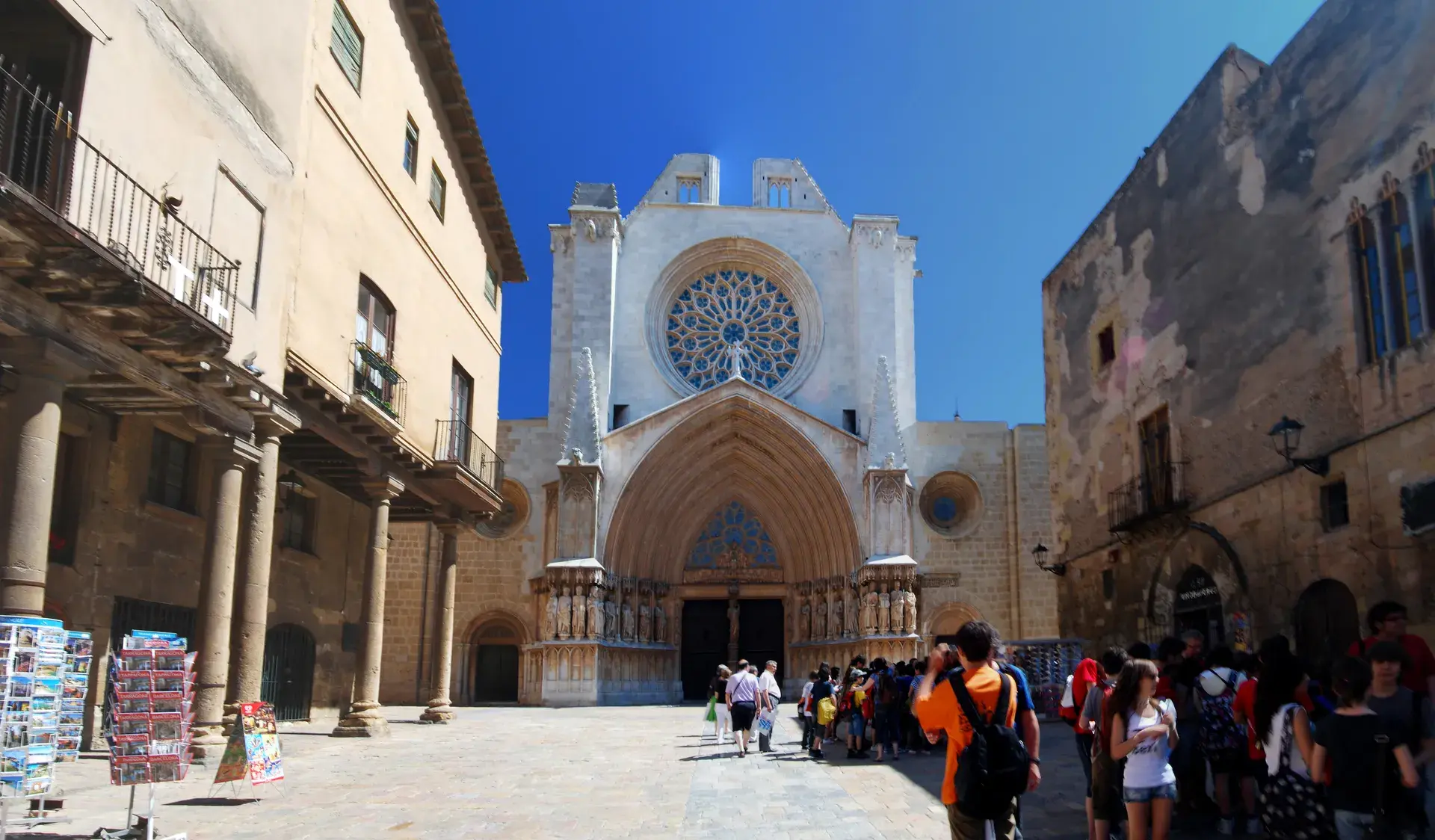
Roman Tarraco maintained two entirely separate forums tailored to different administrative duties. While the Colonial Forum (Fòrum de la Colònia) in the lower city handled daily municipal civic affairs, the Provincial Forum on the upper terrace managed the governance of the wider province. Plaça del Fòrum remains positioned midway along the Part Alta's historic spine, connecting the Cathedral on the former upper imperial cult terrace to the Praetorium Tower and Plaça del Rei leading down toward the circus.
Modern Square Life and Local Markets
Plaça del Fòrum currently serves as a pedestrian gathering place and dining hub within the Part Alta. Outdoor restaurant and café terraces fill the square, offering vermouth, tapas, and local cuisine directly alongside the ancient Roman masonry. In addition to daily dining, the plaza hosts a traditional open-air farmers' market selling fresh fruits and vegetables on Wednesday and Saturday mornings, as well as an antique and flea market on Sunday mornings. The square remains an active center of community life, juxtaposing centuries-old limestone blocks with pastel residential facades, wooden shutters, and wrought-iron balconies.
FAQ
What was the historical purpose of Plaça del Fòrum?
The square occupies part of the ancient Roman Provincial Forum constructed around 73 CE under Emperor Vespasian. It served as the administrative, financial, and legal seat governing the province of Hispania Tarraconensis, which spanned more than half of the Iberian Peninsula.
Are the Roman ruins in Plaça del Fòrum part of a UNESCO World Heritage Site?
Yes, the surviving Roman structures in the square are part of the Archaeological Ensemble of Tárraco, which was designated a UNESCO World Heritage Site in 2000.
What do the different pavement colors in the square indicate?
The contrasting street pavers outline the ancient Roman layout: lighter stones follow the subterranean alignment of the forum's perimeter portico wall, while darker stones indicate the open forum plaza.
When do markets take place in Plaça del Fòrum?
The square hosts an open-air fruit and vegetable farmers' market on Wednesday and Saturday mornings, as well as an antique and flea market on Sunday mornings.