Fuente de la Plaza del Ayuntamiento: Valencia Civic Heart
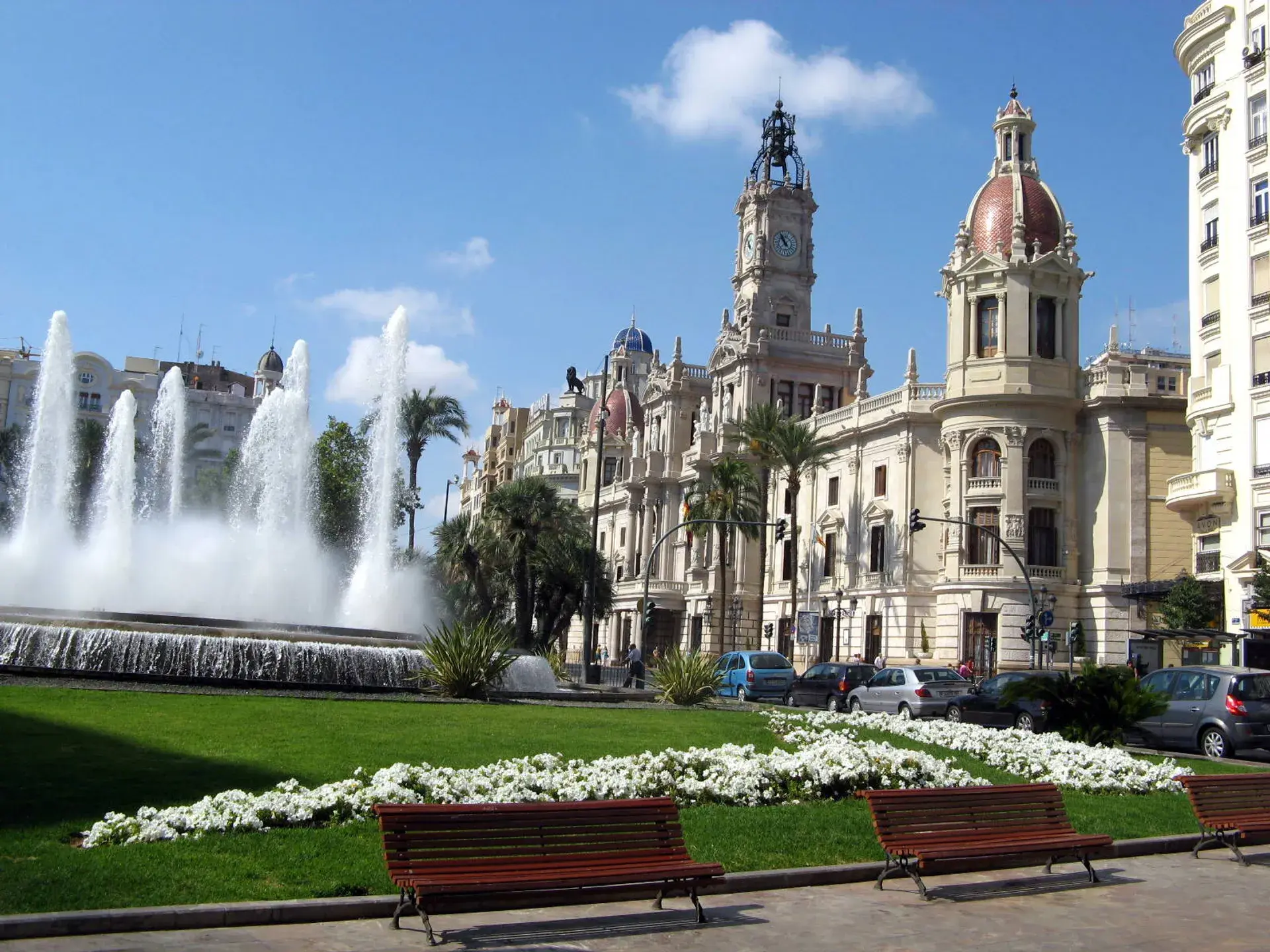
Take in the lively atmosphere around the central Fuente de la Plaza del Ayuntamiento, anchoring one of Valencia's most iconic and expansive civic squares.
A Hub of Modern Valencian History
Situated in the Sant Francesc neighborhood of Ciutat Vella, the Plaza del Ayuntamiento is a broad, triangular public square that reflects Spain's evolving political landscape. Originally the site of the 13th-century Convent of San Francisco, the land was cleared in 1891 after the building functioned as a cavalry barracks. Between the 1900s and 1930s, municipal architects transformed the area, demolishing a former fishermen's quarter to create a grand civic and financial center.
The square's various names document major eras in modern Spanish history. It transitioned from Plaza de San Francisco to Plaza de Emilio Castelar during the Second Republic, Plaza del Caudillo during the Francoist period, and Plaza del Pais Valenciano, before officially becoming Plaza del Ayuntamiento in 1987.
Architectural Landmarks on the Plaza
The plaza is defined by early 20th-century monumental architecture, most notably the City Hall (Ayuntamiento) and the Palacio de las Comunicaciones. The City Hall complex incorporates an 18th-century former school known as the Casa de la Ensenanza. Renovations between 1904 and 1930 gave the building its current eclectic and neoclassical facade, complete with a prominent clock tower and a central balcony. On weekday mornings, the public can visit the building's historic rooms.
Across the square stands the Palacio de las Comunicaciones, built between 1915 and 1922. Designed in French eclectic and Valencian modernist styles, it features a 30-meter metallic telecommunications tower. Five sculpted figures on the facade represent the five continents, symbolizing international communication. Inside, a stained-glass dome comprising 370 panels depicts Spain's 48 provinces. Today, the building operates as an open cultural venue and exhibition hall.
Hidden Relics and Underground Secrets
Beneath the grand architecture, the Plaza del Ayuntamiento holds several historical curiosities. Underneath the City Hall complex sits a preserved 1930s air-raid shelter. This subterranean structure was built to protect local schoolchildren during the Spanish Civil War when Valencia served as the temporary capital of the Spanish Republic.
Inside the City Hall, the Municipal History Museum houses significant regional artifacts. The collection includes a sword attributed to King James I, medieval city keys, and the 1928 Real Senyera, which is Valencia's official flag. The square itself also hides past architectural experiments; in 1931, it featured an elevated platform with an underground flower market nicknamed 'la tortada' (the cake). This structure was dismantled in the 1960s because the subterranean market proved to be too dark and unpopular.
The Epicenter of Las Fallas
Every March, the Plaza del Ayuntamiento serves as the central hub for the Las Fallas festival. The square hosts the daily 2:00 PM mascleta, a choreographed pyrotechnic display focused on acoustic rhythms rather than visual light.
During the mascleta, thousands of gunpowder firecrackers create a synchronized, escalating rhythm. The sound waves bounce off the surrounding high-rise facades, generating intense physical vibrations that can be felt through the ground and in the chest.
A Pedestrian-Friendly Civic Gateway
Converted into a car-free pedestrian zone in 2020, the Plaza del Ayuntamiento now features expansive walking areas with red non-slip asphalt, seating areas, and traditional flower vendor stalls. The central circular fountain, illuminated by colorful lights after sunset, provides a visual contrast against the surrounding white and cream stone facades and green plant displays.
As the main spatial bridge in Ciutat Vella, the plaza acts as a pivotal gateway connecting Valencia's southern transport hubs, like the Estacion del Norte, to the historic core containing the Central Market, La Lonja, and Valencia Cathedral. It remains an active civic space, hosting open-air markets, holiday ice-skating rinks, and public processions throughout the year.
FAQ
What can be found inside Valencia's City Hall?
Valencia's City Hall houses municipal offices, historic public rooms accessible on weekday mornings, and the Municipal History Museum, which holds artifacts like the 1928 Real Senyera flag and medieval city keys.
What is the daily mascleta at Plaza del Ayuntamiento?
The mascleta is a synchronized, acoustic pyrotechnic display held daily at 2:00 PM during the Las Fallas festival in March. Thousands of firecrackers create intense sound waves and physical vibrations that bounce off the square's architecture.
Are cars allowed in Plaza del Ayuntamiento?
No, Plaza del Ayuntamiento was converted into a car-free pedestrian zone in 2020. The square features red non-slip asphalt, seating areas, and flower vendor stalls.