Museo Marqués de Dos Aguas: València's Alabaster Palace
Gaze up at the wildly ornate alabaster doorway of the Museo Marqués de Dos Aguas, a masterpiece of Valencian Rococo design. València's most famous doorway turns a noble family's name into an elaborate, multi-story stone pun.
The Marquis of Two Waters
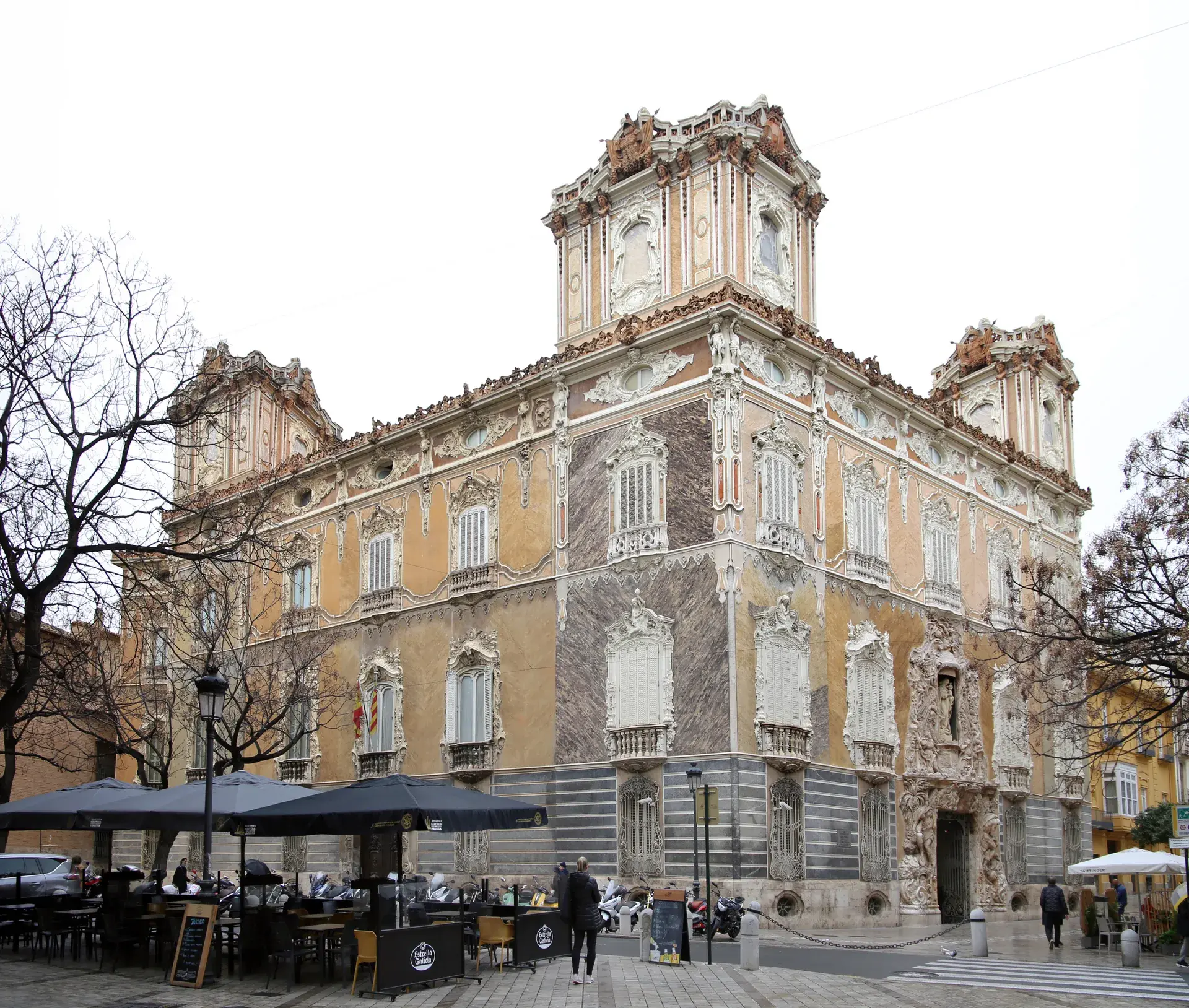
Located on Calle Poeta Querol in València's historic core, the Palacio del Marqués de Dos Aguas is instantly recognizable by its dazzling main portal. Designed between 1740 and 1744 by painter Hipólito Rovira Meavilla and carved by sculptor Ignacio Vergara, the Rococo and Churrigueresque Baroque entrance is sculpted entirely from translucent white alabaster. This bright stone creates a high visual contrast against the surrounding soft pastel and ochre facade.
The portal's design is a literal representation of the noble family's title, the Marquis of Two Waters. Two colossal male Atlases guard the entrance, acting as allegorical figures for the region's two main rivers: the Turia and the Júcar. Water is depicted pouring down from stone amphorae held by these giant river gods. Above the doorway, an upper niche houses a statue of Our Lady of the Rosary, the protective patron saint of the Marquisate, surrounded by sculpted foliage and cascading water streams.
From Gothic Manor to Rococo Palace
The site originally held a Gothic noble manor belonging to the Rabassa de Perellós family, who received the Marquisate of Dos Aguas title from King Charles II in 1699. Under the direction of Hipólito Rovira, the palace was extensively remodeled into the Rococo style during the 1740s, transforming the exterior into the landmark seen today.
In the mid-19th century, owner Vicente Dasí Lluesma oversaw further interior updates. This renovation added Victorian and French-style balconies, gilded stuccoes, and silk-paneled state rooms that remain preserved today. The grounds also hide an even older history: during archaeological excavations in one of the palace courtyards in 1743, workers uncovered Roman artifacts. These findings indicated that the plot originally served as a Roman necropolis dating from the 1st to 3rd centuries AD.
The National Museum of Ceramics
After Manuel González Martí donated his extensive ceramic collection in 1947, the Spanish state acquired the building. It officially opened to the public as the National Museum of Ceramics and Decorative Arts in 1954.
Today, the museum exhibits over 5,000 years of ceramic history, celebrating a long-standing regional tradition of tile production from nearby towns like Manises and Paterna. The vast collection spans prehistoric, Roman, and Islamic pieces, alongside medieval tiles, Alcora porcelain, and modern works by Pablo Picasso. Beyond ceramics, the museum displays historical 18th-century carriages and offers access to the meticulously preserved 19th-century palace rooms. The building is open to visitors from Tuesday through Sunday.
FAQ
Who designed the alabaster portal of the Museo Marqués de Dos Aguas?
The portal was designed by painter Hipólito Rovira Meavilla and carved by sculptor Ignacio Vergara between 1740 and 1744.
What do the statues on the entrance of the palace represent?
The two colossal male figures are river gods representing the Turia and Júcar rivers. They hold stone amphorae pouring water, literally depicting the family's title, the Marquis of Two Waters (Dos Aguas).
What is inside the Museo Marqués de Dos Aguas?
The palace houses Spain's National Museum of Ceramics and Decorative Arts, featuring over 5,000 years of ceramic history, 18th-century carriages, and preserved 19th-century palace rooms.