Roman Theatre of Caesaraugusta Museum | Zaragoza
In the heart of Zaragoza lies the Museo del Teatro de Caesaraugusta, a site where the grandeur of the Roman Empire was dramatically unearthed. For over 1,500 years, one of the largest Roman theatres in Hispania lay completely buried and forgotten, its existence unknown until it was accidentally rediscovered in 1972 during construction work.
Imperial Construction and Design
The Roman Theatre of Caesaraugusta was a significant public work reflecting the city's importance. Construction began in the early 1st century AD during the reign of Emperor Tiberius and was completed under Emperor Claudius. Modeled after the Theatre of Marcellus in Rome, it was an architectural feat, built on flat ground using Roman concrete, known as 'opus caementicium'.
Covering 7,000 square meters with a diameter of 106 meters, the theatre could accommodate approximately 6,000 spectators—a substantial portion of the city's estimated 18,000-20,000 inhabitants. Its impressive three-story facade, adorned with ashlar blocks, rose to a height of 22 meters. A unique feature within Roman Hispania was a special entrance providing high-ranking officials direct access to the orchestra area.
A Cultural Hub's Decline
During the 1st and 2nd centuries AD, the theatre was a vital center for social and cultural life in the flourishing Roman colony. It hosted theatrical performances, musical competitions, and even political gatherings. It stood as a testament to Caesaraugusta's prosperity and its status as a regional administrative hub founded by Emperor Augustus.
By the 3rd century AD, the theatre's role changed. It fell into disuse, and its robust stone blocks and materials were systematically dismantled. These valuable resources were repurposed to fortify the city's walls and for other constructions. This process eventually led to the theatre's complete burial under subsequent urban layers, erasing it from the city's landscape for centuries.
The Modern Museum and Excavations
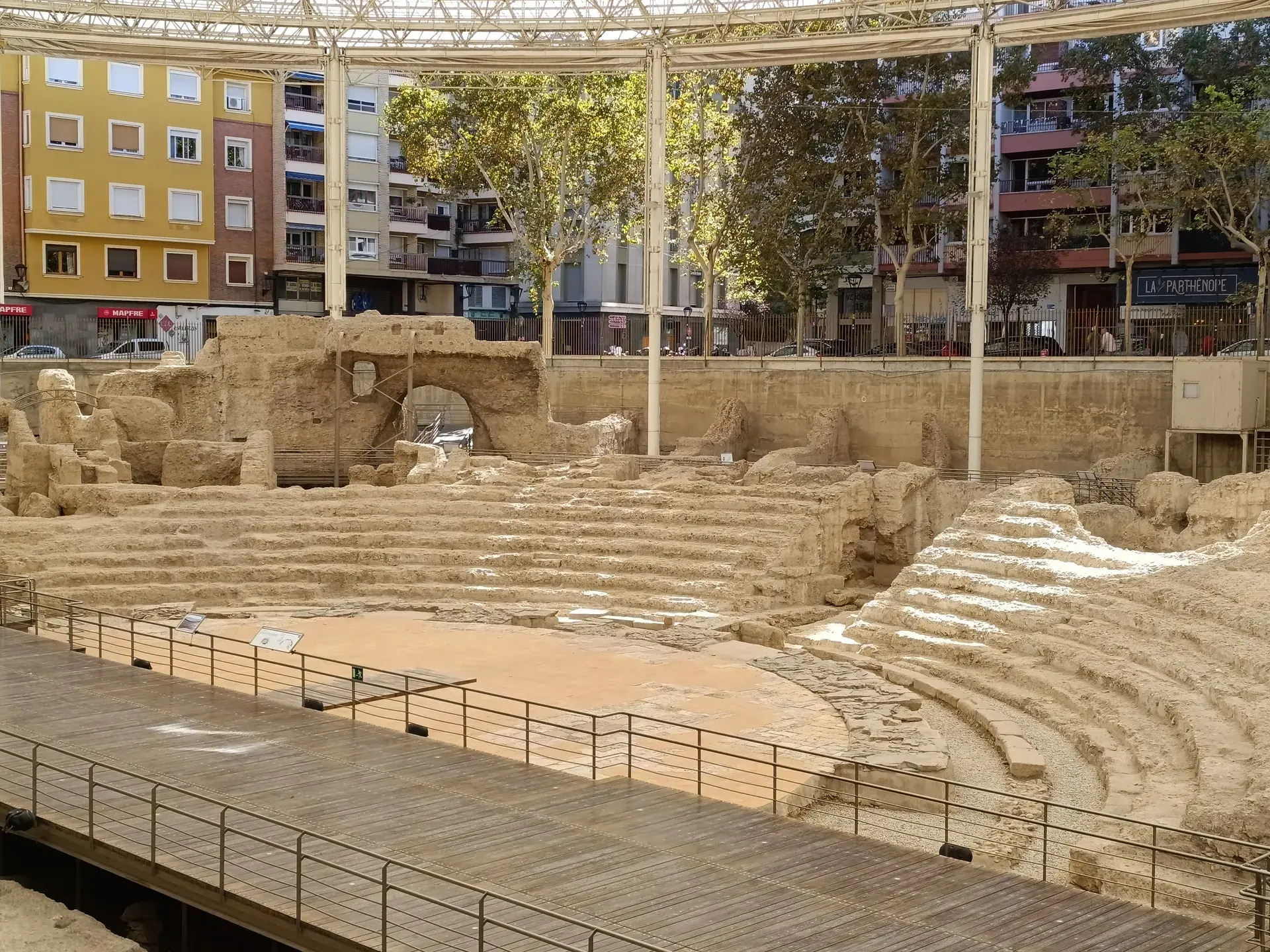
Today, the site is preserved as the Caesaraugusta Theater Museum. The excavated archaeological remains, including the old stands (cavea) and remnants of the stage (pulpitum), are protected by a large, translucent polycarbonate cover that suggests the building's original volume. Visitors can explore the ruins via suspended walkways.
Adjacent to the ruins, an interpretation center brings the theatre's history to life. It features models, multimedia exhibits, and many of the 300,000 artifact fragments unearthed during excavations. The museum is a key stop on the 'Caesaraugusta Route,' which connects Zaragoza's other major Roman sites, including the Forum, Public Baths, and River Port museums.
FAQ
When was the Roman Theatre of Caesaraugusta built?
Construction on the Roman Theatre of Caesaraugusta began in the early 1st century AD under Emperor Tiberius and was completed by the mid-1st century AD during the reign of Emperor Claudius.
How was the Roman Theatre of Caesaraugusta discovered?
After being buried and forgotten for over 1,500 years, the theatre was accidentally rediscovered in 1972 during construction work for a new building on Verónica Street in Zaragoza.
How many people could the Roman Theatre hold?
The theatre had a capacity of approximately 6,000 spectators, which was a significant number considering the city of Caesaraugusta had a population of around 18,000 to 20,000 inhabitants at the time.
What can visitors see at the museum today?
Visitors can view the excavated archaeological remains of the theatre, including the seating area (cavea) and stage, from suspended walkways. An adjacent interpretation center displays artifacts, models, and multimedia exhibits explaining the theatre's history and Roman life.