Puente de Piedra: Zaragoza's Historic Stone Bridge
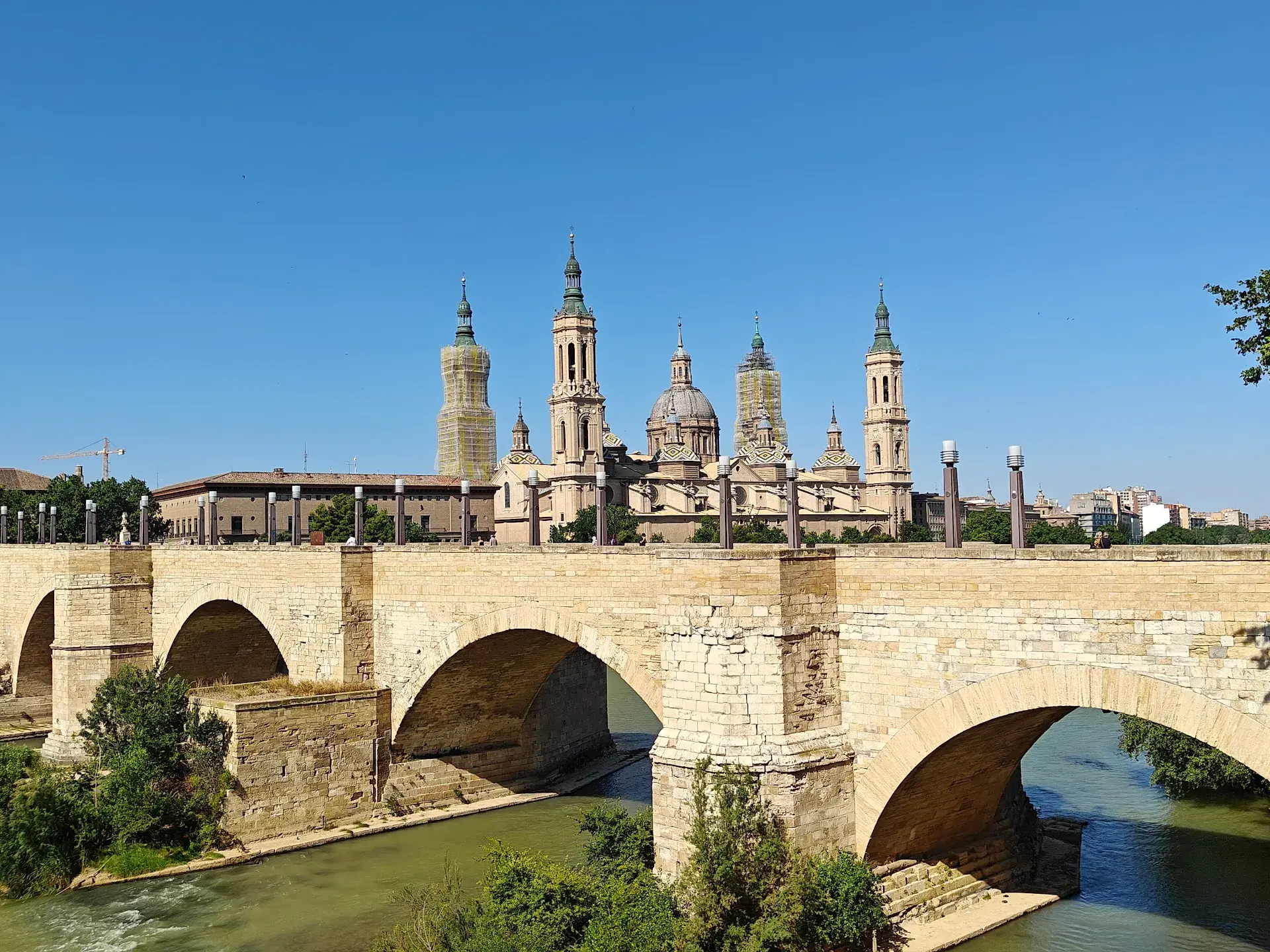
The Puente de Piedra, or Stone Bridge, is an iconic landmark in Zaragoza, Spain, stretching 225 meters across the Ebro River. For centuries, it was the city's only permanent crossing, making it fundamental to Zaragoza's communication, trade, and development. Today, it stands as a symbol of the city's resilience and a testament to its long history.
A History of Construction and Resilience
The bridge's story begins in Roman times, with evidence of a crossing for Caesaraugusta in the 1st century. After its destruction, a new bridge was built by Abderramán II in 839. The current medieval structure, however, began construction in 1401 under the direction of Gil de Menestral and was completed in 1440. The project was not without challenges; one of its arches collapsed in 1435, even before its inauguration.
The bridge has endured numerous trials. A catastrophic flood in 1643 destroyed two central arches, an event famously captured in a painting by Juan Bautista Martínez del Mazo. Architect Felipe de Busignac led the reconstruction in 1659, enhancing its structural defenses. During the Napoleonic Wars in 1813, retreating French troops destroyed an arch to hinder pursuit. The medieval towers that once flanked the bridge were ultimately demolished in 1906.
Architectural Features and Evolution
The Puente de Piedra features seven arches, though one is no longer visible, buried beneath the modern Paseo Echegaray. The stone for its construction was sourced from a quarry in the Burrén mountain, which was owned by the Pope. In the late 18th century, engineer Agustín Sanz oversaw the construction of the Pretil de San Lázaro, a protective wall to mitigate flooding.
A defining feature of the bridge today is the set of four bronze lion statues. These were not part of the original design but were added in 1991, sculpted by Francisco Rallo Lahoz. The bridge also holds the 'Cruz de Basilio,' a memorial to individuals killed during the Sieges of Zaragoza. In 2002, the bridge was declared a Site of Cultural Interest.
The Bridge in Modern Times
Today, the Puente de Piedra remains a vital artery for Zaragoza, accommodating pedestrians, bicycles, buses, and taxis. It is freely accessible 24 hours a day and serves as a popular viewpoint for locals and visitors alike. The bridge offers panoramic vistas of the Ebro River and the Basilica del Pilar, with its views being particularly renowned at sunset. It continues to be a powerful symbol of Zaragoza's identity and enduring history.
FAQ
When was the Puente de Piedra built?
Construction on the current stone bridge began in 1401 and was completed in 1440. However, the site has a history of bridges dating back to Roman times, with a reconstruction occurring in 839.
Are the lions on the Puente de Piedra original to the bridge?
No, the four iconic bronze lion statues are a modern addition. They were sculpted by Francisco Rallo Lahoz and installed on the bridge in 1991.
Is the Puente de Piedra a Roman bridge?
While a bridge existed here in Roman times, the current structure is not Roman. It is a medieval bridge built in the 15th century, though a popular urban legend persists that it is Roman.
Can you walk across the Puente de Piedra?
Yes, the bridge is open to pedestrians and is a popular spot for its views of the Ebro River and the Basilica del Pilar. It also facilitates transit for buses, taxis, and bicycles.