Pulteney Bridge, Bath: History, Architecture & Facts
A Bridge Disguised as a Street
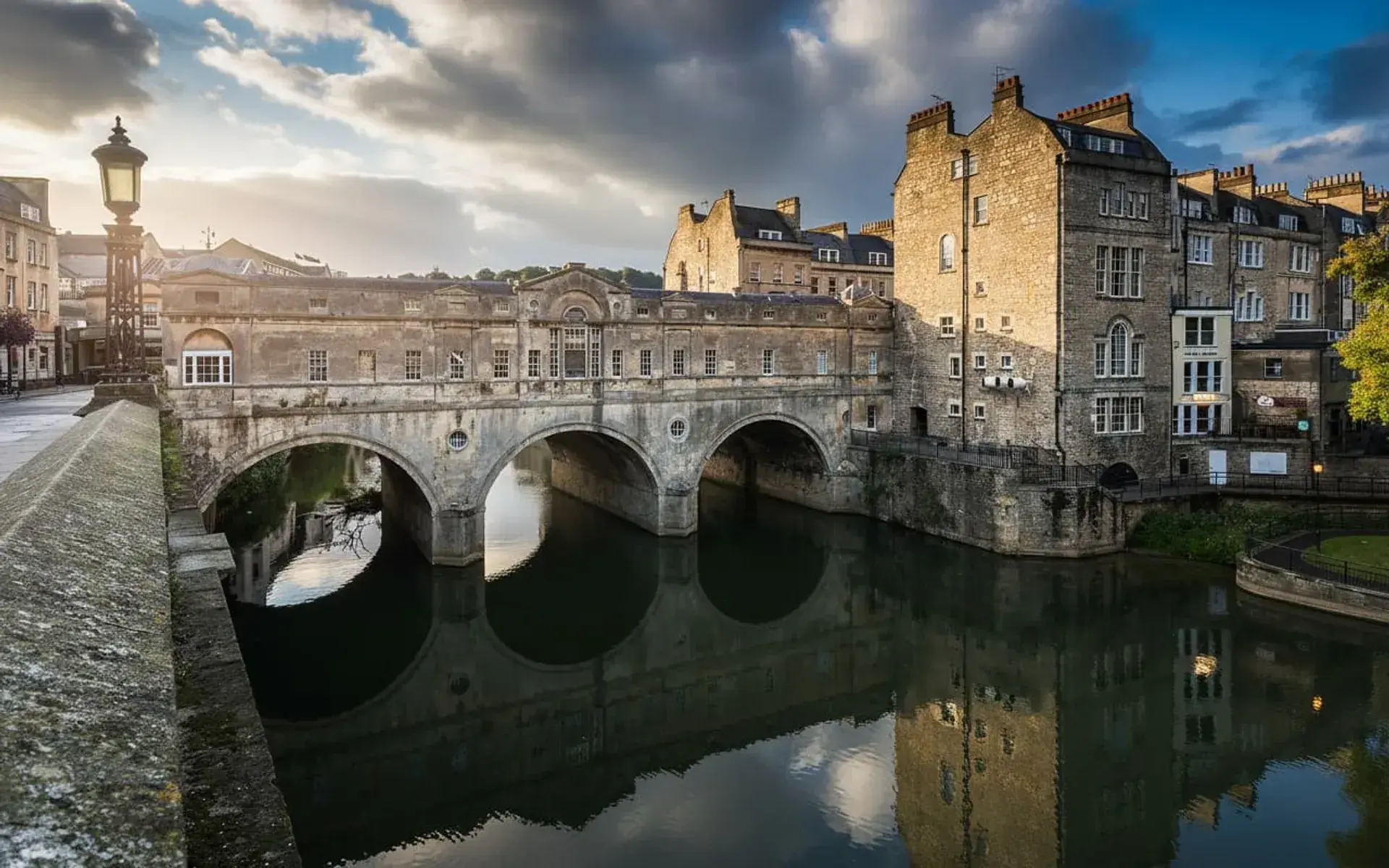
Spanning the River Avon in Bath, England, Pulteney Bridge serves as an essential architectural hinge linking the city's historic medieval and Georgian core near Bath Abbey to the planned district of Bathwick. Constructed from honey-colored Bath limestone, the Grade I listed crossing extends 45 meters (148 feet) over three segmental river arches.
While hundreds of bridges cross British waterways, Pulteney Bridge belongs to an exceptionally rare architectural category: it is one of only four bridges in the world lined with continuous shops across its entire span on both sides. First-time visitors crossing its paved roadway often mistake the bridge for a conventional city street, realizing they are over water only after stepping inside a riverside shop or café.
Bath walking tour with audio and quizzes: Roman baths, Georgian fronts
2 hours9 stopsAudio guideStart any day, at your own paceTicket on your phone · 30-day refundGeorgian Ambition and Palladian Design
The impetus for the bridge arose in 1767 when Sir William Johnstone Pulteney and his wife, Frances Pulteney, inherited the rural Bathwick estate across the Avon. At the time, crossing the river required a ferry. Envisioning a new, grand Georgian suburb that would rival the famed developments built by John Wood on Bath's western side, Pulteney sought a direct road connection.
To execute the vision, Pulteney commissioned Scottish Neoclassical architect Robert Adam. Drawing inspiration from Italian architecture, Adam based his design primarily on Andrea Palladio's unbuilt proposal for the Rialto Bridge in Venice rather than on existing structures. Construction commenced around 1769–1770, and the bridge was completed by 1774, opening a gateway directly into Laura Place and Great Pulteney Street.
A Tale of Two Facades
Pulteney Bridge retained Adam's exact layout for less than two decades. In 1792, architect Thomas Baldwin widened the bridge, altering the original shopfronts to consolidate smaller stalls into larger retail premises. Severe river floods in 1799 and 1800 subsequently destroyed parts of the northern side, prompting surveyor John Pinch the elder to rebuild the damaged sections in a simpler, less decorated fashion.
Throughout the 19th and early 20th centuries, independent shopkeepers added irregular, cantilevered extensions over the water. Recognizing the building's historical vulnerability, authorities designated Pulteney Bridge a scheduled ancient monument in 1936. Bath City Council subsequently acquired the properties and undertook a major restoration based on Adam’s original plans, returning the south facade to its Palladian appearance in time for the 1951 Festival of Britain.
Today, the bridge features two distinct exteriors. The southern facade reflects Robert Adam's formal symmetry, complete with classic pediments and Venetian windows. In contrast, the northern side remains an asymmetrical patchwork of cantilevered additions that tell the story of two centuries of organic commercial adaptation.
The Horseshoe Weir and Cultural Legacy
Directly downstream from the bridge lies a dramatic, three-tiered crescent weir. The constant acoustic roar of water cascading over these stepped barriers contrasts with the sheltered, quiet atmosphere inside the roadway shops. Although the weir appears harmoniously antique alongside the Georgian masonry, the curved concrete structure is modern, built between 1968 and 1972 as part of the Bath Flood Prevention Scheme.
The picturesque combination of bridge and weir gained worldwide cinematic prominence in the 2012 film adaptation of Les Misérables, where the location stood in for the River Seine in Paris during the dramatic suicide scene of Inspector Javert.
Modern Use and Access
Pulteney Bridge continues to function as an active commercial street filled with independent retailers, florists, jewellers, and coffee houses. To protect the historic stone structure and preserve pedestrian flow, private passenger vehicles are prohibited from crossing. The crossing is monitored by a 24-hour automated bus gate, permitting passage solely to scheduled local buses, licensed taxis, cyclists, and pedestrians.
FAQ
Why is Pulteney Bridge considered rare?
It is recognized as one of only four bridges in the world lined with functional shops along its entire span on both sides, sharing this distinction with structures such as the Ponte Vecchio in Florence and the Rialto Bridge in Venice.
Can private cars drive across Pulteney Bridge?
No. Private vehicular traffic is restricted by an automated 24-hour bus gate. Only local buses, licensed taxis, cyclists, and pedestrians are allowed to use the crossing.
When was the curved weir beneath Pulteney Bridge built?
Although often assumed to be Georgian, the three-tiered horseshoe weir was constructed between 1968 and 1972 as part of the Bath Flood Prevention Scheme.