Crown Liquor Saloon: Belfast's Victorian Gin Palace
Belfast’s Victorian Gin Palace
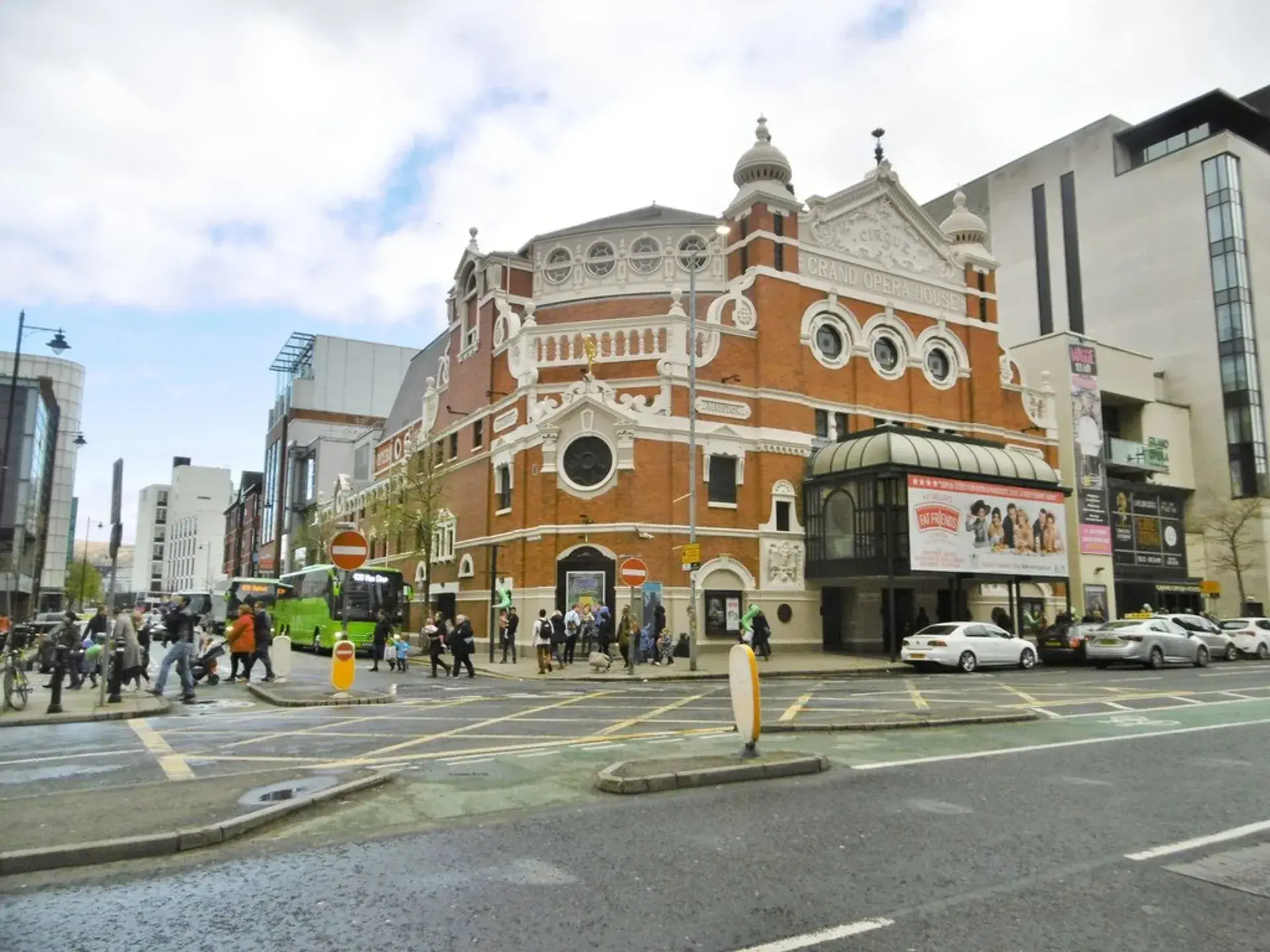
Situated at 46 Great Victoria Street, the Crown Liquor Saloon is a Grade A listed public house that stands as one of the finest surviving examples of a Victorian gin palace. Positioned directly opposite the Grand Opera House and near Belfast Great Victoria Street train station, the pub anchors the city's central transit and theatre corridor. Its creation coincided with Belfast's late-19th-century industrial boom, a period of vast wealth driven by global leadership in shipbuilding, rope manufacturing, and linen production.
The exterior of the building is immediately recognizable by its polychromatic ceramic tiling, added around 1898. Inside, deep shades of primrose yellow, red, and gold frame a lavish space featuring mosaic floors and an expansive, altar-style bar counter topped with polished red granite.
Belfast walking tour with audio and quizzes: Opera House to Big Fish
2 hours8 stopsAudio guideStart any day, at your own paceTicket on your phone · 30-day refundOrigins and Ecclesiastical Craftsmanship
The site was first licensed around 1826 as The Railway Tavern, operated by Felix O'Hanlon to cater to travellers arriving at the nearby railway terminus. Decades later, Michael Flanagan purchased the premises. In 1885, his son Patrick Flanagan oversaw a comprehensive redesign in partnership with the architectural firm E. & J. Byrne.
During this transformation, Flanagan reportedly engaged Italian craftsmen who were concurrently working on Belfast Catholic churches, including St. Peter's Cathedral. These artisans lent ecclesiastical touches to the public house, including religious-style woodwork, intricate floor mosaics, and the distinctive altar-like bar counter.
A notable political statement is preserved at the threshold of the entrance, where an intricate mosaic crown is set into the floor. According to local tradition, Patrick Flanagan, an Irish nationalist, intentionally situated the imperial symbol there so patrons would tread upon it every time they entered.
Gas Lamps and Private Snugs
The saloon is illuminated in part by operational overhead gas lamps, which emit a faint, steady hiss and cast an amber glow while radiating warmth beneath the carved, painted ceiling. Sunlight filtering through the windows interacts with etched and stained-glass partitions adorned with whimsical iconography, including pineapples, fleur-de-lys, clowns, and fairies.
Running along one side of the interior are ten private wooden snugs designed during the Victorian era to provide patrons with seclusion. Each individual booth retains its original gunmetal match-striking plates and antique mechanical brass call bells, which customers used to summon the bartender without leaving their seat.
Resilience and Preservation
The saloon's location placed it in direct peril during the late 20th century. Standing directly opposite the Europa Hotel—one of the most heavily bombed hotels in Europe during the Troubles—the Crown sustained repeated collateral blast damage. Shockwaves shattered the stained-glass windows and fractured the antique woodwork on numerous occasions. Despite the destruction, the establishment was persistently repaired and remained open throughout the period of civil conflict.
Facing threats from urban redevelopment and decay in the 1970s, the saloon was targeted for preservation by local conservationists and poet laureate Sir John Betjeman. Their campaign led the National Trust to acquire the property in 1978. Subsequent major restorations in 1981 (£400,000) and 2007 (£500,000) safeguarded its structural and decorative details.
Today, the building functions both as a National Trust heritage site and an operational pub and restaurant. Leased to Mitchells & Butlers under the Nicholson's brand, it continues to serve cask-conditioned ales, spirits, and pub fare in an authentically preserved Victorian atmosphere.
FAQ
Why is there a crown mosaic on the entrance floor?
Local tradition states that Patrick Flanagan, an Irish nationalist who redesigned the pub in 1885, deliberately embedded the British imperial crown in the entrance floor so patrons would wipe their feet on it upon entering.
What features are inside the wooden snugs?
The ten carved wooden snugs are fitted with original gunmetal strike plates for lighting matches and antique mechanical brass call bells used to signal bar staff.
Who owns and operates the Crown Liquor Saloon?
The property was acquired by the National Trust in 1978 and is operated under lease by Mitchells & Butlers as part of the Nicholson's pub chain.
How was the Crown Liquor Saloon damaged during the Troubles?
Located opposite the frequently bombed Europa Hotel, the saloon suffered repeated blast damage that shattered stained glass and damaged interior woodwork, though it was continually restored and remained open.