Kelly's Cellars: Belfast's Oldest Historic Pub
Belfast’s Oldest Operating Public House
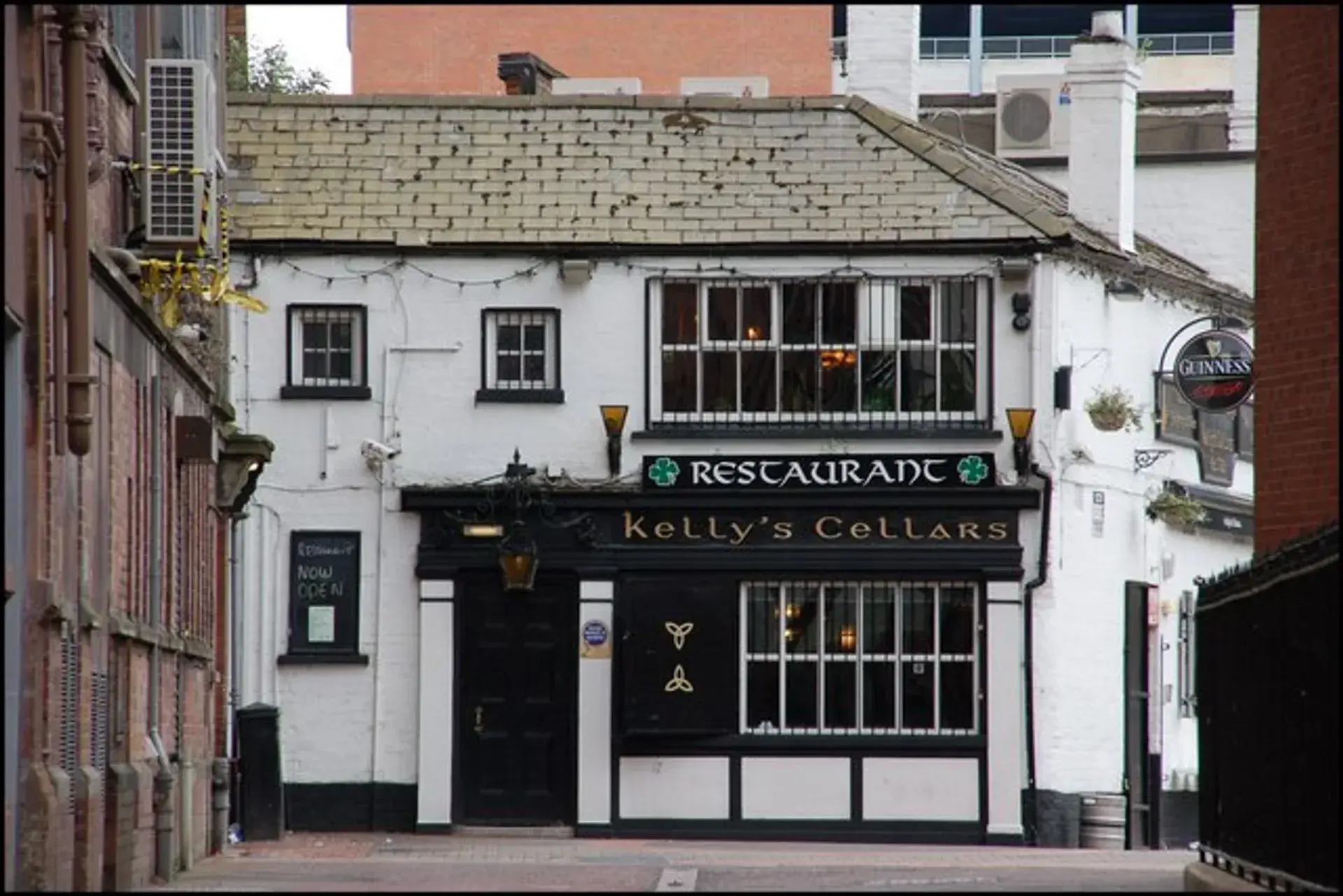
Situated at 30–32 Bank Street off Royal Avenue, Kelly's Cellars is recognized as the oldest continuously operating public house in Belfast. Positioned between modern commercial developments such as CastleCourt and historic landmarks like the 1784 St Mary's Church, the tavern is an enduring architectural survivor of the city's eighteenth-century commercial network of narrow entries.
Belfast walking tour with audio and quizzes: Opera House to Big Fish
2 hours8 stopsAudio guideStart any day, at your own paceTicket on your phone · 30-day refundGeorgian Origins and Architecture
The establishment began as a bonded spirit warehouse storing whiskey, gin, and rum near the River Farset. The venture was founded by merchant Hugh Kelly along a pathway originally known as "Back of the River," named for the open waterway before it was channeled into underground culverts beneath Castle Place and High Street.
While traditional accounts date the founding to March 14, 1720, architectural surveys indicate that the surviving physical fabric dates to circa 1780. Earlier structures occupied the site from the late seventeenth century, and a matching footprint appears on a 1757 town map. Classified as a Grade B2 listed historic building, the two-storey painted brick early Georgian structure features an asymmetrical facade, small sash windows, and low internal ceilings. Inside, an open peat and turf fireplace burns against whitewashed brick walls and low-vaulted architecture.
The United Irishmen and Political History
During the 1790s, Kelly’s Cellars served as a clandestine meeting ground for leaders of the Society of United Irishmen, including Henry Joy McCracken and Theobald Wolfe Tone, who met here to organize the 1798 Rebellion. Local tradition holds that McCracken once evaded capture by British Redcoats during a sudden raid by hiding beneath the tavern's wooden bar counter. McCracken was later captured elsewhere and executed in Belfast's Cornmarket in July 1798. An Ulster History Circle blue plaque was mounted to the building's exterior in 2007 to commemorate this period.
The tavern maintained connections to Irish politics in subsequent generations. In the 1890s and early 1900s, Kelly's Cellars was managed by Joseph Devlin, who later became an influential Nationalist Member of Parliament representing West Belfast.
Community Life, Curiosities, and Blitz Survival
Beyond politics, the pub functioned as an integral community hub. Because nearby residential cottages on Bank Street were small and overcrowded, local families historically used the pub’s back room to host community wakes for deceased neighbours. The tavern also enforced traditional social restrictions of its era, maintaining house rules that barred unaccompanied women from the bar until the 1960s.
Over the centuries, the attic of Kelly's Cellars housed an unusual assortment of artifacts, including an iron key from Smithfield Gaol, an antique elephant's tooth, and painted canvas panels from Dr. Thomas Corry’s touring diorama from the 1860s.
The building sustained structural damage during the Belfast Blitz in April 1941. Although interior alterations carried out between the 1940s and 1960s replaced early fittings, the tavern preserved its core vault layout and historical footprint.
Contemporary Hospitality and Traditional Music
Kelly’s Cellars operates today as an active public house and music venue. In May 2024, the business was acquired by the Downey Group from its long-term proprietors, Lily Mulholland and Martin O'Hara.
The pub hosts live traditional folk music sessions several nights a week. The compact room and vaulted ceilings acoustically amplify instruments such as fiddles, bodhráns, and tin whistles. The kitchen and bar serve classic pub fare, including daily pots of beef stew, alongside draught stout, Irish whiskeys, and regional beers.
FAQ
When was Kelly's Cellars founded?
Traditional accounts date the establishment to March 14, 1720, by merchant Hugh Kelly. However, architectural surveys indicate that the surviving Georgian building fabric dates to circa 1780.
What historical role did Kelly's Cellars play in the 1798 Rebellion?
In the 1790s, the pub served as a clandestine meeting place for leaders of the Society of United Irishmen, such as Henry Joy McCracken and Theobald Wolfe Tone, who used the premises to organize the 1798 Rebellion.
Why was Bank Street previously known as 'Back of the River'?
The street was originally named 'Back of the River' because it sat directly along the open River Farset before the waterway was diverted into underground culverts.
What food and music are offered at Kelly's Cellars today?
The pub hosts traditional Irish folk music sessions featuring instruments like fiddles, bodhráns, and tin whistles multiple nights a week. It serves traditional pub fare, notably beef stew, alongside draught stout and Irish whiskeys.