Cary Grant Statue: Bristol's Hollywood Landmark
A Tribute to Bristol's Native Hollywood Star
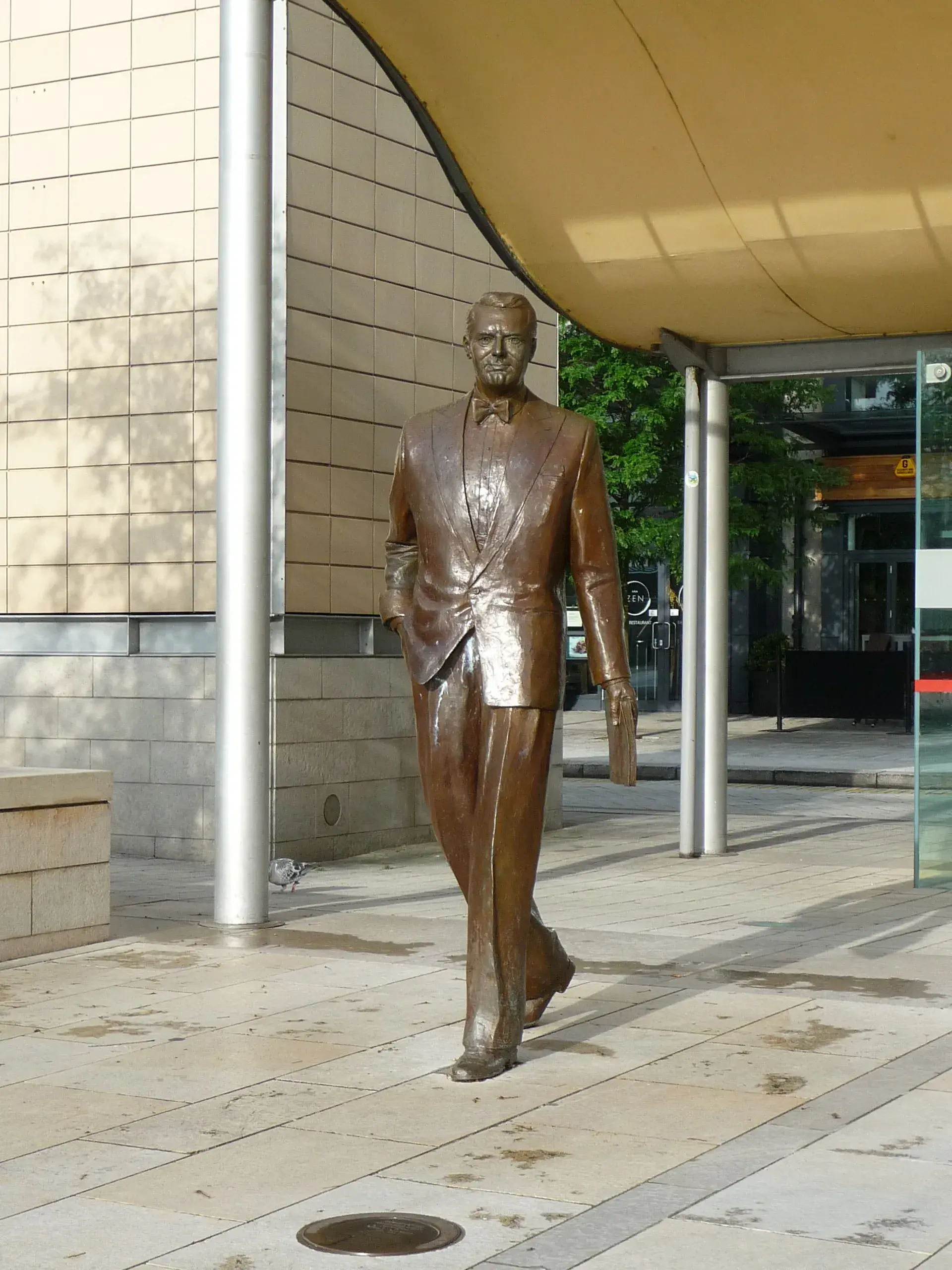
Standing in Millennium Square on Bristol's Harbourside, the Cary Grant Statue commemorates one of cinema's most enduring leading men. Cast in life-sized bronze, the monument captures the screen icon strolling casually in a tailored double-breasted suit, connecting the actor's Hollywood prestige with his working-class English roots.
The statue serves as an open-air public landmark along the Floating Harbour. Placed against the pale stone flags, glass facades, and shallow reflecting water pools of the modern square, the smooth, dark patinated bronze presents the figure mid-stride, blending seamlessly into the everyday foot traffic of the pedestrian plaza.
Bristol walking tour with audio and quizzes: Christmas Steps and quays
2 hours9 stopsAudio guideStart any day, at your own paceTicket on your phone · 30-day refundThe Life of Archie Leach
Before reinventing himself as a movie star, Cary Grant was Archibald Alec Leach, born in Horfield, Bristol, in 1904. His father, Elias, worked as a tailor's presser, and his mother was Elsie Leach. When Archie was nine years old, his father placed Elsie in the Bristol Lunatic Asylum and told the young boy that his mother had either died or gone away on holiday. He did not discover that she was still alive until he was 31, after which he returned regularly to Bristol to visit her throughout his life.
At age 13, Leach stepped backstage at the Bristol Hippodrome, finding employment as an errand boy and limelight operator. Enamored with stagecraft, he joined Bob Pender's acrobatic troupe. In 1920, at age 16, Leach traveled to the United States on tour with the troupe and chose to stay behind. He advanced through American vaudeville and Broadway before heading to California, where he signed with Paramount Pictures and adopted the stage name Cary Grant.
Sculptural Design and Hidden Details
Created by sculptor Graham Ibbeson, the bronze sculpture contains several carefully chosen references to Grant's career and personal history. Tucked under his arm, the actor carries a sculpted replica script of Alfred Hitchcock's 1955 romantic thriller To Catch a Thief.
Ibbeson deliberately positioned the figure facing roughly toward the city centre and the Bristol Hippodrome, directly referencing the theatre where the runaway teenager first learned the entertainment trade. Inscriptions on the plinth highlight both of his identities, calling him "Archie Leach... Known to some outside Bristol as Cary Grant" and "Bristol boy and Hollywood legend."
The Campaign and Unveiling
The statue was funded through an international public campaign led by Bristol writer David Long, which raised approximately £60,000. Supporters contributed from around the globe, including an online fan community known as the "E-mail War Brides," titled after Grant's 1949 screwball comedy I Was a Male War Bride.
The memorial was initially scheduled to debut in September 2001, but the installation was postponed when workers discovered a Victorian cast-iron water main running directly beneath the selected spot in the square. On December 7, 2001, Grant's widow, Barbara Jaynes, formally unveiled the completed sculpture. The event marked the 70th anniversary of his arrival in Hollywood and his inaugural studio contract with Paramount.
Millennium Square and Cultural Legacy
The monument sits in Millennium Square, a major urban regeneration initiative completed around 2000 that transformed former industrial docks into an active cultural and educational quarter. The statue shares the public space with other monuments dedicated to figures with Bristol connections, including Bible translator William Tyndale, poet Thomas Chatterton, and Nobel laureate physicist Paul Dirac.
Located on the primary walking path linking the historic city centre to the Harbourside and the SS Great Britain, the statue is a key physical anchor for Bristol's status as a UNESCO City of Film. It also serves as the gathering and departure point for guided local heritage tours, such as the "Looking for Archie" and "From Bristol to Hollywood" walks produced by the Show of Strength Theatre Company during the biennial Cary Comes Home festival.
FAQ
Who created the Cary Grant Statue in Bristol?
The statue was sculpted by artist Graham Ibbeson and unveiled in December 2001 by Cary Grant's widow, Barbara Jaynes.
What item is Cary Grant holding in the sculpture?
The bronze statue depicts Grant carrying a replica script of Alfred Hitchcock's 1955 film To Catch a Thief.
Why was the statue's unveiling delayed in 2001?
The installation was postponed from September to December 2001 after contractors discovered a Victorian cast-iron water main running directly beneath the intended location.
What is the significance of the statue's orientation?
Sculptor Graham Ibbeson positioned Grant facing roughly toward Bristol's city centre and the Bristol Hippodrome, the theatre where he worked as an errand boy and limelight operator at age 13.