St Nicholas Market & The Exchange: Bristol History Guide
The Architectural Legacy of The Exchange
Standing on Corn Street in the heart of Bristol's Old City, The Exchange represents an exceptionally rare piece of English commercial architecture. Built between 1741 and 1743, the building was designed in the Georgian Palladian style by architect John Wood the Elder, with ornate architectural carvings executed by Bristol sculptor Thomas Paty.
Designated a Grade I listed building in 1959, The Exchange holds distinct national importance as England's only surviving 18th-century exchange building. Comparable contemporary trading exchanges in London and Liverpool were both destroyed by fire, leaving Bristol's landmark as the sole remaining structural example of its era.
Bristol walking tour with audio and quizzes: Christmas Steps and quays
2 hours9 stopsAudio guideStart any day, at your own paceTicket on your phone · 30-day refundFrom Corn Trading to Rock Concerts
The Corporation of Bristol commissioned the hall to provide a unified, dignified meeting space for corn dealers and merchants, who had previously carried out negotiations outdoors in the open street or beneath nearby church walkways. Originally laid out around an open-air central courtyard, the interior underwent a major redesign in 1872 when architect Edward Middleton Barry covered the space with an iron-and-glazed roof to form the enclosed trading hall seen today.
Over the centuries, the hall adapted to various civic uses. During the 1960s, it operated as a bustling live music venue, hosting landmark British rock acts such as The Rolling Stones, The Who, and Cream. To safeguard its structural integrity, Historic England added the building to its Heritage at Risk Register in late 2024 to facilitate necessary repairs and assist long-term municipal conservation efforts.
The Corn Street Facade: Dual Time and The Nails
The exterior of The Exchange showcases notable historical relics connected to Bristol's commercial traditions. High on the Corn Street facade, the building's clock displays two distinct minute hands—one black and one red. Following the mid-19th-century adoption of standardized railway time, the dual hands were installed to display both Greenwich Mean Time and Bristol's local solar time, which lagged approximately 10 minutes behind standard time.
Directly outside along the pavement stand four bronze and brass tables set on pedestals, known collectively as "The Nails." Dating from the late 16th to early 17th centuries, these tables feature flat tops surrounded by raised rims designed to prevent coins from dropping onto the roadway during cash transactions. Local folklore asserts that the phrase "to pay on the nail" originated from business deals conducted on these pedestals; however, historical records confirm the idiom was already documented in literature long before these specific tables were cast. The Nails originally stood at the Tolzey, a walkway adjoining All Saints' Church, and were relocated to Corn Street upon the opening of The Exchange in the 18th century.
The Modern Market and Surroundings
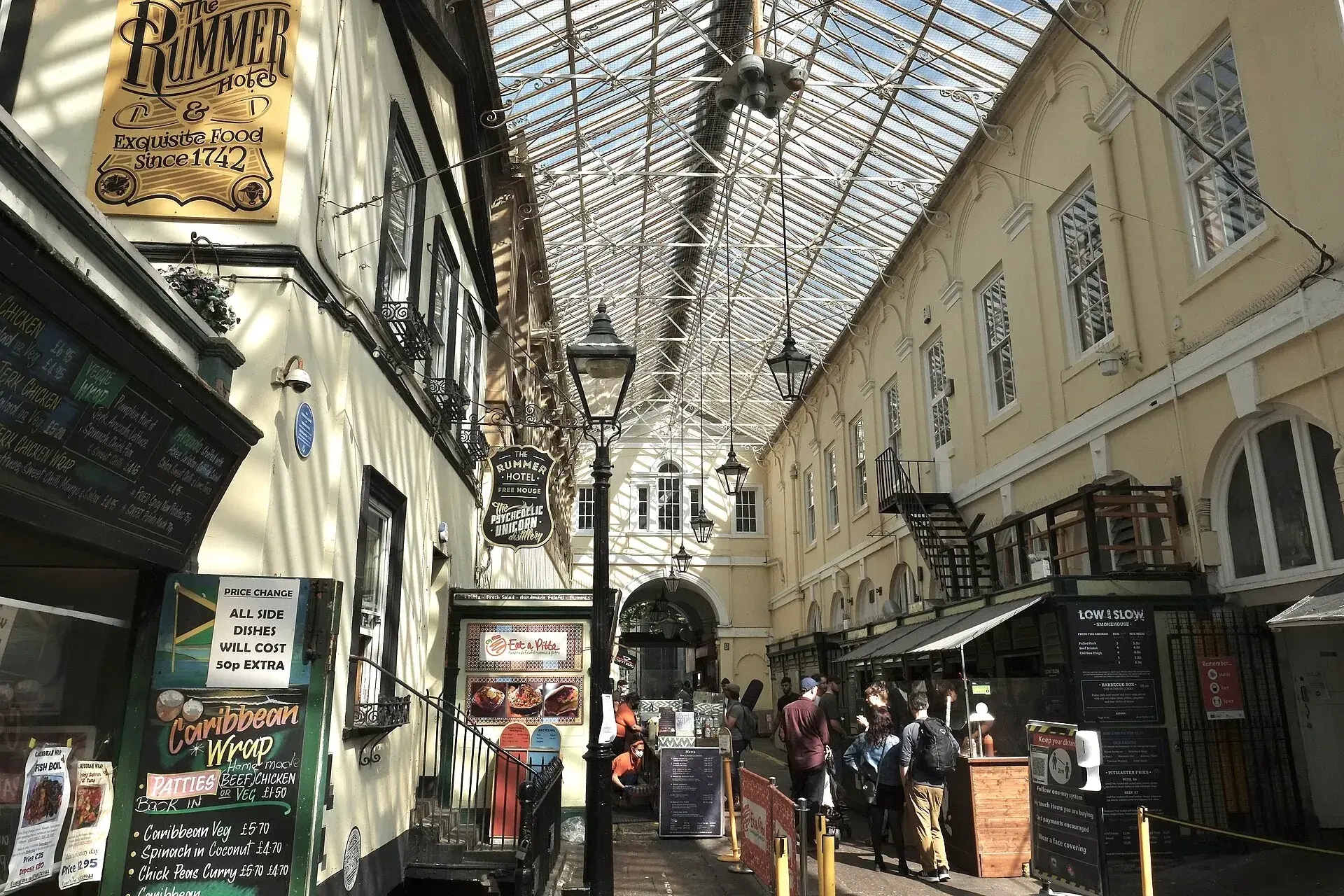
Today, the building is owned and operated by Bristol City Council and houses St Nicholas Market, the city's largest concentration of independent businesses with more than 60 indoor vendors. The complex is divided into three distinct zones: the grand Exchange Hall for general retail, the Covered Market featuring narrow alleys of specialty shops, and the Glass Arcade, dedicated to permanent food vendors.
The Glass Arcade is characterized by the sounds of lunchtime crowds beneath Victorian ironwork and the scents of food cooked on-site, including flatbreads, curries, and pies. St Nicholas Market operates Monday through Saturday from 9:30 am to 5:00 pm. Serving as a central landmark at the intersection of Corn Street, Broad Street, and High Street, The Exchange acts as a key historic link between Bristol's medieval street grid, College Green, and the Floating Harbour.
FAQ
Why does the clock on The Exchange have two minute hands?
The clock features a black minute hand and a red minute hand to simultaneously show Greenwich Mean Time and Bristol's traditional local solar time, which lagged roughly 10 minutes behind standard railway time.
Did the idiom "to pay on the nail" originate at St Nicholas Market?
Although local tradition attributes the phrase to transactions settled over the four bronze tables outside the building, language historians note that the idiom was already established in literature before these specific 16th- and 17th-century tables were created.
What are the opening hours for St Nicholas Market?
St Nicholas Market is open Monday through Saturday from 9:30 am to 5:00 pm. It is closed on Sundays.