St John on the Wall: Bristol's Medieval Gateway Church
The Gateway Built into Bristol's Ancient Defenses
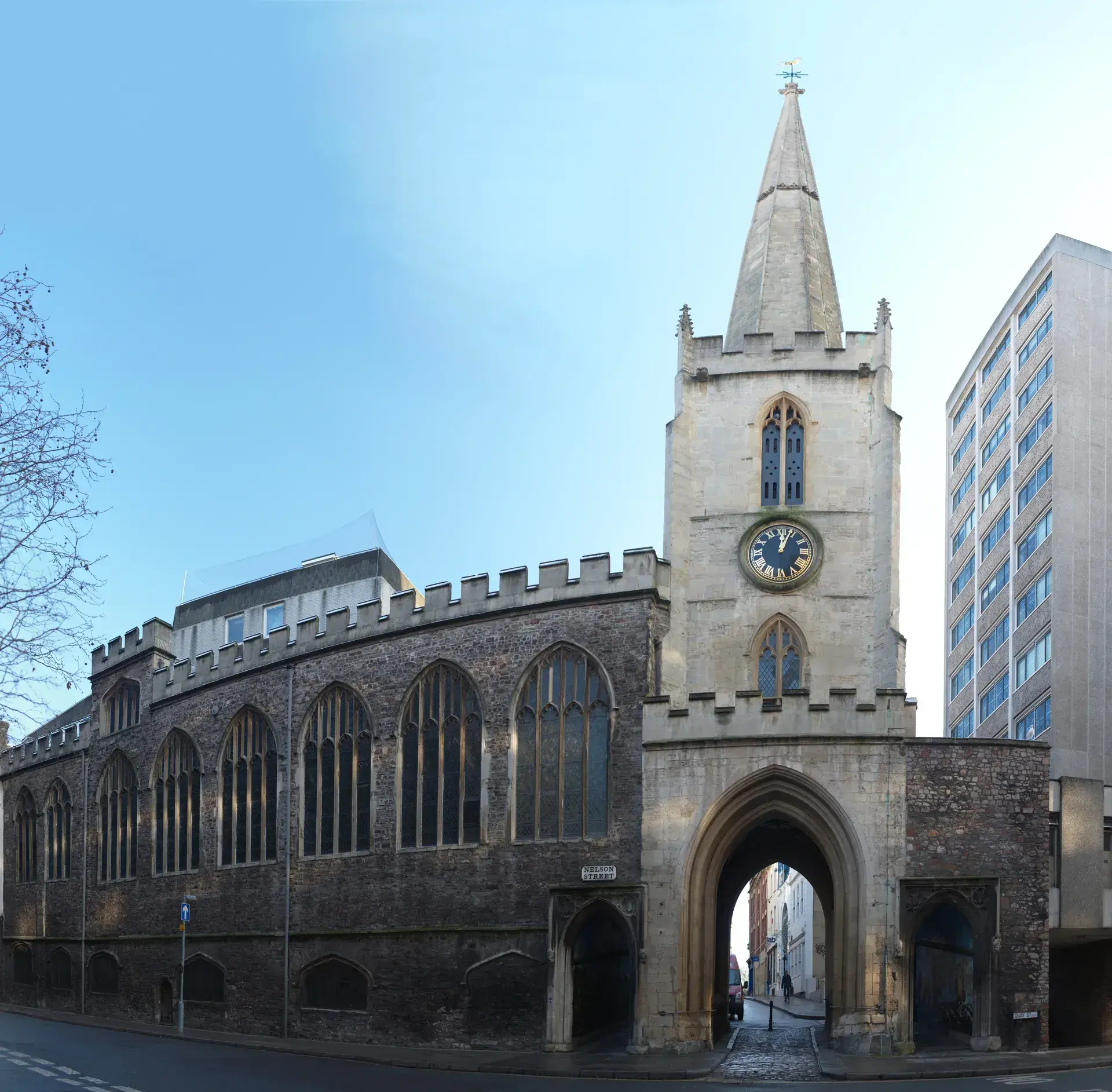
The Church of St John the Baptist, commonly known as St John on the Wall, is a Grade I listed medieval church situated at the lower end of Broad Street in Bristol. Marking the northern limit of the historic Anglo-Norman town, it holds the distinction of being the only surviving portal of the city's nine medieval gates and the sole remaining church built directly onto and into the Anglo-Saxon and Norman wall circuit.
Originally founded in the 12th century, St John’s was one of five churches erected along the city walls. These gatehouse churches served a defensive role while also offering sanctuaries where travellers could pray for safe journeys before departing or give thanks upon arrival. As a key entrance to the city, the gateway later welcomed Queen Elizabeth I during her royal progress in 1574.
Bristol walking tour with audio and quizzes: Christmas Steps and quays
2 hours9 stopsAudio guideStart any day, at your own paceTicket on your phone · 30-day refundArchitectural Form and St John's Gate
Constrained by the defensive fortifications, the church features an unusually narrow single-aisle plan aligned with the wall. Directly above the vaulted archway of St John's Gate rises the church tower, crowned by a perpendicular stone spire. Inside the vaulted stone carriage arch, vertical stone grooves are visible overhead, which once guided the falling timber-and-iron portcullis into place.
The original central carriage arch was flanked in the 1820s by two pierced pedestrian walkways cut into the stone to relieve congestion from heavier foot traffic. The gate tower also has a twin-church heritage: it originally stood between St John to the east and the adjoining church of St Lawrence to the west. The two parishes shared a single belfry until St Lawrence was sold following the Reformation in 1580 and subsequently demolished.
The Rib-Vaulted Crypt and Reconstructed Windows
Beneath the upper nave sits an extensive 14th-century rib-vaulted crypt, originally dedicated to the Holy Cross. Positioned at what was once the exterior base of the defensive wall, the crypt contains graves and memorials carved with medieval merchant marks. These distinctive geometric symbols were used by local merchants on export cargo shipments rather than personal coats of arms.
Between 1350 and 1390, the upper church underwent a major rebuilding financed by Walter Frampton, a prominent merchant and three-time Mayor of Bristol. Frampton died in 1388 and is commemorated by an effigy and tomb chest set within an arched recess in the chancel. Higher up in the nave, the clear windows hold another piece of history: salvaged fragments of colored medieval stained glass that were gathered and reassembled after being blown out by bomb blasts during the Bristol Blitz of World War II.
Statues, Conduits, and Historic Traditions
The exterior features several notable historical curiosities. High on the Broad Street side of the gate, carved stone niches house weathered statues of Brennus and Belinus. Local lore identifies them as legendary pre-Roman Celtic kings and mythical founders of Bristol, though they are anachronistically depicted holding Christian crosses.
Outside the wall along Nelson Street is the St John's Conduit, a medieval water supply. According to local civic records, the conduit was historically rigged during parliamentary elections in the 18th and 19th centuries to flow with free wine for voters.
Conservation and Modern Role
Parish worship at St John on the Wall ceased in 1984, and the building was taken into the care of the Churches Conservation Trust in 1985. The site now operates as a heritage landmark open for public visits, historical exhibitions, and guided tours detailing medieval Bristol.
The historic nave and crypt also host community art events, small acoustic concerts, and candlelit carol services. Conservation work continues to protect the medieval spire and rib-vaulted crypt against structural wear, aging foundations, and vibrations from modern urban traffic.
FAQ
Why is St John on the Wall built directly over a city gate?
The church was integrated directly into Bristol's medieval fortifications in the 12th century, serving both to strengthen the city walls and to offer travellers a place to pray before leaving or entering the city. It is the only one of Bristol's nine medieval city gates to survive intact.
Who was Walter Frampton?
Walter Frampton was a prominent merchant and three-time Mayor of Bristol who largely funded the rebuilding of the church between 1350 and 1390. His tomb chest and effigy remain in the chancel.
What can be seen inside the St John's Gate archway?
Looking overhead inside the vaulted stone carriage arch reveals the deep vertical stone grooves that once guided the gate's heavy timber-and-iron portcullis.
What are the merchant marks found in the crypt?
The memorials and graves in the 14th-century crypt feature interlocking geometric emblems known as merchant marks, which traders used to identify export cargo shipments instead of using coats of arms.