
Christmas Steps, Bristol: History and Heritage
Origins and Etymology
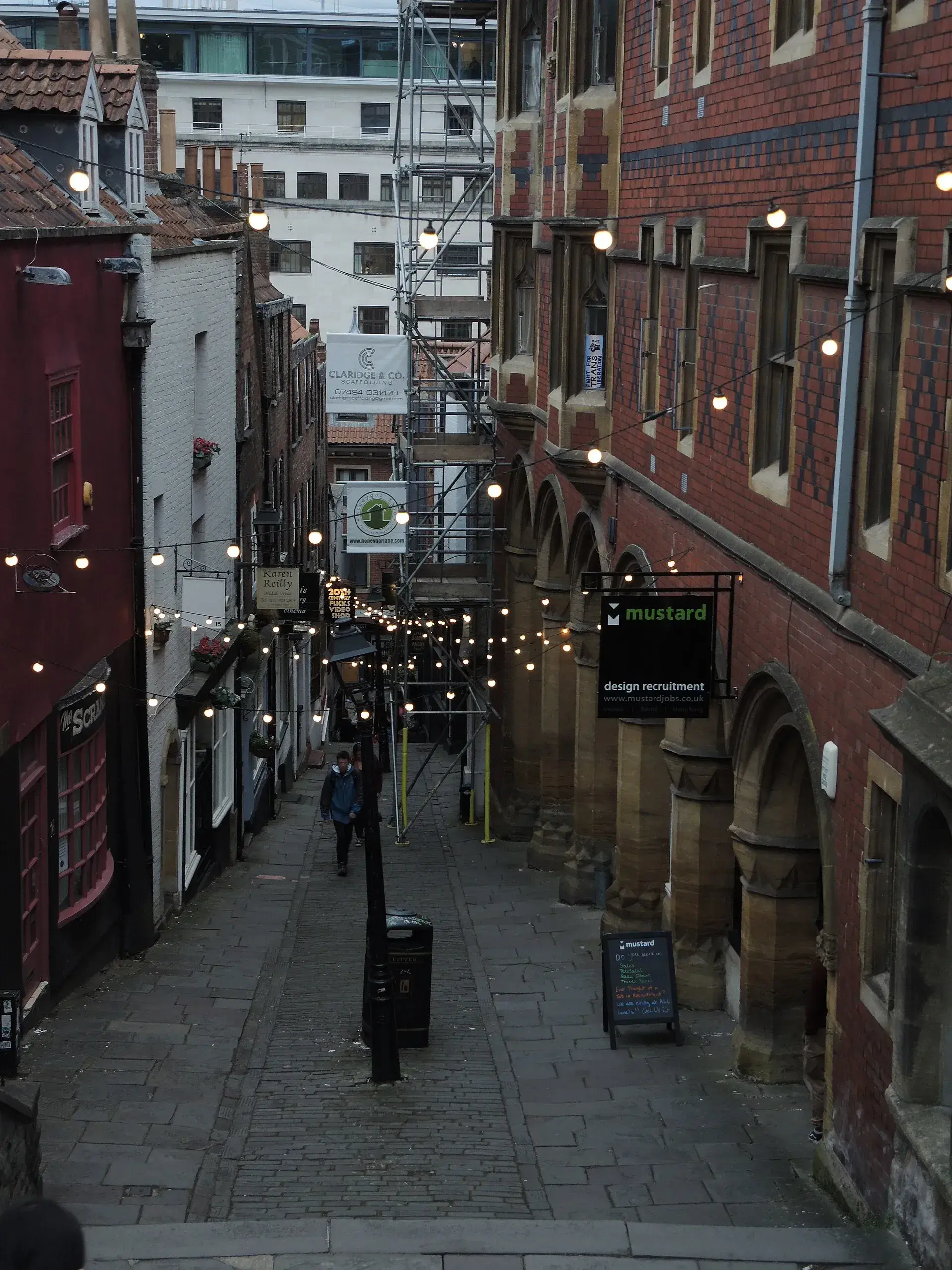
Christmas Steps is a steep pedestrian lane in central Bristol connecting Colston Street and St Michael's Hill with the lower medieval city centre and St Bartholomew's Hospital. The route originated during the medieval period as Stypstrete, or Steep Street, an unpaved hillside track that provided access between the fortified city wall and St Michael's Church. As cutlers established workshops along the incline, the passage became known as Knifesmith Street (Knyfesmythstrete).
In 1480, chronicler William Worcestre recorded the passage as "knyfesmythstrete aliter Cristmastrete." Over centuries, phonetic softening shifted the Middle English pronunciation from "Knifesmith" into "Christmas." Despite the festive sound of its modern name, the street has no historical connection to the holiday season. During the English Civil War, Royalist officer Colonel Henry Lunsford was fatally shot on the street on 26 July 1643, leading to the thoroughfare being briefly referred to as Lunsford's Stairs.
Bristol walking tour with audio and quizzes: Christmas Steps and quays
2 hours9 stopsAudio guideStart any day, at your own paceTicket on your phone · 30-day refundThe 1669 Stepping and Civic Works
By the mid-17th century, the incline remained a hazardous, muddy path. In September 1669, wealthy wine merchant, vintner, and former sheriff Jonathan Blackwell funded a civic project to pave and step the corridor. Blackwell officially designated the new thoroughfare Queene Streete in honour of Catherine of Braganza, commissioning stone resting alcoves and a carved stone tablet near the top flight to commemorate the donation.
Despite the formal title, local residents continued using versions of its older moniker, and municipal authorities officially recognized the name Christmas Steps by the late 19th century. Between 1865 and 1881, the steps underwent substantial rebuilding. Today, the four flights of stone steps, the stone seating niches flanking the top flight, and Blackwell's commemorative tablet are Grade II listed.
Architecture and Physical Features
Topographically, Christmas Steps links the low-lying medieval riverside core near St John's Gate with the elevated Georgian and Victorian expansions of Kingsdown and Clifton. Centuries of pedestrian foot traffic have worn the broad flagstones slick and slightly concave, demanding careful footing on the gradient.
Flanking the top steps are original stone alcoves, built into the masonry as resting niches for porters and travellers ascending from the River Frome valley. The passage is bounded by Grade II listed buildings dating from the late 17th to the early 19th centuries. At No. 1 stands an early 18th-century public house premises, while the property at the bottom of the flight served for more than a century as one of Britain's oldest continuously running fish-and-chip shops before becoming a bakery.
Modern Role in the Arts Quarter
In contemporary Bristol, Christmas Steps serves as the central spine of the pedestrianised Christmas Steps Arts Quarter. The lane maintains an architectural cross-section of central Bristol's vertical landscape while preserving a tradition of independent commerce.
The historic buildings along the stairs house a variety of specialist trades and creative enterprises, including artisanal tailors, musical instrument makers, art galleries, and vintage retailers. Hospitality venues line the route as well, featuring The Christmas Steps pub, the Ahh Toots bakery and café at the base of the stairs, and a dedicated board game café.
FAQ
How did Christmas Steps get its name?
The name is a centuries-long linguistic corruption of Knifesmith Street (Knyfesmythstrete), named after the medieval cutlers who once traded along the path. By 1480, chronicler William Worcestre recorded it as 'knyfesmythstrete aliter Cristmastrete', showing the phonetic softening that eventually produced the modern name.
Who financed the stone steps on Christmas Steps?
In September 1669, vintner and former sheriff Jonathan Blackwell funded the paving and construction of the stone steps, complete with stone rest niches, originally naming the passage Queene Streete in honour of Catherine of Braganza.
Why were stone niches built into the top flight of steps?
The stone niches flanking the uppermost flight of stairs were constructed as rest alcoves, allowing uphill travellers and porters carrying goods to pause and recover after climbing out of the River Frome valley.