Queen Square, Bristol: History and Restoration
Queen Square is a 2.4-hectare formal Georgian square situated in central Bristol. Functioning as a transitional hinge between historic King Street to the north and the active quayside of the Floating Harbour, the square serves as one of the city's most prominent public green spaces and a notable benchmark in urban heritage restoration.
Origins and Merchant Enclave
Laid out in 1699 on reclaimed ground formerly known as the Town Marsh, the square was named in honour of Queen Anne following her visit to the city in 1702. Developed during Bristol's 18th-century maritime trade boom, the square became the primary residential quarter for wealthy merchants, shipowners, and civic officials.
The perimeter was lined with terraces predominantly built in red brick, a material that was relatively uncommon in Bristol at the time of construction. At its heart stands a Grade I-listed bronze equestrian statue of King William III, designed by sculptor John Michael Rysbrack. Cast in 1733 and erected in 1736 atop a Portland ashlar pedestal, the monument portrays the monarch dressed as a classical Roman emperor rather than in contemporary Georgian royal attire.
Bristol walking tour with audio and quizzes: Christmas Steps and quays
2 hours9 stopsAudio guideStart any day, at your own paceTicket on your phone · 30-day refundThe 1831 Bristol Riots
In October 1831, Queen Square became the focal point of the Bristol Riots, which erupted following the House of Lords' rejection of the parliamentary Reform Bill. Hostility turned toward the anti-reform judge Sir Charles Wetherell, who was pursued to the square's Mansion House and forced to flee across adjacent rooftops in disguise.
Rioters occupied the square for three days, looting premises and burning approximately half of the surrounding buildings, including the Mansion House and the Custom House. The unrest was brought to an end by a dragoon cavalry charge. In the aftermath of the devastation, affluent families largely relocated up the hill to Clifton. Although the destroyed terraces were rebuilt in the 1830s, the square shifted toward commercial and office purposes and later narrowly avoided conversion into a central railway terminus in the 1860s.
From Highway to Heritage Restoration
In 1937, Bristol Corporation approved a major road initiative that drove an Inner Circuit dual carriageway diagonally across Queen Square. For over fifty years, the four-lane thoroughfare funnelled up to 20,000 vehicles per day across the lawns, disrupting the square's original symmetry and shifting the William III monument.
Traffic was experimentally closed to through-movements in 1992. Supported by National Lottery funding in the late 1990s, the dual carriageway was permanently removed. The restoration re-established the square's perimeter railings, realigned the central equestrian statue, and returned the grounds roughly to their 1817 appearance.
Historical Curiosities and Modern Use
Queen Square is connected to several notable historical figures and milestones. In 1792, Number 37 Queen Square became the first overseas consulate established by the United States, led by Consul Elias Vanderhorst following his appointment by George Washington. In 1821, Elizabeth Blackwell, who would later become the first woman to earn a medical degree in the United States in 1849, was born on the square. Sydney Smirke's Greek Revival Custom House, erected between 1835 and 1837, also remains an architectural anchor along the perimeter.
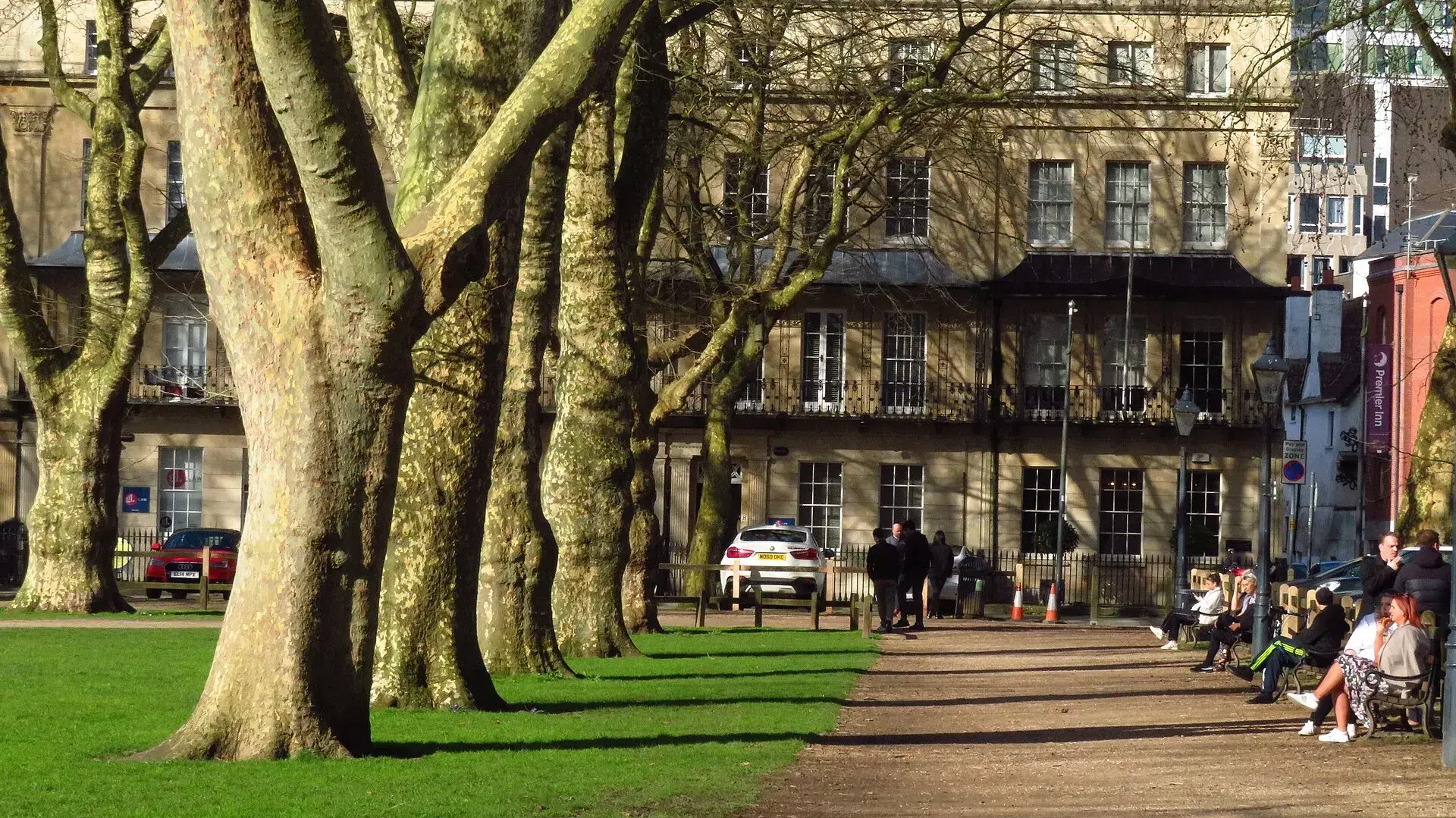
Today, Queen Square is a fully pedestrianised public park managed by Bristol City Council and accessible without charge at all hours. Wide gravel promenades traverse flat lawns framed by mature perimeter trees. The peripheral buildings shelter the central greensward from vehicle noise, providing an open civic space used for community gatherings, outdoor film screenings, open-air concerts, and events during the annual Bristol Harbour Festival.
FAQ
When was Queen Square originally built?
Queen Square was laid out in 1699 on former marshland and was named after Queen Anne following her visit to Bristol in 1702.
What happened to Queen Square during the 1831 Bristol Riots?
Protesting the rejection of the parliamentary Reform Bill, rioters besieged the square, burning roughly half of its buildings—including the Mansion House and Custom House—before being suppressed by a dragoon cavalry charge.
Who is depicted in the central statue in Queen Square?
The Grade I-listed statue depicts King William III dressed in the attire of a classical Roman emperor. It was sculpted by John Michael Rysbrack, cast in 1733, and erected in 1736.
Why was a major road built through Queen Square?
In 1937, Bristol Corporation approved cutting an Inner Circuit dual carriageway diagonally across the square. The road carried up to 20,000 vehicles a day until its experimental closure in 1992 and permanent removal during a late-1990s restoration.