Pembroke College Gatehouse: Cambridge's Oldest Gate
The Oldest Surviving Gatehouse in Cambridge
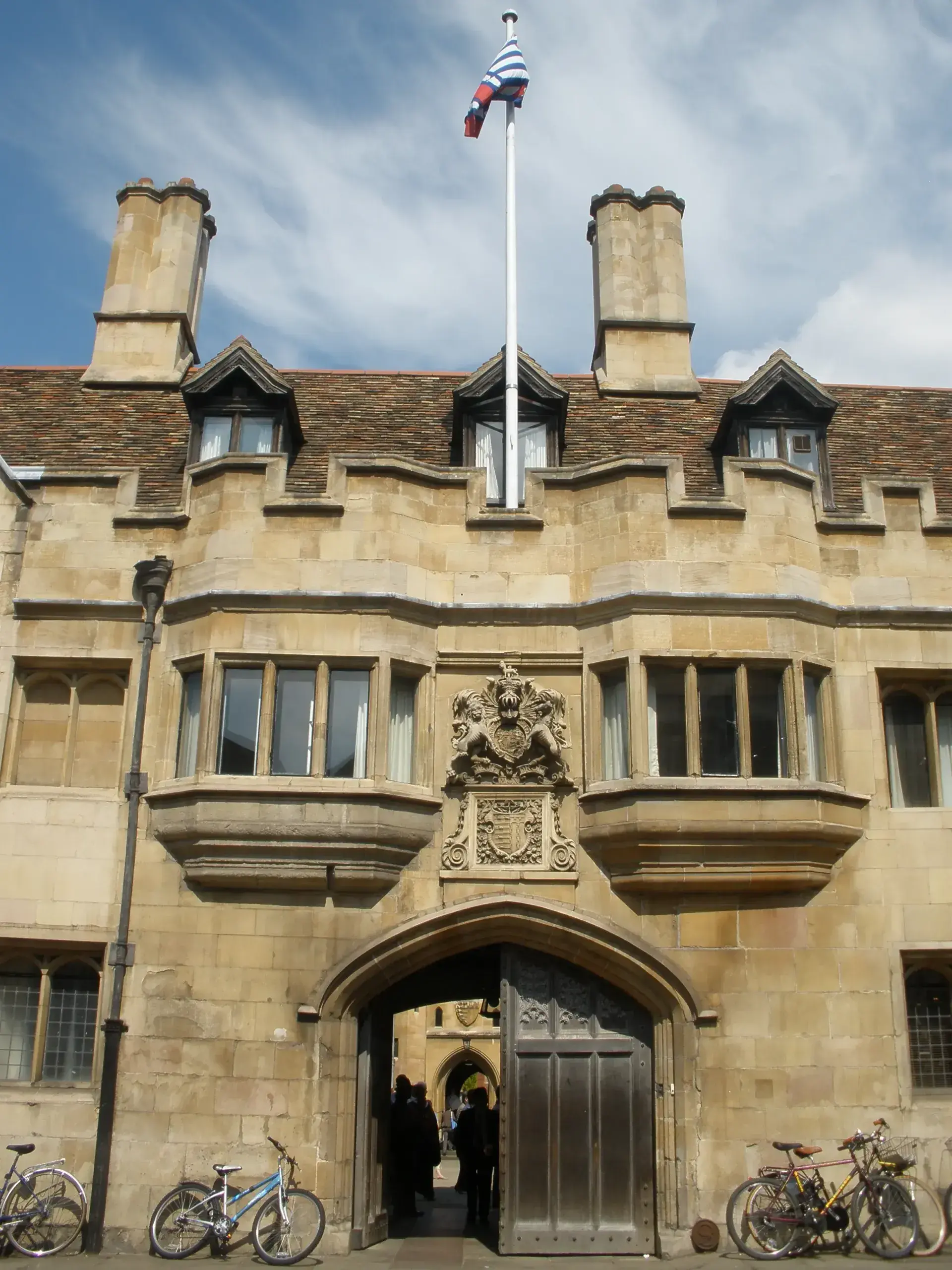
Situated at the junction of Trumpington Street and Pembroke Street, the Pembroke College Gatehouse holds the distinction of being the oldest surviving collegiate gatehouse in Cambridge. Built in the late 14th century, between the 1360s and 1370s, the Grade I listed building forms an integral part of the West Range of Old Court.
Unlike the monumental, four-turreted gate towers constructed during the Tudor period at institutions like Trinity, King’s, and St John’s, the gatehouse at Pembroke exemplifies the modest, domestic scale typical of early collegiate architecture. Positioned along one of the principal historic routes entering Cambridge from the south, it links the approaches from Peterhouse and the Fitzwilliam Museum to King's Parade and the city center.
Foundation and Architectural Evolution
Pembroke College was founded in 1347 by Marie de St Pol, Countess of Pembroke and widow of Aymer de Valence, under a royal charter issued by Edward III. Originally established as the Hall of Valence Mary, Pembroke is the earliest Cambridge college to continually occupy its original foundation site with an unbroken corporate existence.
The gatehouse was configured to serve as the gateway to Old Court, an arrangement designed to consolidate all early college activities—including the hall, library, kitchens, Master's lodge, and scholar chambers—around a single courtyard. Over the centuries, the structure evolved while retaining its medieval core. During the 18th century, the exterior was refaced in stone ashlar, and it continues to display 17th-century mullioned windows above the arched entrance bay. When Victorian architect Alfred Waterhouse demolished sections of Old Court's south and east ranges, the medieval western range and its gatehouse were preserved.
Transition into Old Court
The gatehouse marks an abrupt acoustic and visual boundary. The narrow, stone-arched passage muffles the vehicle traffic of Trumpington Street, opening immediately into the sheltered lawn and manicured grass of Old Court.
Upon clearing the entrance passage, the classical facade and pediment of the college chapel come into view to the right. Designed by Christopher Wren and completed in 1665, the chapel stands in sharp stylistic contrast to the medieval and post-medieval stonework of the surrounding court.
Literary Lore and Statutes
The entrance has also witnessed notable episodes in Cambridge university history. In 1756, the poet Thomas Gray, author of Elegy Written in a Country Church-Yard, moved into Pembroke College through this portal. Gray relocated after students at neighboring Peterhouse played a cruel prank exploiting his severe fear of fire; they raised a false alarm that baited him down an exterior rope ladder directly into a barrel of cold water. Following the incident, Gray resided at Pembroke for the remainder of his life.
Other historical details and traditions linger around the entrance. Marie de St Pol’s original foundation statutes enforced strict behavioral expectations, ordering penalties for excessive drinking and requiring scholars to report peers caught frequenting disreputable establishments in the town. College lore also attributes spectral sightings to Ivy Court, which lies just past the gatehouse interior.
Current Role and Access
Today, the gatehouse remains the operational public entrance to Pembroke College and houses the Trumpington Street Porters' Lodge. In addition to acting as the primary security checkpoint, the gatehouse serves as the central hub where visiting hours are posted and self-guided maps are distributed for those viewing Old Court, Christopher Wren's chapel, and the wider college grounds.
FAQ
When was the Pembroke College Gatehouse built?
The gatehouse was constructed in the late 14th century, specifically between the 1360s and 1370s, making it Cambridge's oldest surviving collegiate gatehouse.
How does Pembroke's gatehouse differ from other Cambridge gate towers?
Rather than following the grandiose, four-turreted Tudor tower designs found at Trinity, King's, or St John's, Pembroke's gatehouse reflects the modest domestic scale of 14th-century college foundations.
Why did poet Thomas Gray move through this gate in 1756?
Thomas Gray moved from Peterhouse to Pembroke College after students staged a false fire alarm to trigger his phobia, prompting him to climb down a rope ladder straight into a barrel of cold water.
What function does the gatehouse serve today?
The gatehouse serves as the formal public entrance to Pembroke College, hosting the active Porters' Lodge, security checkpoint, and distribution point for visitor maps.