Senate House Cambridge: History & Degree Ceremonies
The Ceremonial Stage of Cambridge
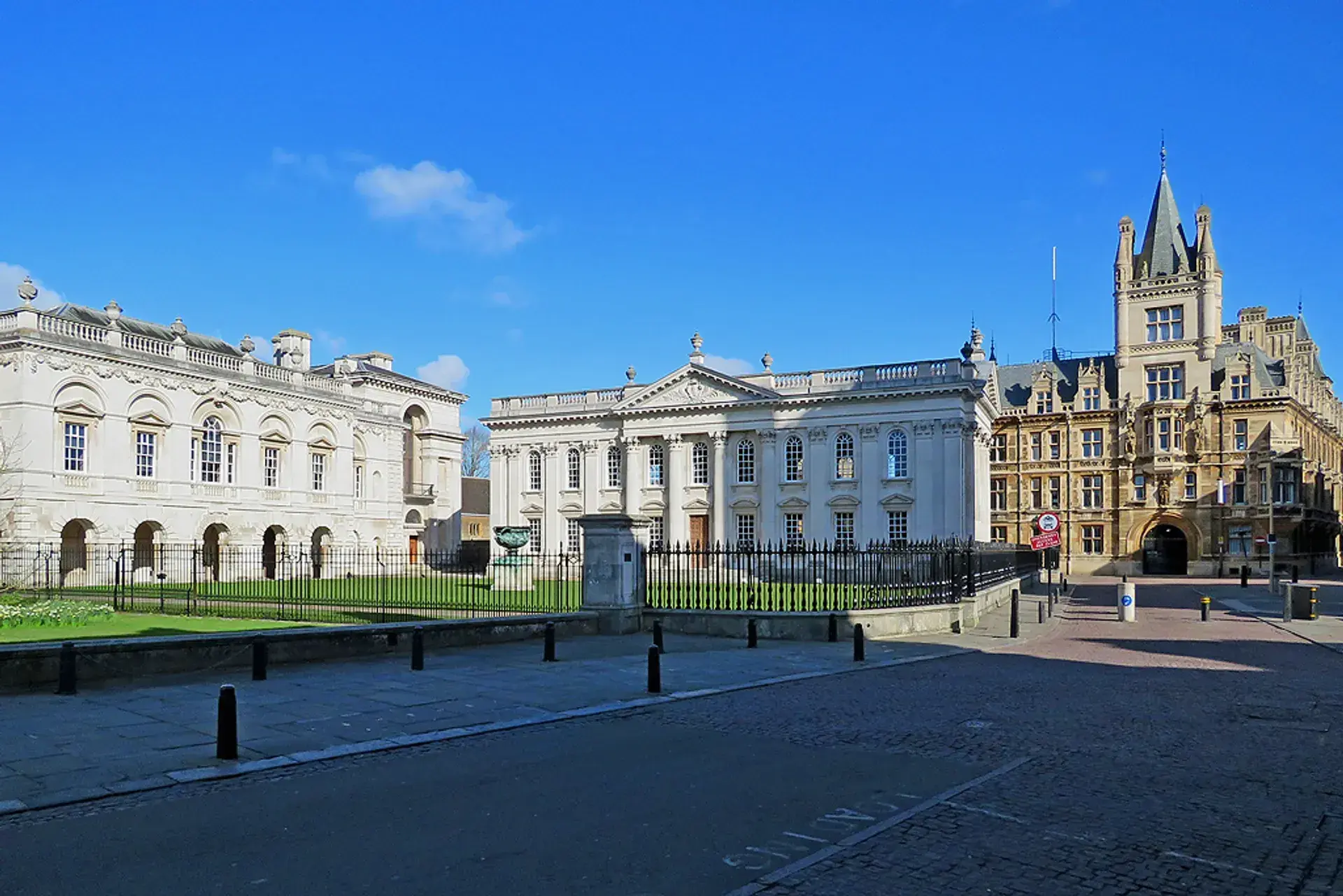
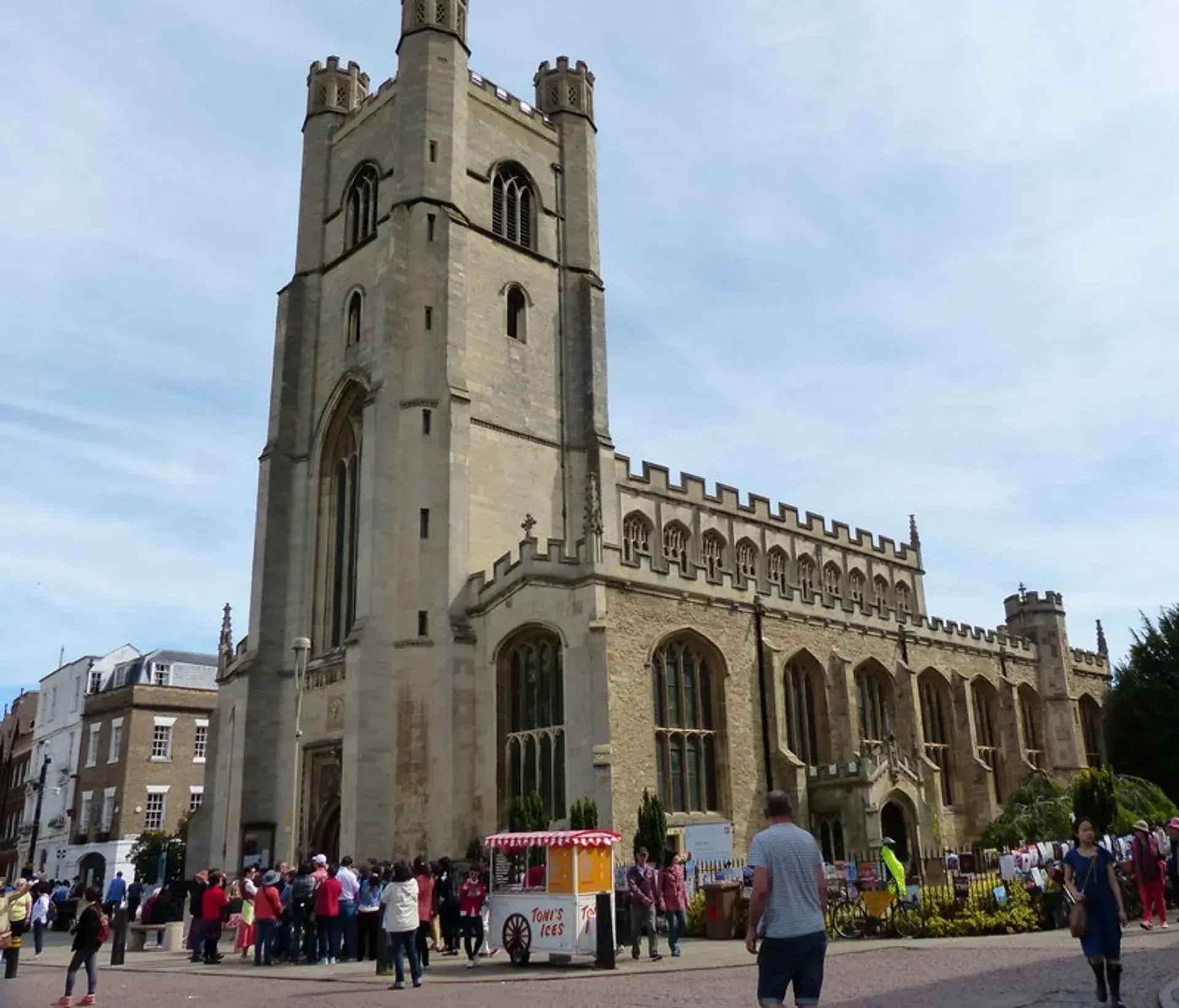
Standing on King's Parade at Senate House Hill, the Senate House serves as the ceremonial heart of the University of Cambridge. Directly facing Great St Mary’s Church, the building occupies a historic crossroads between town and gown. Following nineteenth-century street clearances, its southern facade serves as a distinctive classical vista for pedestrians looking northward along King's Parade.
Designed by architect James Gibbs, who adapted earlier proposals by Sir James Burrough, the Grade I listed building is executed in a neoclassical Corinthian style. Built with crisp white Portland stone ashlar, its exterior features giant Corinthian pilasters, two tiers of sash windows, and an ornamental roofline balustrade. Foundation work commenced on 22 June 1722, the hall formally opened in July 1730, and the western end was completed in 1768.
An Unfinished Classical Quadrangle
The construction of the Senate House was initiated after the university's medieval Old Schools ran short of administrative space. This shortage intensified when King George I presented the university library with the extensive book collection of Bishop John Moore, displacing administrative functions from the Old Regent House.
Originally, Gibbs's building was not intended to stand alone. It was designed as the northern wing of an ambitious three- or four-sided classical court planned to replace the medieval university core. Shifting architectural priorities and funding shortfalls ultimately brought an end to the grand scheme, leaving the Senate House as an isolated classical pavilion.
Centuries of Governance and Politics
For approximately two centuries, the Senate House served as the governing and debating chamber for the Cambridge Senate, which comprised university graduates holding a Cambridge Master of Arts. The Senate convened here to vote on university statutes and, until the abolition of the university constituency in 1950, to elect Cambridge’s two Members of Parliament.
The floor of the Senate House was also the site of high-profile institutional debates. Proposals to grant full degrees to women were debated and voted down here in 1897 and 1921. Full degrees were eventually granted to female students in 1948.
Degree Congregations and Rituals
Today, the Senate House is used almost exclusively for Congregations of the Regent House, particularly degree conferrals held throughout the academic year. These ceremonies follow centuries-old traditions conducted largely in Latin. Candidates are presented college by college by their Praelector, who leads them forward by the right hand. Each candidate then kneels before the Vice-Chancellor, or their deputy, to receive their degree.
Because the eighteenth-century hall has no modern overhead lighting, degree congregations must be conducted strictly during daylight hours. To accommodate all graduating students, colleges cycle through ceremonies in multiple daytime batches. On ceremony days, Senate House Yard fills with the sound of academic gowns and the murmur of visiting families as graduates process in strict college sequence through the black iron gates.
While the interior is reserved for university members and invited ceremony guests, the exterior has long held a public academic role. Glass-fronted wooden boards outside the building historically served as the official public posting location for degree class lists.
Academic Curiosities and Student Pranks
The Senate House has been the backdrop for numerous long-standing university traditions and notable escapades:
- The Original Wooden Spoon: The common phrase "wooden spoon" originated in the Senate House during the Mathematical Tripos examinations. An actual wooden spoon—which grew up to five feet in length in late Victorian times—was given as a booby prize to the student who achieved the lowest passing grade for an honours degree. During ceremonies, friends would rig the spoon with strings and suspend it from the Senate House gallery over the candidate's head as they knelt, until the university outlawed the practice in 1875. The final spoon was awarded in 1909.
- Balcony Proclamations: Mathematical Tripos results were traditionally read aloud from the interior gallery of the hall, after which copies of the class lists were dropped down to the assembled undergraduates waiting below.
- The 1958 Austin Seven Van: On the morning of 8 June 1958, an Austin Seven van appeared 70 feet above the ground, straddling the apex of the Senate House roof. Overnight, twelve engineering students from neighbouring Gonville & Caius College had stripped the vehicle's engine and transmission, winched it up using a derrick made from scaffolding borrowed from King's College, and guided it across a plank bridge. Retrieval proved so difficult that the fire brigade and university had to dismantle the vehicle into six pieces with blowtorches to bring it down.
FAQ
Can the general public tour the interior of the Senate House?
No. The interior of the Senate House is closed to the general public and is reserved exclusively for university members and invited ceremonial guests.
Why are graduation ceremonies held only during the day?
Because the eighteenth-century hall lacks modern overhead lighting, degree congregations are restricted strictly to daylight hours, requiring colleges to process in multiple daytime shifts.
What is the origin of the "wooden spoon" phrase?
The phrase originated at the Senate House as an actual booby prize given to the Cambridge student who received the lowest passing honours mark in the Mathematical Tripos examinations.