Torrione Matilde di Canossa: Tarquinia Gate Tower
Architectural Profile and Military Design
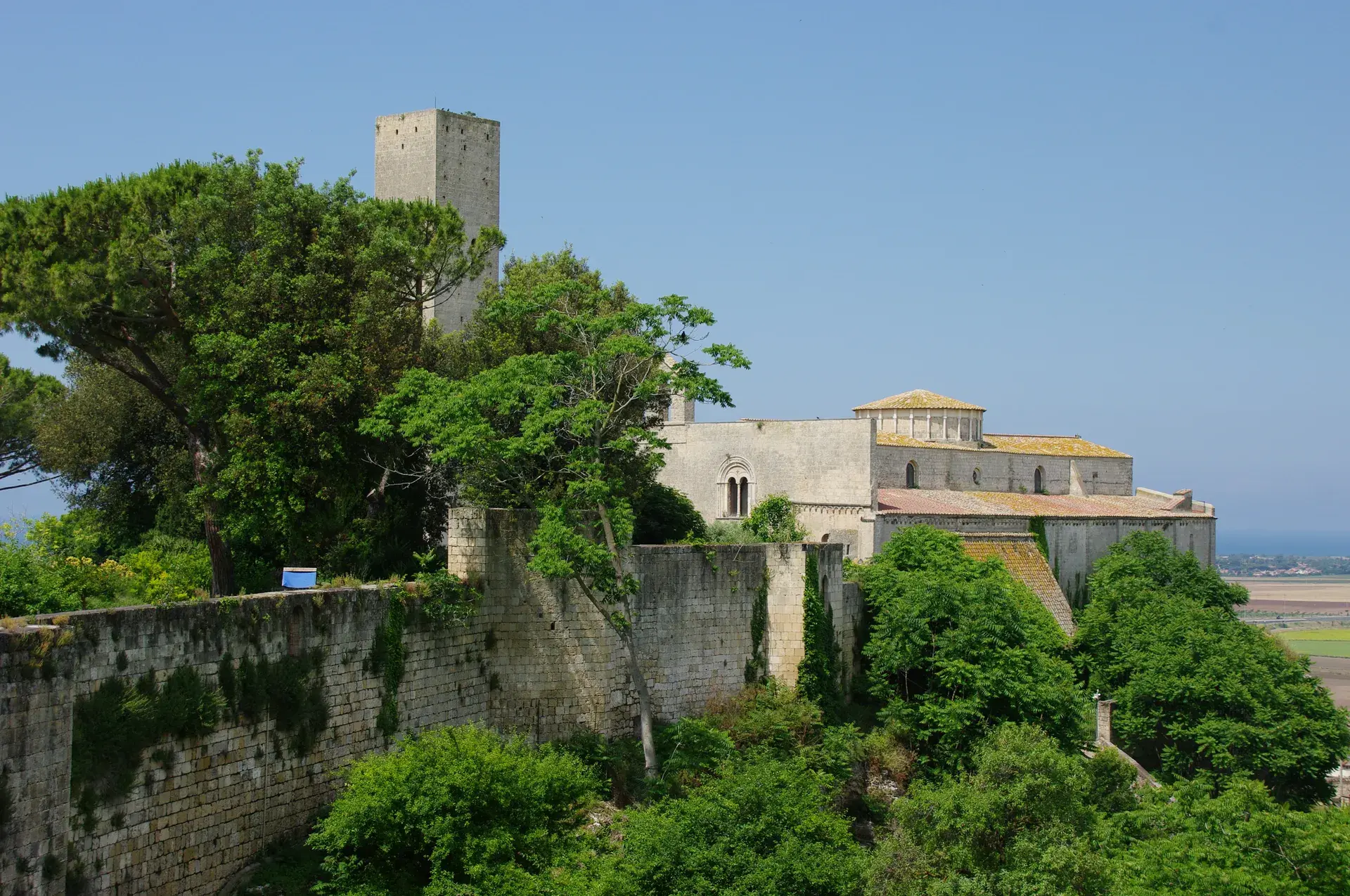
Rising more than 30 meters above the western rocky edge of Tarquinia along Via di Porta Castello, the Torrione Matilde di Canossa—also referred to as the Torrione del Castello—is a massive cylindrical gate tower. The structure was constructed from regular ashlar blocks of local macco, a warm-toned, whitish-yellow calcarenite sandstone quarried throughout the region. The upper rim of the tower is defined by projecting stone corbels designed to support elevated defensive machicolations.
The tower anchors a specialized military entrance known historically as la resechata, meaning the cutoff or resection. Rather than offering a direct passage, the gate incorporates a staggered bayonet defensive system flanked by stone curtain walls and a square tower. This layout forced approaching attackers through sharp, blind right-angle turns within a narrow corridor. The configuration completely neutralized charging momentum and made battering rams impossible to deploy against the inner gate. Immediately past this fortified choke point stands an imposing noble tower measuring 43 to 45 meters in height, which ranks as the tallest surviving medieval tower in Tarquinia.
The Vitelleschi Fortification and La Resechata
Although long associated with earlier medieval periods in local folklore, archival documentation confirms that the extant circular bastion and its integrated gate system were built between 1436 and 1439. The project was commissioned by the papal commander Cardinal Giovanni Vitelleschi, who governed Corneto (the historic name of Tarquinia) during a major era of urban reconfiguration.
Cardinal Vitelleschi designed la resechata for internal defense rather than external invasion. The primary purpose of the complex was to cordon off and isolate the older, depopulated Castello quarter from the developing town center. Today, the monument still stands at the architectural dividing line between central Tarquinia's dense medieval street network and Castrum Corgnetum, the early promontory settlement established following the decline of ancient Etruscan-Roman Tarquinia.
The Misattributed Legend of Countess Matilda
The tower's popular name references Countess Matilda of Tuscany, under whose authority Corneto fell around 1080. Early medieval records documented a now-vanished palace within the castle district associated with her administration, which local oral tradition eventually conflated with the surviving circular tower.
Historically, this attribution is impossible. Countess Matilda died in 1115, more than three centuries before Cardinal Vitelleschi erected the 15th-century artillery-era gatehouse. Despite the factual gap, the romantic association with the Countess of Canossa persisted through centuries of local naming.
Modern Access and Valley Panoramas
Today, Porta Castello functions as a public pedestrian portal linking the town center to the open precinct of Santa Maria in Castello. Progressing through the narrow, high-walled, shaded corridor of la resechata underneath the massive curved stone tower leads to an abrupt visual opening onto the broad clifftop plateau, with panoramic views over the Marta River valley.
The structure is maintained as a civic monument. While the gateway remains an open thoroughfare, access to the upper fortifications and the elevated wall walkways overlooking the valley is managed through scheduled and on-request visits arranged with the Tarquinia Municipal Tourist Office at the Barriera San Giusto InfoPoint.
FAQ
When was the Torrione Matilde di Canossa built?
Archival evidence confirms the extant circular tower and its gate complex were constructed between 1436 and 1439 under the patronage of Cardinal Giovanni Vitelleschi.
Why is the tower named after Matilda of Canossa?
The name stems from local tradition recalling that Corneto was subject to Countess Matilda of Tuscany around 1080. However, Matilda died in 1115, more than 300 years before the current tower was erected.
What was the purpose of the bayonet defensive gate?
The bayonet gate design forced attackers through sharp, blind right-angle turns between high stone walls, eliminating charging momentum and preventing the deployment of battering rams.
Can the tower and walkways be visited?
The gate serves as a public pedestrian route, while access to the elevated fortifications and valley walkways can be arranged via scheduled or on-request visits through the Tarquinia Municipal Tourist Office.