Escadas Monumentais: Coimbra's Historic Staircase
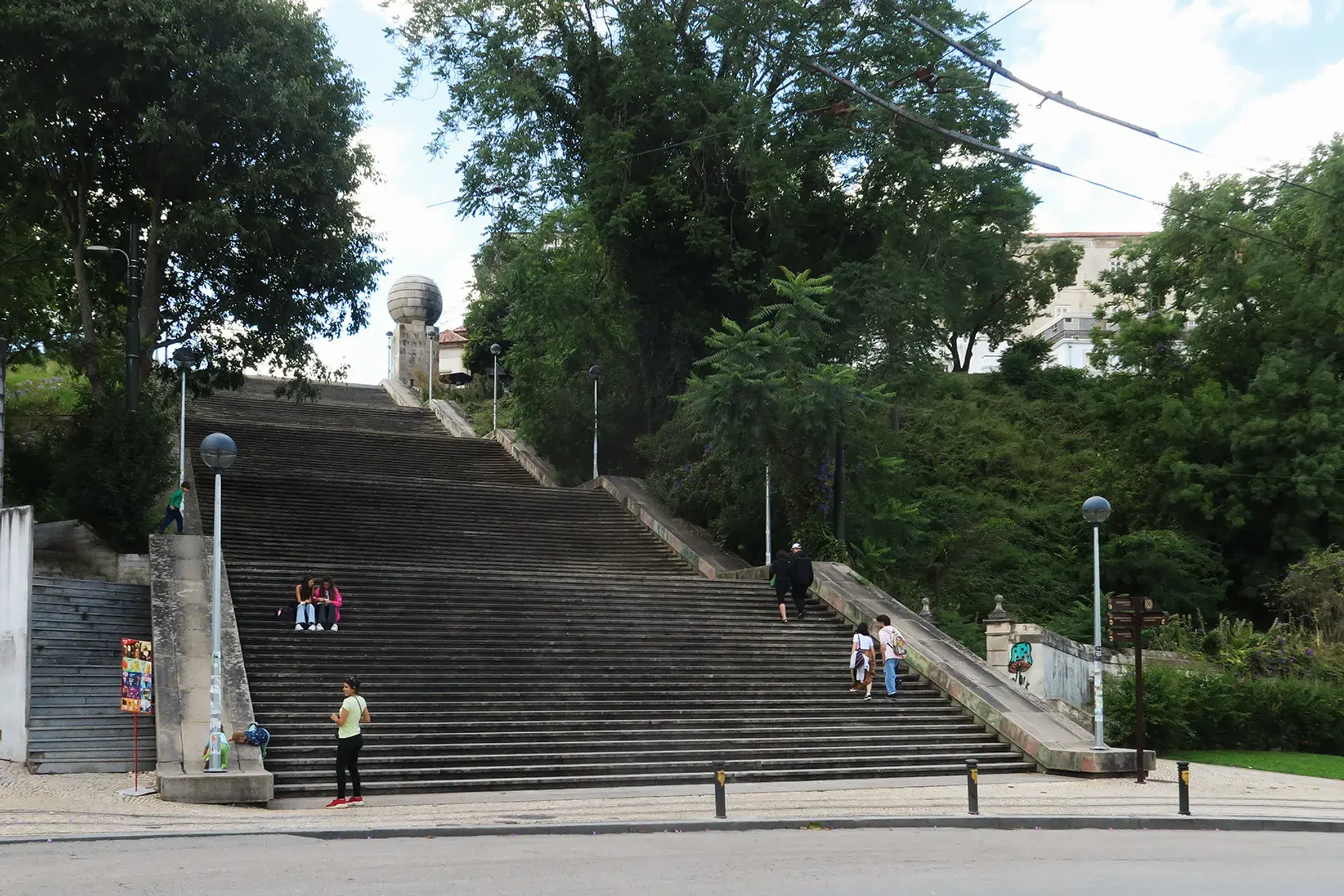
The Escadas Monumentais serve as a prominent geographic and cultural bridge in Coimbra, linking the 19th-century civic areas near Praça da República to the UNESCO World Heritage-designated historic university core at the top of the hill. Consisting of 125 exposed stone steps arranged in five flights of 25, the staircase demands physical exertion that emphasizes the abrupt vertical transition from the street-level urban rhythm to the stark, windswept stone plateaus of the university summit.
A Controversial Monument of the Estado Novo
Despite the centuries-old history of the university campus, this centerpiece staircase is a relatively modern 20th-century intervention. Constructed between the 1940s and 1960s under the authoritarian Estado Novo regime, the massive urban redevelopment project was overseen by architects Cottinelli Telmo and Luís Cristino da Silva.
To create an austere fascist-era university precinct, the regime entirely erased the medieval and early modern street grid that stood on the site until the 1940s. The construction demolished a centuries-old residential neighborhood and the final arch of the historic São Sebastião aqueduct. The new structure replaced the smaller, tree-lined Escadas do Liceu, acting as an architectural instrument of state power designed to emphasize physical separation, symmetry, and an imposing ascent to knowledge.
Epicenter of the 1969 Academic Crisis
While intended as a symbol of state authority, the staircase eventually transformed into a platform for resistance. During the Academic Crisis (Crise Académica) of April 1969, the Escadas Monumentais became an epicenter of student defiance against the dictatorship and the colonial war. The stone steps witnessed massive student assemblies as well as violent police baton charges, forever cementing the site's role in Portugal's political history.
Academic Traditions and Student Folklore
Today, the stairs function as an everyday arterial commuting route for students, faculty, and locals traveling between residential hubs and university departments at Praça D. Dinis. Beyond daily transit, the staircase remains an active gathering point for the university's academic welcoming rituals, known as the praxe.
A rich body of student folklore surrounds the Escadas Monumentais. Academic tradition holds that the five tiers of 25 steps represent the five years of traditional university degree courses. During the praxe, senior students frequently order incoming freshmen (caloiros) to climb and descend the staircase repeatedly while counting out every single step. Furthermore, a popular campus superstition warns that the number of times a student stumbles or trips while climbing the stairs predicts the exact number of exam subjects (cadeiras) they will fail during that academic year.
FAQ
How many steps are in the Escadas Monumentais?
The Escadas Monumentais consist of 125 stone steps, which are arranged in five tiers of 25 steps each.
When were the Escadas Monumentais built?
The staircase was constructed between the 1940s and 1960s during the Estado Novo regime. The design was overseen by architects Cottinelli Telmo and Luís Cristino da Silva.
What student traditions take place on the staircase?
The staircase is a central location for the university's academic welcoming rituals (praxe), where freshmen are often ordered to climb and count the steps. Additionally, campus folklore dictates that stumbling on the stairs predicts the number of exam subjects a student will fail that year.