Porta e Torre de Almedina: Coimbra's Historic Gate
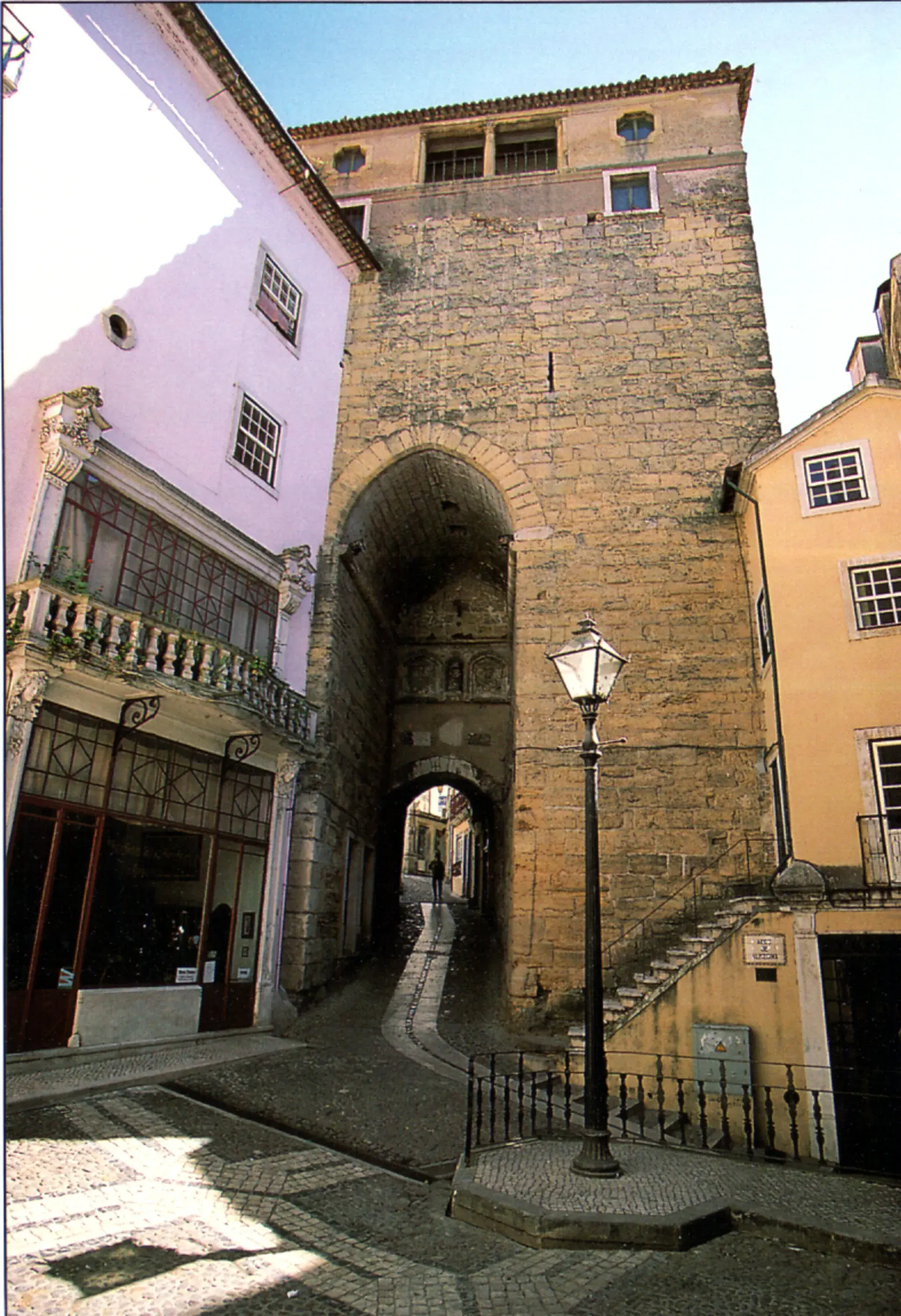
The imposing medieval stone masonry and defensive architecture of Porta e Torre de Almedina loom over the street below. This ancient stone boundary perfectly divides the two halves of Coimbra's history: the riverside merchant district below, and the steep scholarly hill above.
A Boundary Between Two Worlds
The complex consists of the Almedina Gate (Porta de Almedina), the defensive Torre de Almedina built directly over the vaulted gateway, and the outer Porta da Barbacã entrance. Located on Rua Ferreira Borges, it is the primary surviving medieval gate of Coimbra's ancient fortified circuit.
The gate serves as a critical physical and thematic transition point. It bridges the flat, riverside merchant district, known as the Baixa, with the steep, scholastic, and religious hill of the Alta, which leads toward the Old Cathedral and the University. The name itself derives from the Arabic 'al-madīna', meaning 'the city', and the site was classified as a National Monument in 1910.
Centuries of Architectural Evolution
Originally, the gate served as the primary entrance to the Moorish walled settlement. Following the 1064 Christian capture of Coimbra by Fernando I of León, Mozarabic governor Count Sesnando Davides reorganized the city's defensive line to secure the area.
The structure underwent significant fortification and structural overhauls in the 14th century under King Fernando I, and again in the early 16th century during the reigns of Kings Manuel I and João III. Curiously, the outer barbican arch was originally a Moorish horseshoe arch. During later remodelings, stonecutters trimmed back the lower springers to create a slightly pointed, rounded profile.
The Tower of Municipal Power
From the late Middle Ages into the 19th century, the Torre de Almedina transitioned from a purely military structure into the seat of municipal power. It was adapted into the town hall and court, earning the alternative historic name Torre da Relação.
Atop the tower hangs a municipal bell, known as 'o sino de correr'. From the Middle Ages until 1870, this bell governed daily life in Coimbra. It rang to signal night curfews, the official opening and locking of the town gates, and the start of municipal council sessions. In later years, the tower also housed the Free School of Drawing Arts and the Municipal Historical Archive.
Crossing the Threshold Today
The physical passage transitions dramatically from the bright, flat commercial street of Rua Ferreira Borges into a dark, vaulted stone tunnel. Inside the barrel-vaulted arch, a 16th-century Renaissance high-relief stone carving of the Virgin and Child, attributed to the workshop of João de Ruão, rests overhead.
Passing directly through the inner gate leads to Rua do Quebra-Costas. Translated as 'Back-Breaker Street', this path was humorously named for its steep incline, stone stairs, and historically slick cobblestones. Today, the tower itself houses the Walled City Interpretation Centre, part of the Coimbra Municipal Museum, which features historical exhibitions and scale models of the medieval defensive perimeter.
FAQ
What does the name Almedina mean?
The word derives from the Arabic term 'al-madīna', which translates to 'the city'. It was historically used to designate the fortified medieval urban core of Coimbra.
What is inside the Torre de Almedina today?
The tower operates as the Walled City Interpretation Centre, a branch of the Coimbra Municipal Museum. It features historical exhibitions and scale models showcasing Coimbra's medieval defensive walls.
Why is the street behind the gate called Rua do Quebra-Costas?
Translating to 'Back-Breaker Street', the route earned its humorous name due to its severe incline, stone stairs, and cobblestones that were historically very slick.