Cathedral of Évora: Portugal's Fortress Church
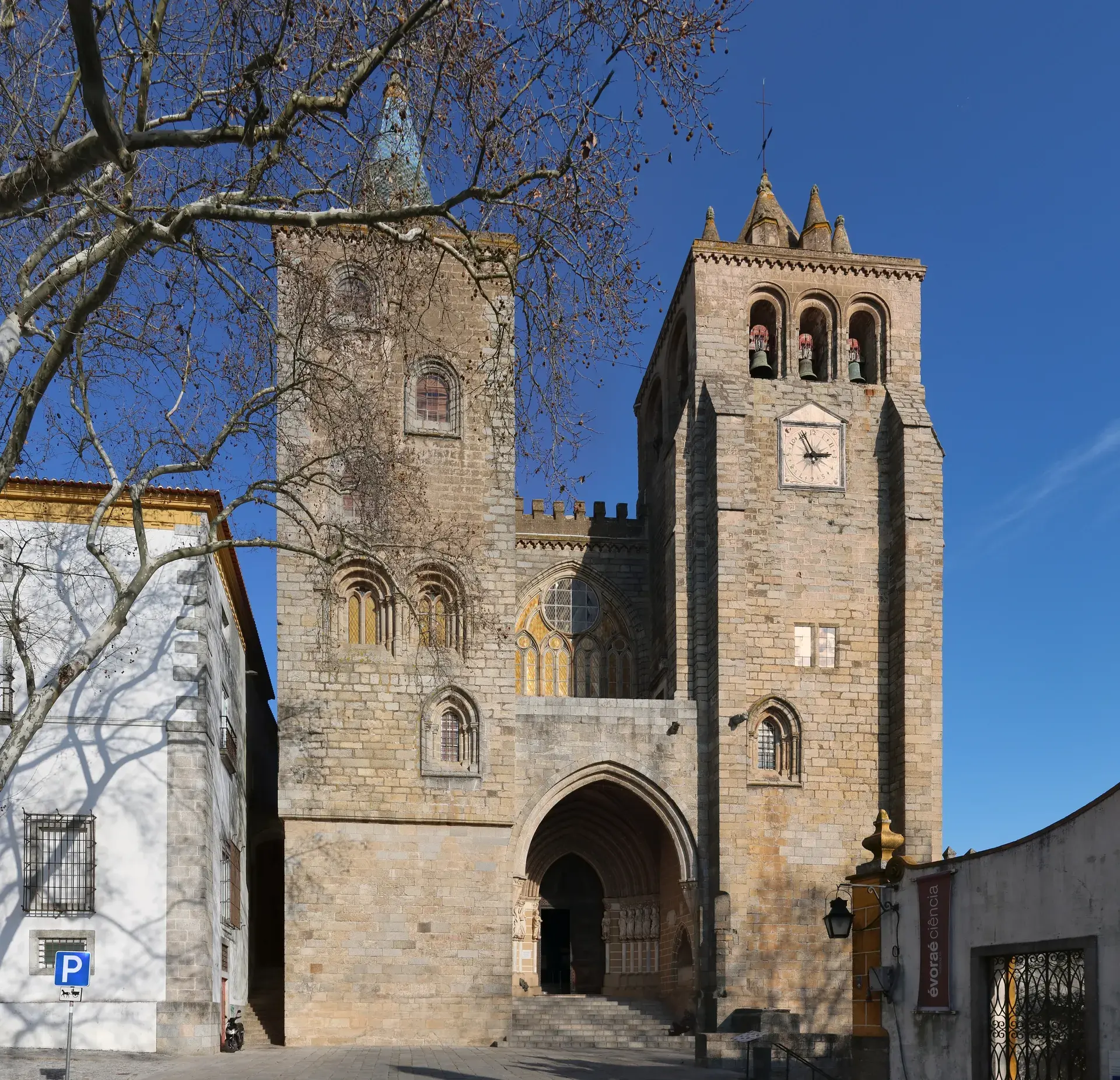
The Basilica Cathedral of Our Lady of the Assumption, commonly known as the Cathedral of Évora, is the largest medieval cathedral in Portugal. Located at the highest point of Évora's historic center, this massive granite fortress-church dominates the city's skyline with its jagged battlements and soaring asymmetrical towers.
A History of Conquest and Expansion
Following the capture of Évora from Islamic rule by Geraldo Sem Pavor in 1166, construction of a Christian cathedral began in 1186 on the site of the city's former main mosque. The initial Romanesque structure was consecrated in 1204 and completed around 1250. Between 1280 and 1340, the building expanded into an early Gothic design, which included a cloister added by Bishop D. Pedro.
Centuries later, King João V commissioned a high Baroque remodeling of the main presbytery. Executed between 1718 and 1746 by royal architect João Frederico Ludovice, the redesign utilized polychrome marble from nearby Estremoz.
Fortress Architecture and Gothic Details
Built primarily from thick, local granite, the cathedral features machicolations and defensive walls that give it the appearance of a medieval military stronghold. The western facade is flanked by two distinct towers: a southern clock and bell tower with a tile-covered conical spire, and a northern fortified belfry.
The main Gothic entrance, known as the Apostles Portal, showcases rare 14th-century life-sized, free-standing marble sculptures carved by Master Pêro and Telo Garcia. Inside, an octagonal lantern tower, complete with stone "scales" and Gothic turrets, bathes the transept in light.
Rare Artifacts and Treasures
The cool, dim interior is supported by heavy, bare grey-granite pillars. Within the central nave stands a rare 15th-century polychrome stone statue of the Virgin Mary depicted visibly pregnant (Nossa Senhora do Ó). This explicit depiction is an uncommon surviving example, as such artwork was largely suppressed after the Renaissance.
The cathedral is also steeped in local historical tradition, which claims that the heraldic flags of Vasco da Gama's fleet were blessed inside the presbytery in 1497 before his voyage to India. Additionally, the Sacred Art Museum in the tower houses a 13th-century French carved ivory triptych of the Virgin and Child, along with a True Cross reliquary adorned with over 1,400 gemstones.
Rooftop Views and City Context
The cathedral serves as an active Catholic church and a central cultural attraction in Évora. Tiered ticketing provides access to the nave, the Gothic cloister, the museum, and the roof. A 135-step spiral staircase leads up to an open, paved granite roof deck. This vantage point offers broad panoramas over Évora's whitewashed rooftops, its defensive walls, and the surrounding Alentejo plains. Situated next to the Roman Temple and the Évora Museum, the cathedral is a monumental religious anchor for the historic upper district.
FAQ
What makes the Cathedral of Évora's architecture unique?
Built primarily of local granite, the cathedral features thick walls and jagged battlements that give it the appearance of a medieval military fortress, while blending Romanesque, early Gothic, and Baroque architectural styles.
What rare artifacts can be found inside the Cathedral of Évora?
The cathedral houses a rare 15th-century statue of a visibly pregnant Virgin Mary (Nossa Senhora do Ó), 14th-century marble sculptures of the Apostles, and a 13th-century French carved ivory triptych.
Can visitors go to the roof of the Cathedral of Évora?
Yes, visitors can climb a 135-step spiral staircase to access an open granite roof deck, which offers panoramic views of Évora's historic center and the surrounding Alentejo plains.