Roman Temple of Évora: History & Architecture
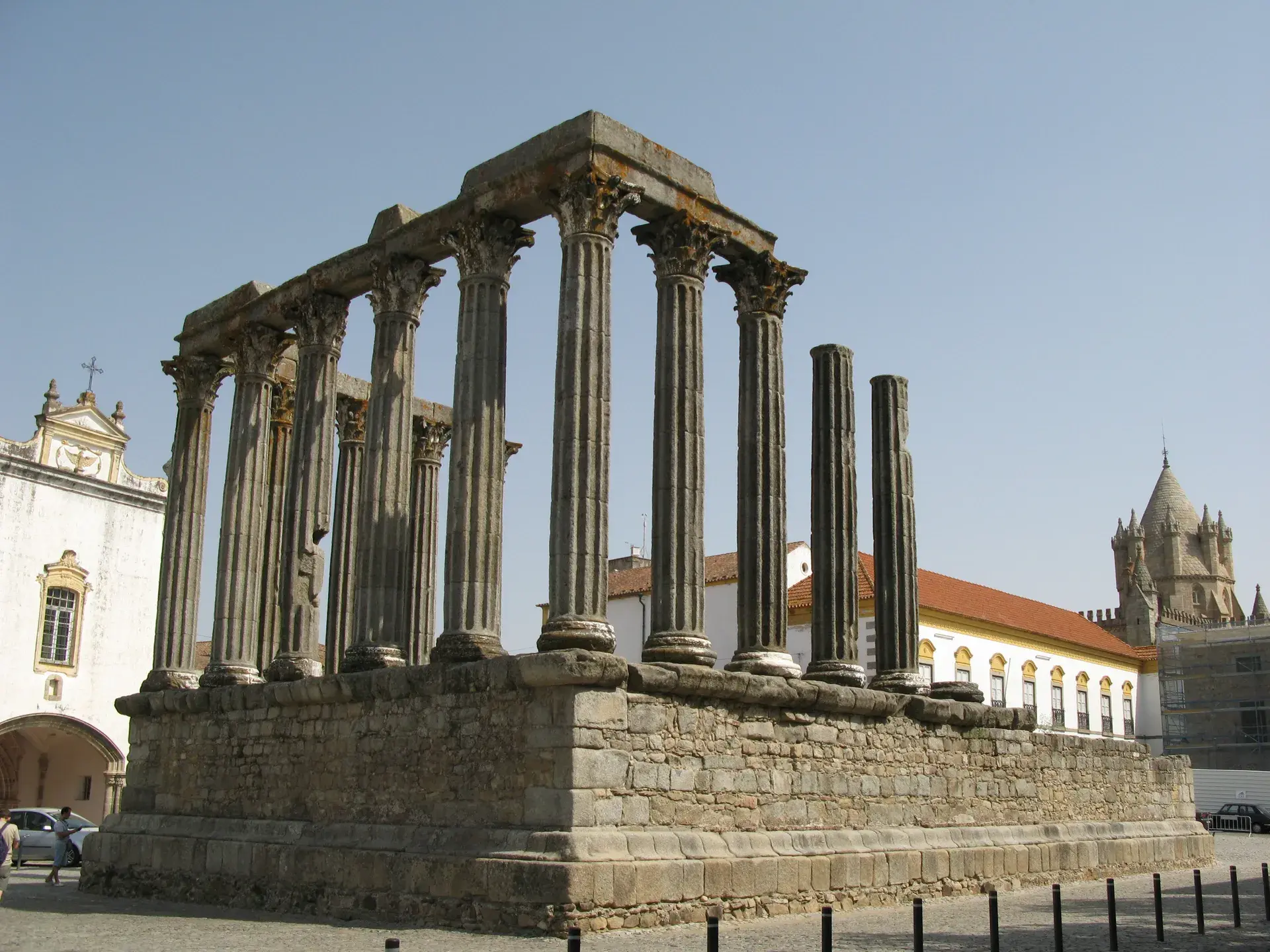
The striking granite and marble columns of this 1st-century Roman temple were built to honor Emperor Augustus. Situated at the highest point of Évora's historic center, the Roman Temple of Évora anchors the city's civic acropolis. Built in the early 1st century CE during the Augustan era, the structure originally served as the central religious sanctuary of the Roman forum in Liberalitas Iulia. Today, it stands as a prominent feature of Évora's UNESCO World Heritage Site designation.
Architectural Splendor of the Augustan Era
The monument is a hexastyle Corinthian-style temple constructed on an elevated rectangular granite podium measuring roughly 25 by 15 meters. Fourteen of its original columns remain standing. A striking visual contrast defines the structure: the column shafts are carved from coarse, dark grey Alentejo granite, while the ornate Corinthian capitals and architrave bases are crafted from creamy-white Estremoz marble.
Archaeological excavations have revealed that the temple was originally surrounded by a large water basin or reflecting pool, which would have amplified the grandeur of the sanctuary during antiquity.
The Slaughterhouse Paradox
The Roman Temple of Évora is widely considered one of the best-preserved Roman ruins on the Iberian Peninsula. Its exceptional preservation is not due to reverence, but rather its pragmatic repurposing over the centuries.
After suffering damage during 5th-century Germanic invasions, the ruin was eventually incorporated into the fortifications of Évora Castle during the Middle Ages. The spaces between the imposing columns were filled with masonry, and the top was fitted with crenellations. From the 14th century until 1836, this walled-up structure served a variety of utilitarian roles, including a castle stronghouse, a wood depot, and most notably, a municipal slaughterhouse and butcher shop.
Enclosing the columns protected the stones from being looted by later builders, a genuine threat considering King Afonso V explicitly authorized the removal of stone from the site in 1467 for other defensive works in the city.
Uncovering the Roman Monument
The temple as it is seen today is the result of an extensive romantic-era restoration. Between the 1840s and 1871, Joaquim António da Cunha Rivara and architect Giuseppe Cinatti led efforts to dismantle the medieval infill walls and reveal the ancient Roman columns beneath.
Today, the monument sits proudly in the pedestrianized Largo Conde de Vila Flor, neighboring essential landmarks like the Évora Cathedral and the Évora Museum. The ruin is free to view at all times and features dramatic illumination at night. While observers are welcome to approach the perimeter of the structure, climbing the elevated stone podium is strictly prohibited to protect the historic site.
The Legend of Diana
For centuries, the monument has been colloquially referred to as the "Temple of Diana." However, this popular name is not supported by archaeological evidence. The moniker stems from a 17th-century legend that incorrectly linked the structure to the Roman goddess of the hunt, despite historical consensus confirming its dedication to the imperial cult of Augustus.
FAQ
Why is it called the Temple of Diana?
The name "Temple of Diana" comes from a 17th-century legend linking the site to the Roman goddess of the hunt. However, archaeological evidence shows the temple was actually dedicated to the imperial cult of Emperor Augustus.
Can visitors go inside the Roman Temple of Évora?
Observers can walk up to the perimeter of the monument at any time, but climbing onto the elevated stone podium is strictly prohibited to preserve the ancient ruins.
How did the Roman Temple of Évora survive so intact?
The temple survived because it was incorporated into the medieval Évora Castle and its columns were walled up with masonry. For nearly 500 years, the enclosed structure was used as a municipal slaughterhouse, which largely protected its ancient stones from being dismantled and looted.