Guimarães Castle: Birthplace of Portugal
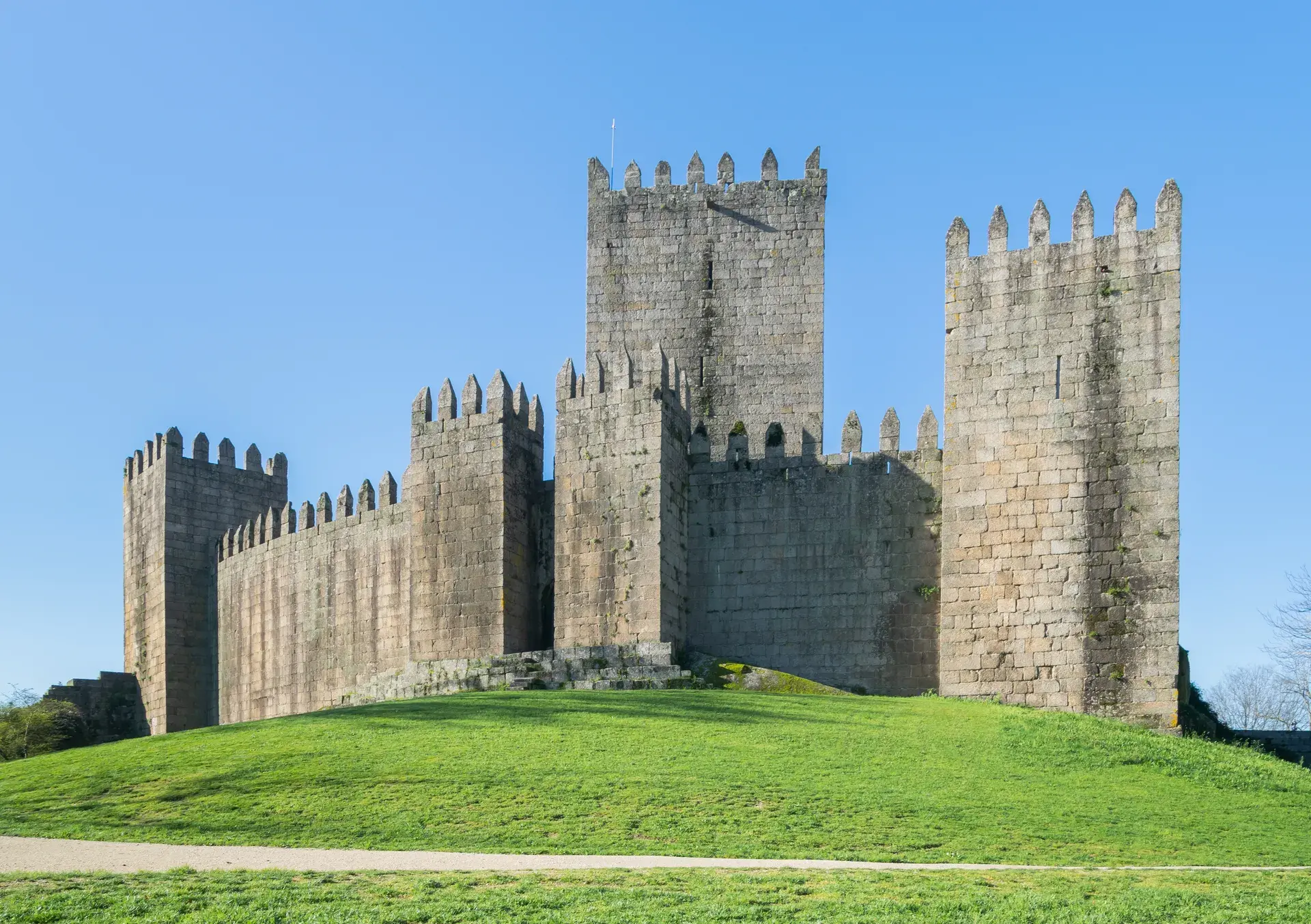
Visitors gaze up at the sturdy stone walls and battlements of this hilltop Romanesque fortress linked to the birth of Portugal's first king. Anchoring the Sacred Hill at the northernmost point of the Guimarães historic center, Guimarães Castle is the physical embodiment of the city's motto: Aqui nasceu Portugal (Here Portugal was born).
A Foundational Stronghold
The fortress was first established around 958 by Countess Mumadona Dias to protect the nearby monastery of Santa Maria from Moorish and Viking incursions. It was later rebuilt and reinforced in stone during the late 11th and early 12th centuries under Count Henry of Burgundy and Teresa of León, eventually serving as the defensive anchor and residence for the rulers of the County of Portugal.
The Birth of a Nation
On June 24, 1128, the castle served as the military base for Dom Afonso Henriques during the Battle of São Mamede. His decisive victory over his mother's allied forces paved the way for Portuguese sovereignty. While local tradition strongly asserts that Afonso Henriques was born inside the castle walls, historians still actively debate whether his birth occurred there or elsewhere in the region. The adjacent 12th-century Romanesque Chapel of São Miguel do Castelo is also held by tradition as the site of his baptism.
Architectural Evolution and Restoration
The castle features a pentagonal perimeter, eight rectangular crenellated towers, and a towering central keep known as the Torre de Menagem. Its severe, tooth-edged granite battlements gained their current Gothic form in the late 13th century under the reigns of King Afonso III and King Dinis. Tradition even connects the fortress to the castle charges depicted on the Portuguese national coat of arms.
As Portugal's borders expanded south during the Reconquista and firearms rendered medieval walls obsolete, the castle lost its strategic value by the late 15th century. It intermittently served as a 16th-century prison before falling into decay. Its pristine medieval silhouette seen today is largely the result of an ideological reconstruction undertaken between 1936 and 1940 by the Estado Novo regime for national centenary celebrations.
Exploring the Monument
Today, Guimarães Castle operates daily as a ticketed monument and museum under Museus e Monumentos de Portugal. It was classified as a National Monument and integrated into the Guimarães UNESCO World Heritage Site in 2001. Visitors can explore rough-hewn granite masonry, compact vaulted passages inside the central keep exhibition, and exposed stone foundations across the Armoury Square (Praça de Armas). The upper wall walk offers panoramic sightlines overlooking the tile roofs of the medieval city, the Minho countryside, and the neighboring Palace of the Dukes of Bragança.
FAQ
Was the first King of Portugal born in Guimarães Castle?
Local tradition claims Afonso Henriques was born inside the castle, but historians actively debate whether his birth occurred there, in Viseu, or elsewhere in the region.
Can visitors go inside Guimarães Castle?
Yes, it operates daily as a ticketed monument. Visitors can explore the central keep exhibition, the Armoury Square, and traverse the outer ramparts and battlements.
When was Guimarães Castle built?
The original structure was established around 958 by Countess Mumadona Dias. It was later rebuilt in stone in the late 11th and early 12th centuries, gaining its Gothic additions in the late 13th century.