Fraumünster Zurich: History, Spire, & Stained Glass
Architectural Presence on the Limmat
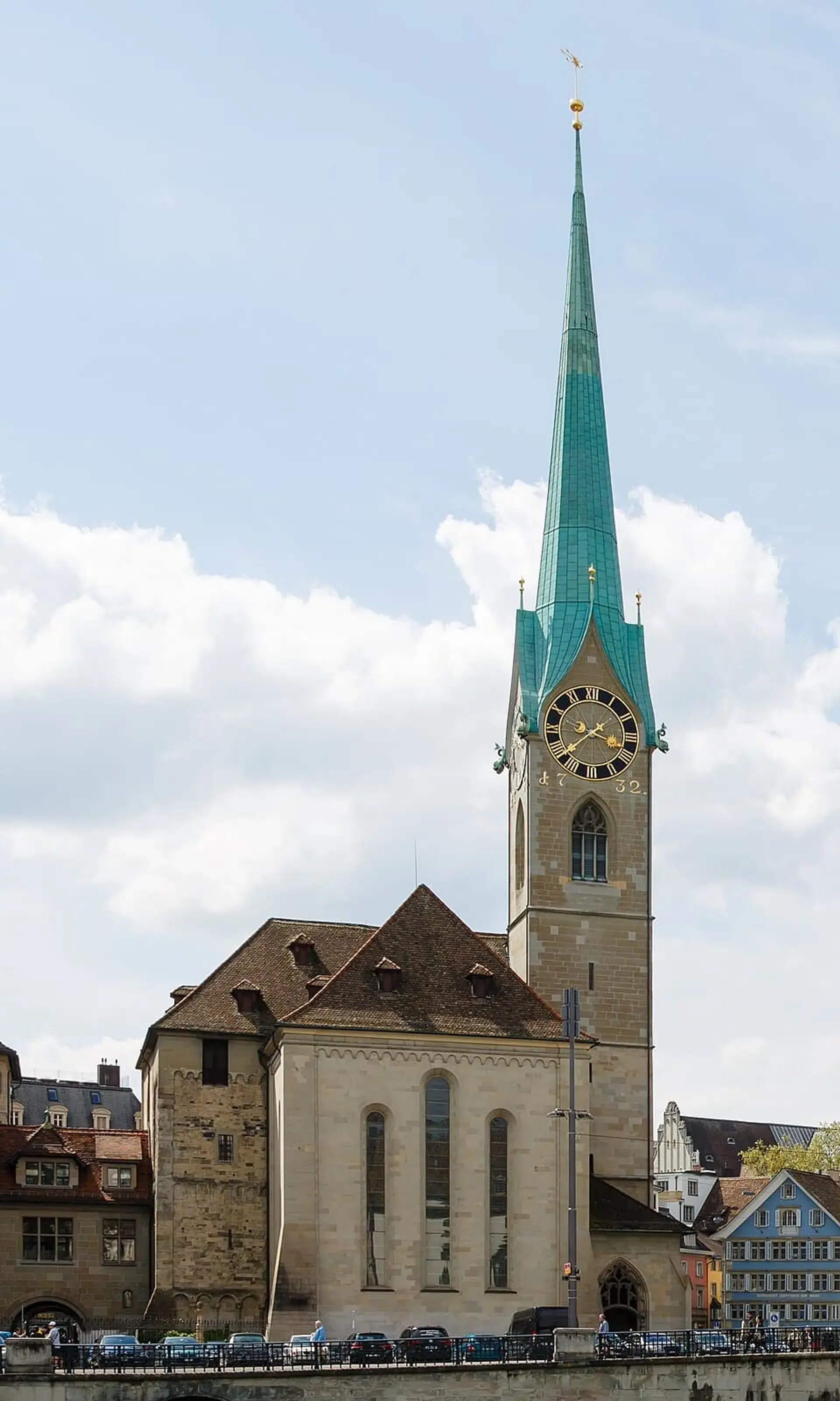
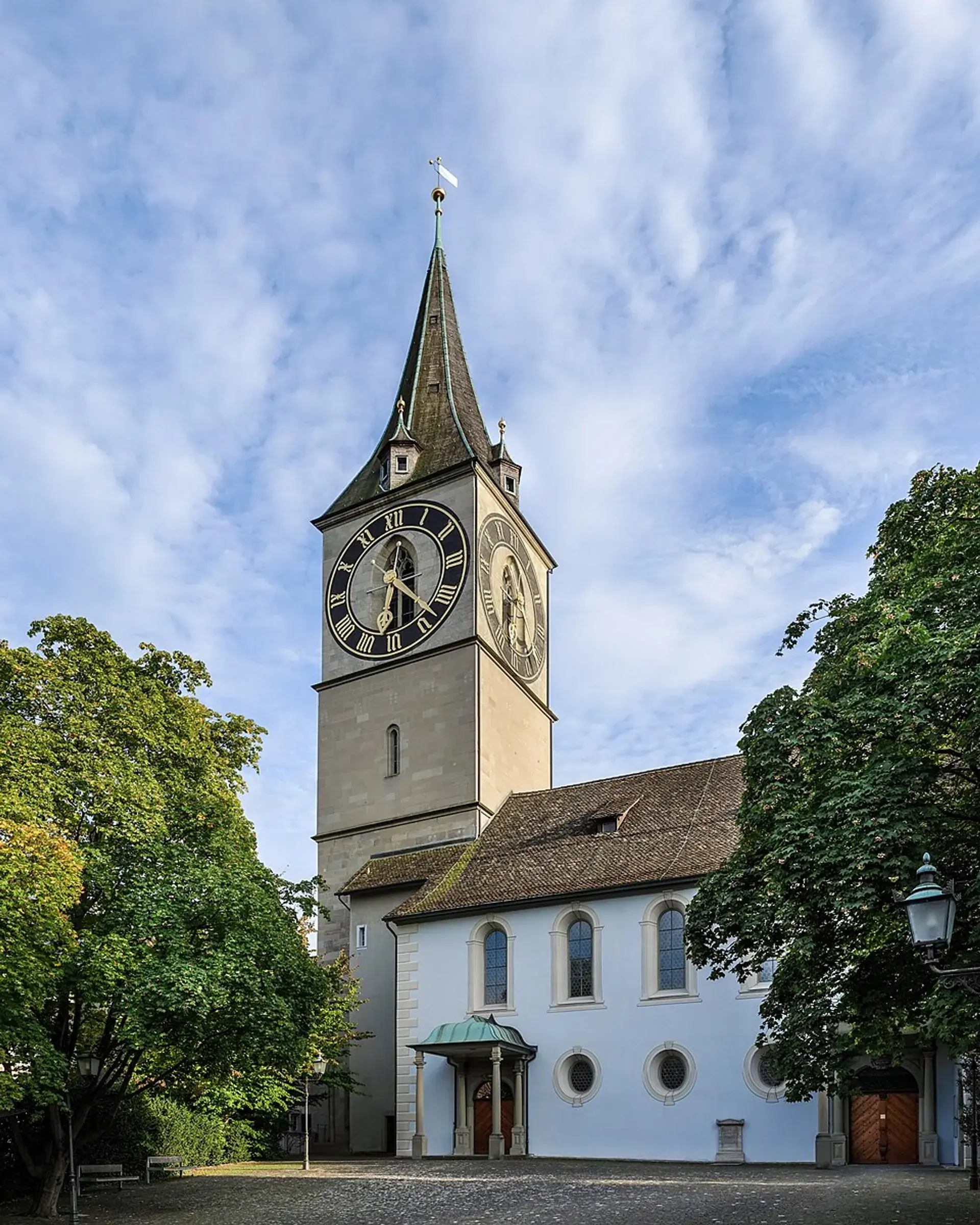
Rising above the western bank of the River Limmat, Fraumünster is an essential landmark within Zürich’s historic core. Its slender, copper-clad spire forms an unmistakable silhouette against the skyline, standing in visual dialogue with the twin towers of Grossmünster directly across the river. Together with St. Peter’s Church and the Predigerkirche, Fraumünster defines the four-tower panorama of Zürich's Old Town (Altstadt).
The church anchors the broad open pavement of Münsterhof, one of the city's primary historic squares. Because restoration projects and maintenance scaffolding periodically encase historic stone facades across the city, visitors often focus first on the church's impressive exterior setting. The open views across the Münsterbrücke, the reflections on the Limmat, and the church's 13th-century Romanesque choir and Gothic transept offer rich perspectives even when exterior walls undergo preservation work.
Imperial Foundations and Medieval Governance
Fraumünster originated in 853 AD, founded by King Louis the German, a grandson of Charlemagne, as an imperial Benedictine convent for aristocratic women. Hildegard, the king’s daughter, was installed as the convent's first abbess.
During the Middle Ages, the abbey’s influence extended far beyond religious life. In 1045, Holy Roman Emperor Henry III granted Fraumünster the authority to hold markets, collect tolls, and mint coins. These privileges elevated the presiding abbess to the de facto secular and economic ruler of Zürich. Emperor Frederick II reaffirmed this independence in 1218 by granting the abbey imperial immediacy (Reichsunmittelbarkeit), making it answerable directly to the Holy Roman Emperor.
The abbey’s political dominance began to wane in 1336 with the adoption of Rudolf Brun’s guild constitution, which established Zürich’s first independent mayoralty. Two centuries later, the Swiss Reformation arrived under the leadership of Huldrych Zwingli. On November 30, 1524, the final abbess, Katharina von Zimmern, dissolved the convent by formally surrendering its keys, properties, and rights to the Zürich city council to avoid civil conflict. Following the dissolution, Catholic furnishings and altars were cleared away. In 1898, the former convent quarters were dismantled to make room for Zürich’s new Stadthaus, though the church itself and elements of its Romanesque cloister were carefully preserved.
Cloister Murals and the Founding Legend
In the cloister connecting the church to the Stadthaus, visitors can examine a fresco cycle painted by Swiss artist Paul Bodmer between 1924 and 1934. The murals illustrate the traditional medieval founding legend of the church.
According to local lore, King Louis the German’s daughters, Hildegard and Bertha, routinely traveled through dark woods to pray at the Grossmünster. A white stag with glowing antlers appeared to guide them through the wilderness, stopping at a marshy meadow beside the Limmat. Recognizing the encounter as a divine instruction, the king commissioned the abbey on the exact location where the stag rested.
Interior Stained Glass and the Crypt
While Fraumünster is visible from many vantage points throughout the city, entering the church interior is an optional, ticketed experience that remains subject to closure during services or private events. Inside, a strictly observed whisper policy maintains an echoing quiet over the stone floors. The interior also houses the largest pipe organ in the Canton of Zurich, featuring 5,793 pipes.
The church is celebrated internationally for its 20th-century stained glass. In the north transept stands Augusto Giacometti’s 1945 window, Heavenly Paradise. In the Romanesque choir, five monumental vertical stained-glass windows designed by Marc Chagall were installed in 1970. Chagall was already in his eighties when he accepted the project, and in 1978 he contributed an additional rose window to the south transept. Beneath the choir floor rests the 9th-century Carolingian crypt. Walled off and sealed in 1900, it was reopened to the public in 2016 as a museum exhibition displaying the archaeological foundations of the original abbey.
Visiting Fraumünster
Fraumünster serves as an active parish church within the Evangelical Reformed Church of the Canton of Zurich and frequently hosts organ recitals, choral performances, and sacred concerts. For sightseers, entry requires a ticket fee of CHF 5, which covers an audio guide, access to the nave, and entry to the underground crypt museum. The building typically opens daily from 10:00 to 18:00 during summer months and closes at 17:00 in the winter season, with Sunday visits commencing at noon following morning church services.
FAQ
What can be seen if Fraumünster is covered in scaffolding?
Visitors can still appreciate the church's setting on Münsterhof, views of its slender copper-clad spire, the historic bridge of Münsterbrücke, and panoramic vantage points of the Limmat river and Old Town skyline.
What are the famous stained-glass windows in Fraumünster?
The church features five choir windows and a south transept rose window designed by Marc Chagall, as well as the 1945 'Heavenly Paradise' window created by Augusto Giacometti in the north transept.
Is there an admission fee to enter Fraumünster?
Yes. Tourist admission costs CHF 5, which includes an audio guide and access to the interior and the subterranean Carolingian crypt museum.
Why was the abbess of Fraumünster historically important to Zurich?
In 1045, Holy Roman Emperor Henry III granted the abbey royal rights to collect tolls, hold markets, and mint coins, effectively placing secular and economic governance of Zürich in the hands of the abbess.