St. Peter’s Church: Europe’s Largest Clock Face
The Landmark Clock and Belfry
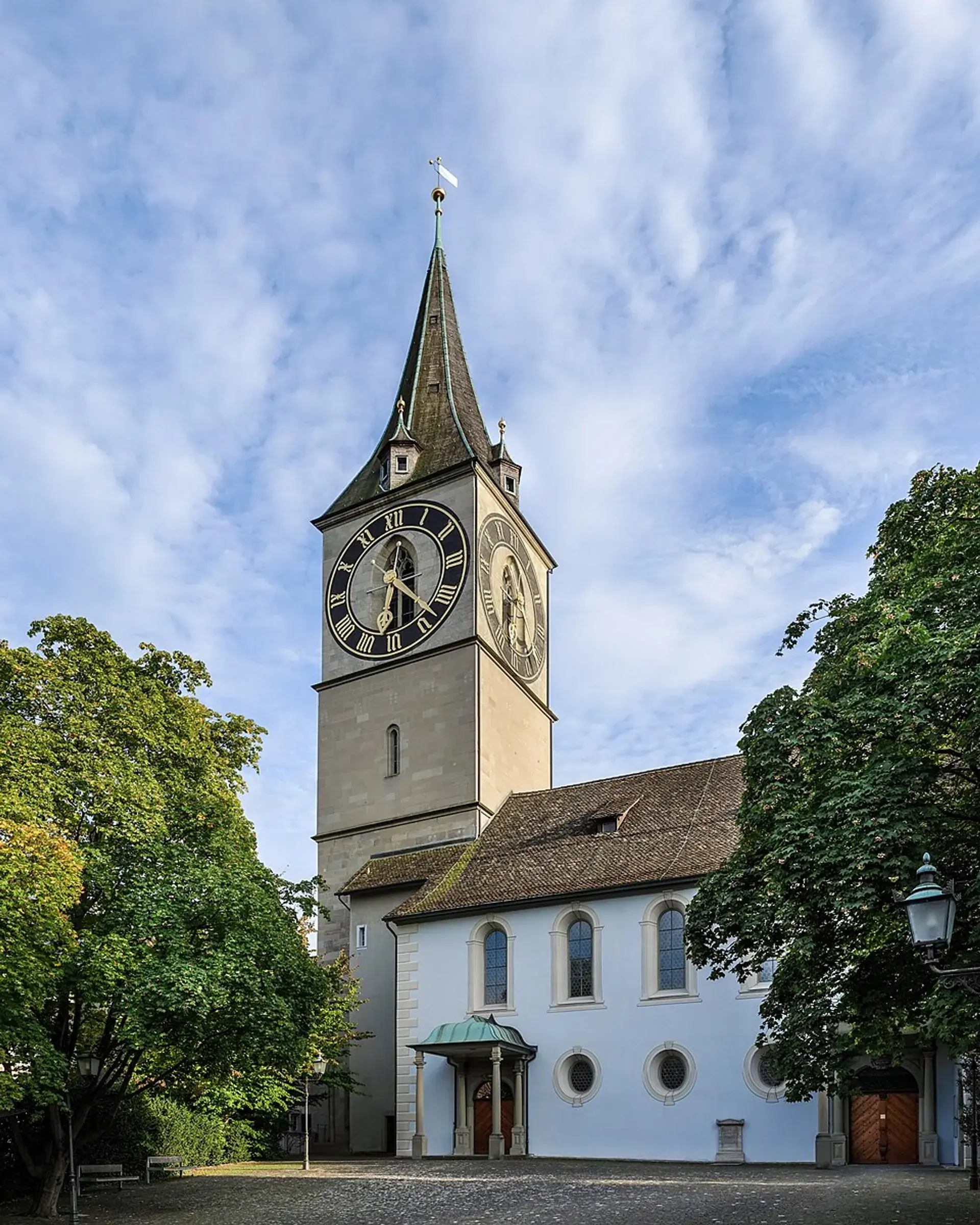
St. Peter’s Church (Kirche St. Peter) in Zürich features the largest church clock face in Europe. Mounted on its 64-metre-high medieval steeple, each of the four clock dials measures between 8.64 and 8.7 metres in outer diameter, with an hour hand measuring 5.07 metres and a minute hand measuring 5.73 metres. For centuries, this steeple clock served as Zürich’s official standard timekeeper, and municipal laws legally required all other public clocks across the city to calibrate against it.
The belfry directly beneath the spire houses five bells cast in 1880. The largest of these bronze bells weighs more than 6,000 kilograms without its clapper. In 1996, the 24-metre-high helm roof underwent a major restoration and was re-covered with 42,000 hand-split larch shingles sourced from the Engadine valley, making it the only wooden shingle roof in central Zürich.
Dual Civic and Religious Ownership
A distinct feature of St. Peter’s is its divided ownership structure. While the nave, belfry, and interior belong to the Evangelical Reformed parish, the tower itself is municipal property owned by the City of Zürich.
Because the steeple belonged to the municipality, it served as Zürich’s primary fire-watch station from 1340 until 1911. Dedicated fire guards were stationed in the tower around the clock to spot blazes across the city's timber and stone quarters and sound alarms.
Architectural Evolution and Civic Heritage
Located on the St. Peterhofstatt square on the left bank of the Limmat River, St. Peter’s is Zürich’s oldest civic parish church. Archaeological evidence confirms the presence of an early Christian sanctuary dating to the 8th or 9th century, with pre-Romanesque foundation walls still preserved beneath the choir. Successive structures were erected on the site around 1000 AD, around 1230 in a late-Romanesque style, and in 1460 with a Gothic nave.
Unlike the nearby Grossmünster and Fraumünster, which operated as collegiate and monastic institutions, St. Peter’s served as Zürich’s only parish church for ordinary citizens prior to the Protestant Reformation. In 1345, Zürich’s first independent guild mayor, Rudolf Brun, acquired the church; he was later buried there in 1360. During the Reformation, Leo Jud served as pastor from 1523 to 1542, collaborating with Huldrych Zwingli on the translation of the Zurich Bible. Later, theologian and writer Johann Kaspar Lavater ministered here from 1778 to 1801, and his grave marker remains set into the exterior wall.
In 1706, the medieval nave was demolished and reconstructed as a three-aisled Baroque hall, marking the first new Protestant church building erected in Zürich after the Reformation.
Contemporary Function and Access
Today, St. Peter’s Church remains an active congregation within the Evangelical Reformed Church of the Canton of Zürich, hosting regular Sunday worship and religious services. Along with the Grossmünster, Fraumünster, and Predigerkirche, its steeple stands as one of the four principal towers defining the Old Town skyline.
The church is open daily to the public without an admission charge. In addition to its parish role, the historic hall frequently serves as a venue for classical and sacred music concerts.
FAQ
How large is the clock face on St. Peter’s Church?
The four clock faces on the steeple each measure between 8.64 and 8.7 metres in diameter, making them the largest church clock faces in Europe.
Why does the City of Zürich own the tower of St. Peter’s Church?
The tower is owned by the municipality because it served as Zürich's official fire-watch station from 1340 to 1911, while the church nave, interior, and belfry belong to the Evangelical Reformed parish.
Is St. Peter’s Church open to visitors?
Yes, St. Peter’s Church is open daily to the public free of charge, operating as both an active place of worship and a concert venue.