Grossmünster: Zurich's Historic Twin-Towered Basilica
Origins and the Legend of Charlemagne
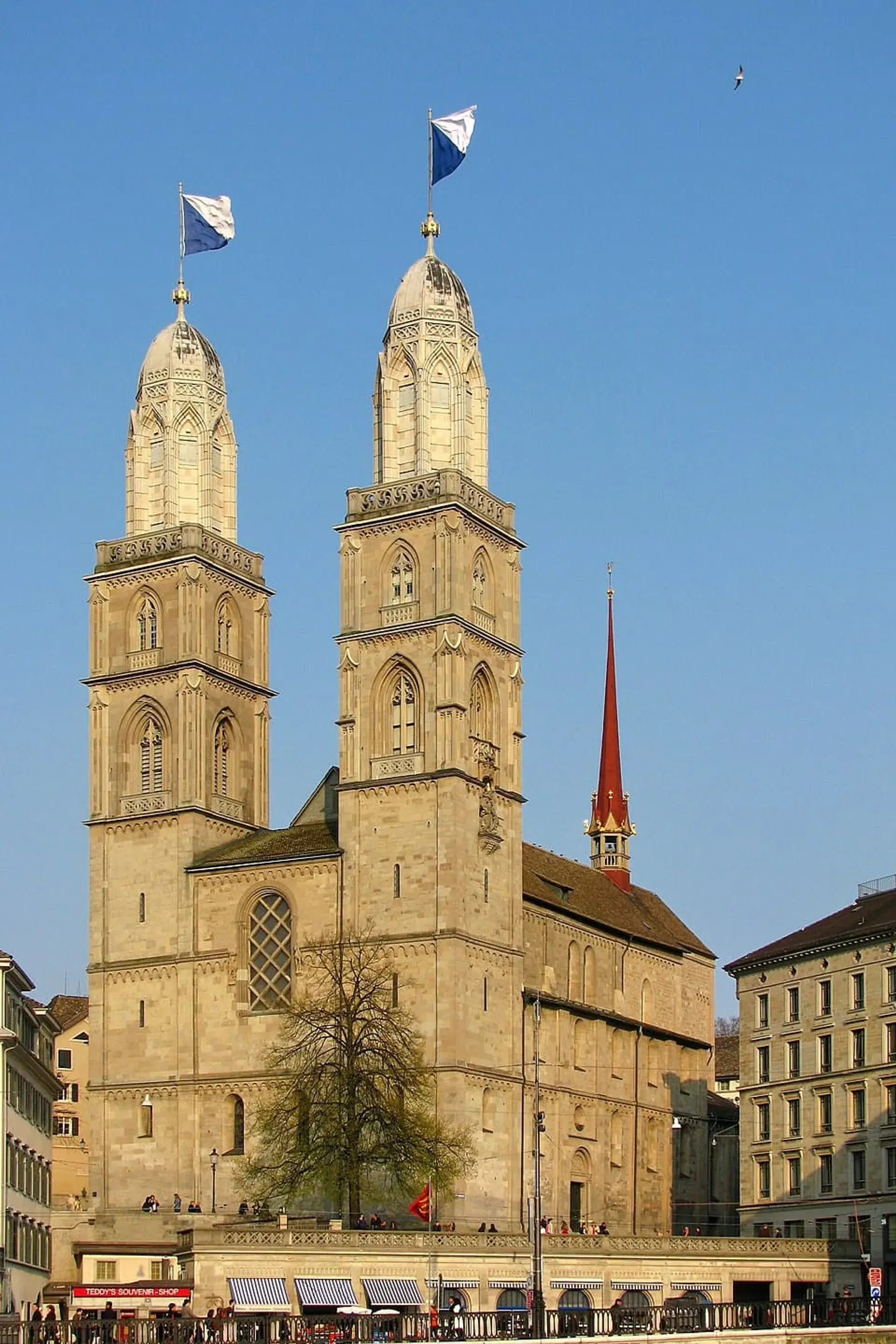
Grossmünster stands on the eastern bank of the Limmat river at Zwingliplatz, serving as an enduring focal point of Zürich's Old Town. Local tradition traces the foundation of the church to the Holy Roman Emperor Charlemagne. Legend recounts that Charlemagne's horse knelt over the graves of Zürich's patron saints—Felix, Regula, and Exuperantius—prompting the emperor to establish a religious foundation on the site. Archaeological excavations beneath the church have confirmed the presence of an authentic Roman burial ground.
The core Romanesque basilica was erected between approximately 1090/1100 and 1220/1230 over earlier Carolingian foundations. Operating as a collegiate chapter of secular canons, Grossmünster played a dominant civic and ecclesiastical role throughout the Middle Ages, frequently engaging in jurisdictional rivalries with the Fraumünster abbey situated across the river.
The Cradle of the Swiss Reformation
Grossmünster's historical trajectory shifted decisively in 1519 when Huldrych Zwingli was appointed as the people's priest. Preaching from the Grossmünster pulpit, Zwingli introduced the theological ideas that catalyzed the Swiss Reformation. By 1523 and 1524, he convinced city magistrates to separate from the authority of the Roman Catholic Church.
In accordance with Reformed principles, an extensive iconoclastic clearing took place in 1524. The church interior was systematically stripped of its ornate adornments: altarpieces, religious sculptures, and organs were removed, the shrine of the patron saints was dismantled, and the decorated walls were whitewashed to create an austere worship space centered strictly on the spoken word. Following Zwingli's death, reformer Heinrich Bullinger continued this tradition and solidified Zürich's Reformed administration.
Romanesque Architecture and Interior Artworks
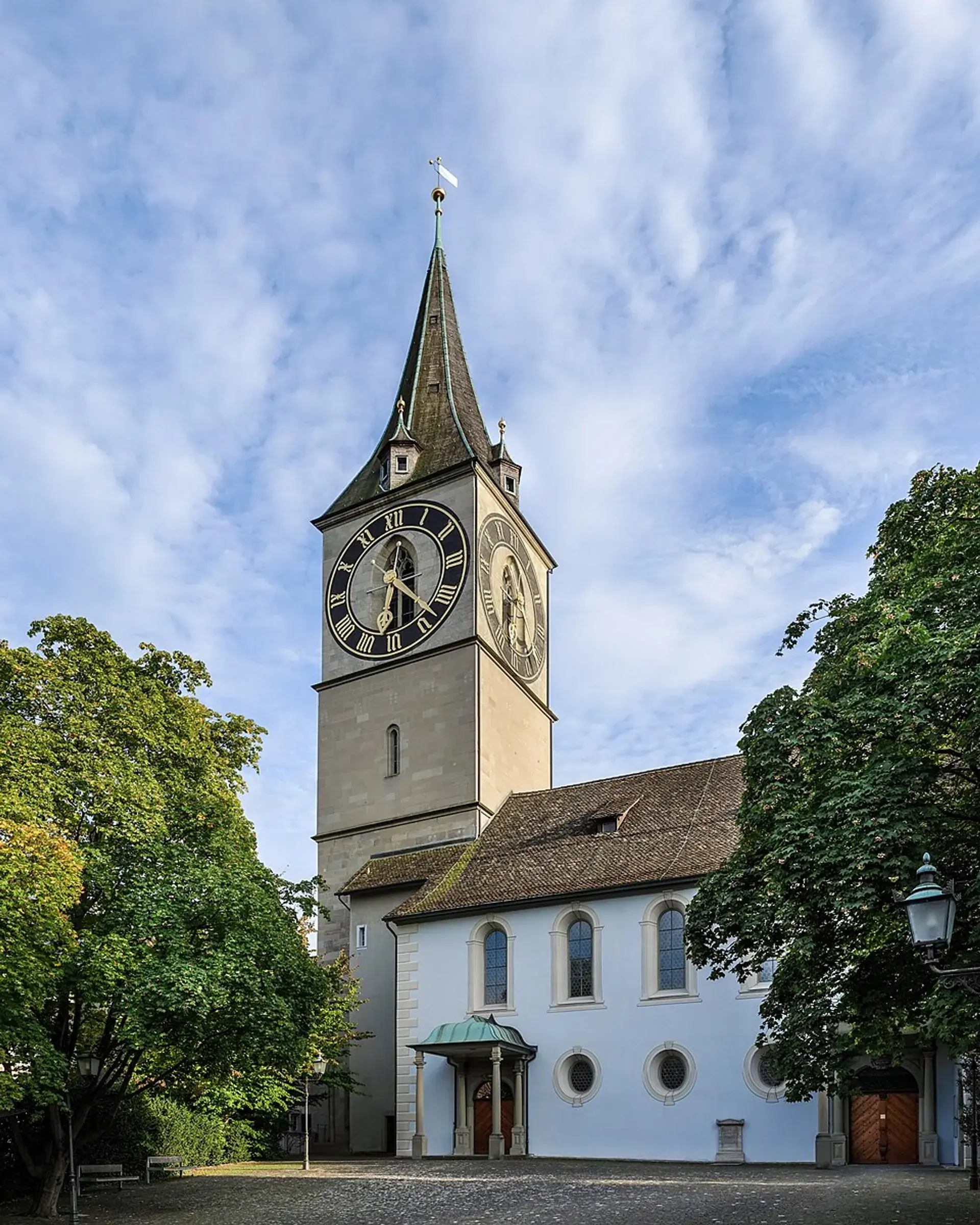
The exterior of Grossmünster is instantly recognizable by its twin towers, which were constructed between 1487 and 1492. After a fire consumed the original wooden spires in 1763, neo-Gothic finials designed by Johann Caspar Vögeli and Johannes Haggenmiller were installed in the 1780s. Together with Fraumünster, St. Peter, and the Predigerkirche, the basilica anchors Zürich's historic skyline.
Inside, pale sandstone masonry and whitewashed surfaces interact with distinctive decorative additions spanning the 20th and 21st centuries. Three choir windows created by Augusto Giacometti in 1932 and 1933 illustrate the Christmas story in vibrant stained glass. In 2009, German artist Sigmar Polke introduced a series of western nave windows formed from thin, translucent slices of natural Brazilian agate, creating mosaic-like panels that project warm amber and quartz tones across the stone nave. The church's exterior portals are framed by bronze relief doors sculpted by Otto Münch in 1935 and 1950.
Below the choir lies the Romanesque crypt, which preserves surviving 14th- and 15th-century wall paintings depicting the martyrdom and legends of Felix and Regula. The crypt also houses the original 15th-century sandstone sculpture of a seated Charlemagne; the weather-worn statue mounted on the exterior of the south tower is a 20th-century replica.
Ascending the Karlsturm
The south tower of Grossmünster, known as the Karlsturm, provides access to an elevated viewpoint approximately 50 meters above ground level. Reaching the open observation platform requires climbing 187 steps via a narrow spiral staircase.
The tower stairwell features an unexpected modern intervention: a "Dance of Death" (Totentanz) mural painted directly onto the historic stone masonry by Harald Naegeli, the Swiss graffiti artist known as the "Sprayer of Zurich." At the summit, the platform offers panoramic vistas across the Limmat, the Old Town rooftops, and Lake Zürich.
Current Use and Visiting Conditions
Grossmünster continues to operate as an active parish church within the Evangelical Reformed Church of the Canton of Zürich, holding regular Sunday services, musical recitals, and civic ceremonies. General daytime admission to the nave is open to the public free of charge, with tower access available independently.
To safeguard the delicate medieval frescoes inside the Romanesque crypt from fluctuating humidity, the subterranean space is periodically locked on rainy days. Extensive phased restoration work is planned from 2025 through 2029, with access to both the nave and the Karlsturm tower climb maintained throughout the project.
FAQ
Why are the nave windows in Grossmünster made of agate?
In 2009, artist Sigmar Polke designed seven nave windows using thinly sliced, polished Brazilian agate rather than traditional stained glass, allowing natural light to filter through the mineral layers in glowing amber and quartz tones.
What historical role did Grossmünster play in the Reformation?
Grossmünster was the birthplace of the Swiss Reformation. Huldrych Zwingli began preaching here in 1519, leading to the city's break with the Catholic Church and the stripping of church decorations, organs, and saint shrines in 1524.
Is the Charlemagne statue on the outside of Grossmünster original?
No, the seated Charlemagne statue visible on the exterior of the Karlsturm is a 20th-century replica. The authentic 15th-century sandstone original is kept inside the church's Romanesque crypt.
Can visitors climb the Grossmünster towers?
Visitors can climb the south tower, the Karlsturm, via a 187-step spiral staircase to reach an open viewing platform roughly 50 meters above the city.