Zeughauskeller: Zürich's Historic Arsenal Beer Hall
From 15th-Century Munitions Depot to Dining Hall
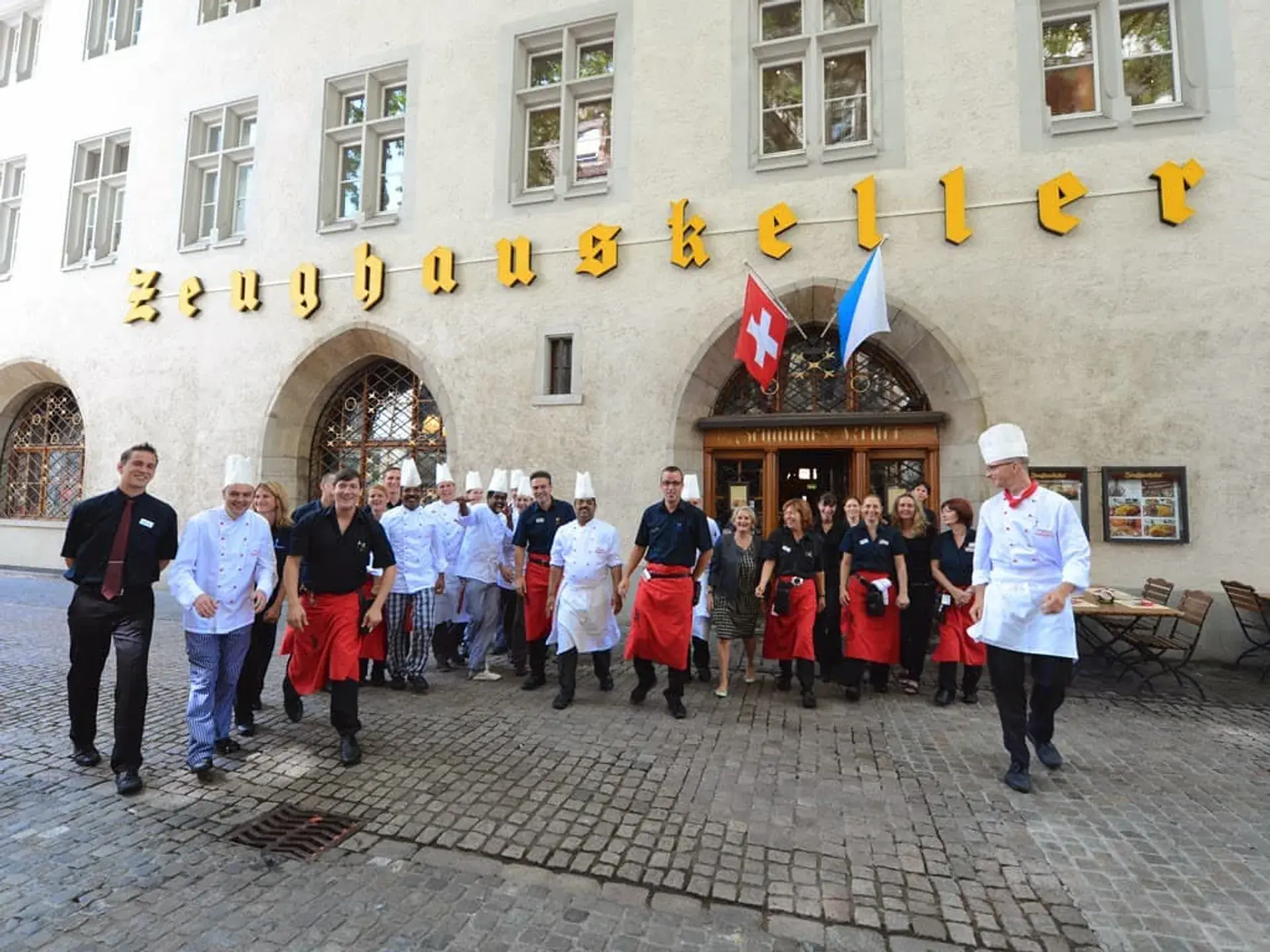
Situated at Bahnhofstrasse 28a near Paradeplatz, the Zeughauskeller occupies a building dating to 1487. Constructed during an era of armed conflicts involving the Old Swiss Confederacy, the structure initially functioned as Zürich's municipal arsenal (Zeughaus). For nearly four centuries, it served as the city's primary depot for storing, maintaining, and distributing weapons, armor, and artillery ammunition.
Military operations at the site came to an end in 1867 when Zürich relocated its cantonal armory across the Sihl River. After decades of private and residential use, the historic ground floor was repurposed in 1926 into a traditional beer hall and restaurant. The venue has since operated as an independent business passed down through generations, including steward Denise Hammer.
Architecture and Arsenal Atmosphere
The interior of the Zeughauskeller preserves its late-medieval structural framework. Diners sit at long communal solid-wood tables beneath heavy timber ceiling beams supported by original 15th-century stone columns. The dining hall possesses an echoey, lively tavern acoustic created by the high ceilings and open layout.
Reflecting its military heritage, the hall's stone arches and walls are decorated with historical weaponry, including iron pikes, halberds, shields, crossbows, and artillery hardware. This historic interior offers a civic counterweight to the surrounding modern banking institutions and luxury retail outlets of the Paradeplatz district.
Swiss Fare and Signature Sword Service
Operating daily as a high-volume culinary establishment, the Zeughauskeller serves traditional regional Swiss cuisine alongside draft beers. Standard menu items include Zürcher Geschnetzeltes (sliced veal cooked in a white wine cream sauce), whole roasted pork shanks (Schweinshaxe), sausages, and Rösti.
The restaurant is well known for military-themed presentations, notably the Bürgermeister Schwert ("Mayor's Sword"). For this dish, marinated meat is wrapped directly around the blade of a metal sword before being grilled and brought to the table. Another thematic offering is a sausage specialty named the Kanonenputzer ("cannon cleaner").
Legends of Tell and Zwingli
Over the centuries, the arsenal became tied to regional legends. Nineteenth-century folklore and traveler records frequently asserted that the crossbow used by Swiss hero Wilhelm Tell was preserved inside the armory.
Early guidebooks also referenced local traditions asserting that the battle-axe carried by church reformer Huldrych Zwingli at the Battle of Kappel in 1531 was kept on the premises. Nineteenth-century historical commentators, however, dismissed the authenticity of the weapon attributed to Zwingli.
FAQ
When was the Zeughauskeller building originally constructed?
The building was erected in 1487 to serve as Zürich's central municipal weapons and munitions depot.
When did the arsenal transition into a restaurant?
Military use ended in 1867, and the building's ground floor was converted into the Zeughauskeller beer hall and restaurant in 1926.
What is the Bürgermeister Schwert dish?
The Bürgermeister Schwert, or 'Mayor's Sword,' is a house specialty where marinated meat is wrapped around the blade of a metal sword before being grilled and served.
What historical legends are associated with the old arsenal?
Nineteenth-century accounts recorded popular local traditions claiming the arsenal held Wilhelm Tell's crossbow and Huldrych Zwingli's battle-axe from the 1531 Battle of Kappel.