Carfax Tower Oxford: History and Skyline Views
The Historic Crossroads of Oxford
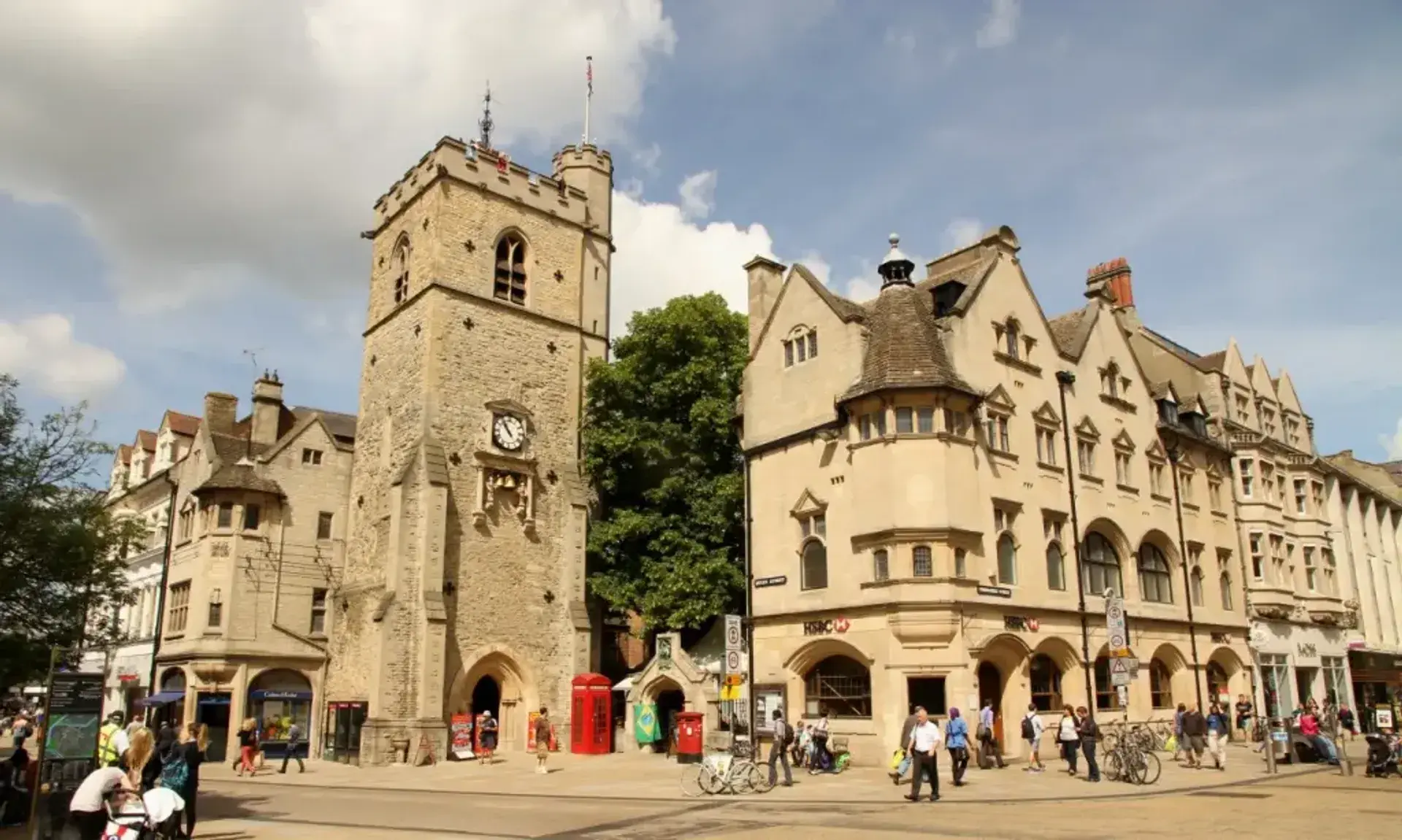
Carfax Tower stands at the historic center of Oxford, where Cornmarket Street, St Aldate's, Queen Street, and the High Street meet. This junction reflects the cardinal axes of the original Saxon town grid, historically separating the academic college grounds from Oxford's civic and commercial core. The name Carfax originates from the Latin quadrifurcus (meaning four-forked) via the Norman French word carrefour.
Historically, the intersection was also the site of the Carfax Conduit. Constructed in 1617, this stone fountain supplied spring water and was made to flow with wine during royal celebrations. Severe traffic congestion at the crossroads eventually led to the conduit's removal in 1787, after which it was relocated to Nuneham Park.
Oxford walking tour with audio and quizzes: town, gown and Wren
2 hours10 stopsAudio guideStart any day, at your own paceTicket on your phone · 30-day refundThe Civic Church of St Martin
The tower is the sole surviving element of St Martin’s Church, which was designated Oxford's official City Church in 1122. Serving as the primary place of worship for the Mayor and the Oxford Corporation, the church held dedicated municipal pews and served as the burial place for more than twenty Oxford mayors. Behind the tower, a solitary surviving gravestone marks the burial plot of William Henry Butler, the Mayor of Oxford in 1836, along with his wife and two infant daughters, representing the only remaining trace of the churchyard.
St Martin's was also deeply entangled in the historical conflicts between local citizens and university academics. The tower's bells regularly sounded the civic alarm to summon townspeople during clashes with scholars. Most notably, on 10 February 1355, a dispute over wine at the neighboring Swindlestock Tavern triggered the St Scholastica Day Riot. During the clash, townsfolk rang St Martin’s bells to rally fighters, while scholars sounded the bells of the University Church of St Mary the Virgin.
Demolition and Architectural Survival
Although the medieval church was rebuilt between 1820 and 1822, the Carfax Improvement Scheme led to the demolition of the 19th-century church building in 1896 to make way for carriage and tram traffic. The 13th-century stone tower was saved through a campaign led by the rector, Reverend Carteret Fletcher, under the Oxford Corporation Act.
To allow the medieval structure to stand independently following the demolition of the church nave, architect Sir Thomas Graham Jackson modified the building in 1897. Jackson added exterior buttresses and a dedicated stair turret, securing the Grade II listed landmark that remains today.
Tower Mechanics and the Skyline Cap
Mounted beside the clock on the tower's east wall are the Quarterboys—two mechanical figures dressed in classical Roman attire. Every 15 minutes, these automata strike small exterior bells to sound the quarter hours. Inside, the tower houses a ring of six change-ringing bells cast in the 1670s by Richard Keene, which continue to be rung for civic and ceremonial occasions by the Oxford Society of Change Ringers.
Reaching 74 feet (23 metres) in height, Carfax Tower functions as a critical benchmark in municipal planning. A long-standing local regulation prevents new buildings in central Oxford from exceeding the tower's height, ensuring the preservation of the city's historic skyline. Today, the tower is owned and maintained by Oxford City Council as a ticketed viewpoint, offering panoramic views over the city via a 99-step spiral staircase to an open roof platform.
FAQ
Why is Carfax Tower standing without the rest of the church?
St Martin's Church was demolished in 1896 under the Carfax Improvement Scheme to widen streets for carriage and tram traffic. Rector Reverend Carteret Fletcher successfully campaigned to save the 13th-century tower, and architect Sir Thomas Graham Jackson added supportive buttresses in 1897 so it could stand alone.
What are the Quarterboys on Carfax Tower?
The Quarterboys are two mechanical figures dressed in classical Roman attire positioned beside the clock face on the east wall. Every 15 minutes, they mechanically strike exterior bells to mark the quarter hours.
How does Carfax Tower influence construction in Oxford?
Under municipal planning guidelines, new buildings within Oxford's city centre are prohibited from exceeding the tower's height of 74 feet (23 metres) in order to safeguard the historic skyline.