Martyrs' Memorial Oxford: Victorian History & Guide
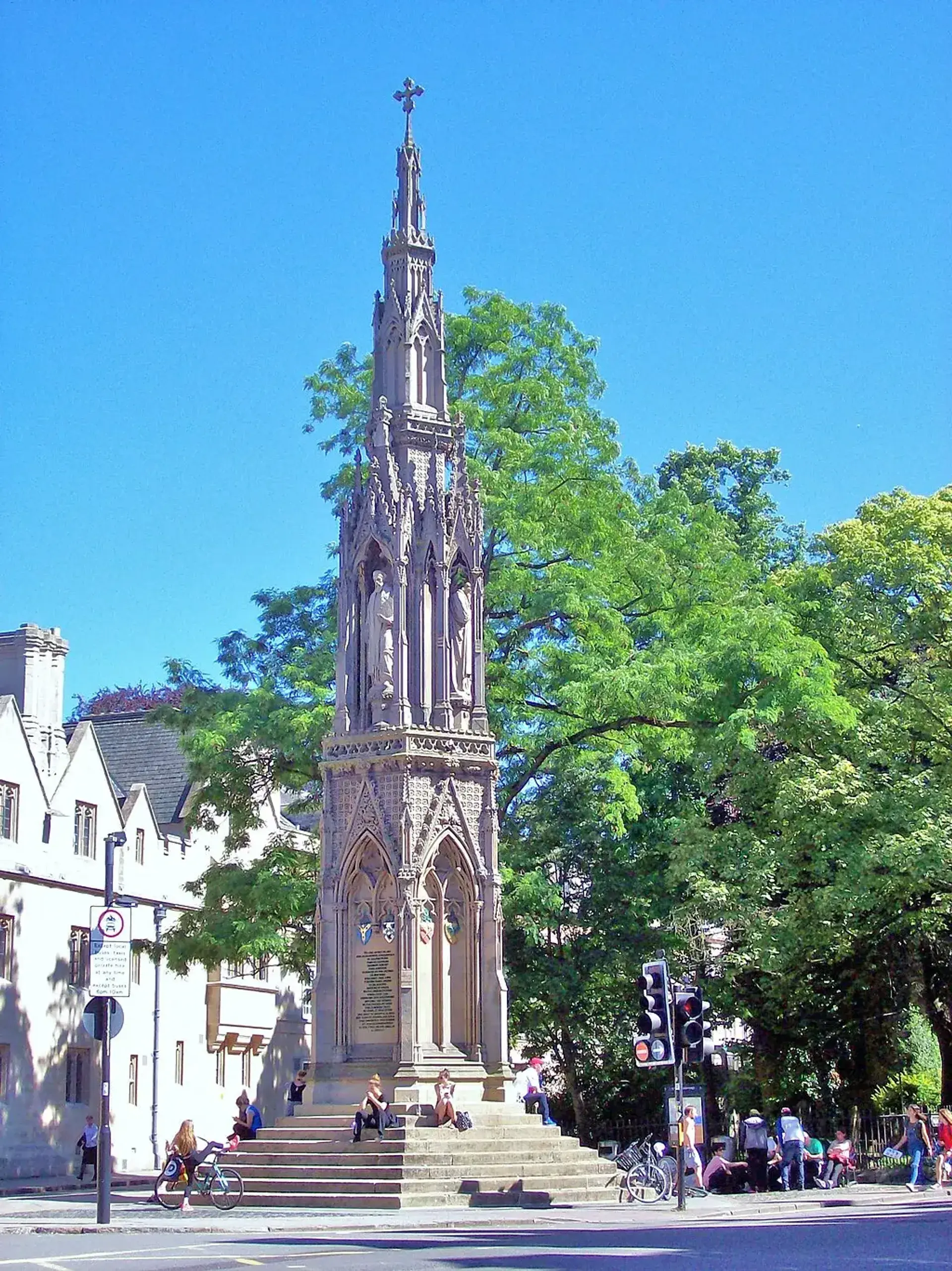
The Martyrs' Memorial is a Grade II* listed Victorian Gothic monument situated on a pedestrian traffic island at the junction of St Giles', Magdalen Street, and Beaumont Street in Oxford. Positioned adjacent to the Church of St Mary Magdalen, the monument marks the northern threshold of Oxford's historic core, anchoring the approach to Broad Street and facing both the Ashmolean Museum and the Taylor Institution.
Designed by architect Sir George Gilbert Scott and constructed between 1841 and 1843, the memorial commemorates three 16th-century Protestant bishops known as the Oxford Martyrs. Its spire-like form connects Oxford's academic institutions with its commercial district and remains an enduring city landmark.
The Oxford Martyrs and the Reformation
The monument commemorates Archbishop of Canterbury Thomas Cranmer, Bishop of Worcester Hugh Latimer, and Bishop of London Nicholas Ridley. During the reign of Queen Mary I and her effort to reverse the English Reformation, all three Anglican bishops were tried for heresy at the University Church of St Mary the Virgin.
Latimer and Ridley were executed by burning at the stake on October 16, 1555, in the city ditch outside Oxford's northern defensive town wall. Cranmer was held in captivity, recanted his Protestant beliefs under duress, and later renounced those recantations. He was executed at the same site on March 21, 1556.
Oxford walking tour with audio and quizzes: town, gown and Wren
2 hours10 stopsAudio guideStart any day, at your own paceTicket on your phone · 30-day refundThe 19th-Century Theological Conflict
Nearly three centuries passed between the executions and the commissioning of the memorial. In 1840, Anglican clergymen led by the Reverend Charles Pourtales Golightly organized the construction of the monument. The effort was initiated as a direct public challenge to the contemporary Oxford Movement, whose Tractarian leaders, such as John Henry Newman and John Keble, advocated for Anglo-Catholic liturgical and theological revivals within the Church of England.
The monument served as a physical assertion of Oxford's Protestant character. The project carried an architectural irony: Scott designed the memorial using the Gothic Revival style, an aesthetic vigorously promoted by the very High Church Anglo-Catholics the monument was commissioned to oppose.
Architectural Design and Sculptures
Scott modelled the multi-tiered memorial after the 13th-century Eleanor Crosses erected by King Edward I, specifically drawing inspiration from Waltham Cross in Hertfordshire. The monument resembles a detached church spire, featuring gables, heraldic shields, pinnacles, and finials tapering upward against the sky.
The primary structure was constructed from Magnesian limestone, while its three statues were carved from softer Caen stone by sculptor Henry Weekes. Each statue occupies a niche facing a specific direction:
- Thomas Cranmer faces north, holding a Bible.
- Nicholas Ridley faces east.
- Hugh Latimer faces west, with his arms folded across his chest.
Separation from the Execution Site
Although commonly mistaken for the place of martyrdom, the memorial does not stand where the executions occurred. Erecting a large monument on Broad Street was considered impractical in the 1840s. The genuine execution location in the former city ditch is marked separately by a cobblestone and iron cross sunk directly into the roadway of Broad Street outside Balliol College.
Modern Use and Conservation
Steps made of stone wrap around the octagonal base of the memorial, raising it above street level. In modern times, the site serves as a popular social meeting point and resting place for students, residents, and visitors. Oxford undergraduates once maintained a running prank involving the memorial, telling gullible visitors that the structure was the spire of an underground cathedral and charging admission for fictitious tours.
Due to centuries of exposure and stone decay, the monument was previously placed on the Buildings at Risk register. A full-scale conservation and repair initiative carried out jointly by the Oxford Preservation Trust and the Oxford City Council was completed in January 2003, securing the landmark for the future.
FAQ
Where did the Oxford Martyrs' executions actually occur?
The executions took place outside the northern city wall in the city ditch. The exact location is marked by a cobblestone and iron cross embedded in the road surface of Broad Street outside Balliol College, not at the Martyrs' Memorial itself.
Who designed the Martyrs' Memorial?
The monument was designed by architect Sir George Gilbert Scott between 1841 and 1843, with the three statues sculpted by Henry Weekes.
Which figures are depicted on the monument?
The memorial depicts Thomas Cranmer (Archbishop of Canterbury), Hugh Latimer (Bishop of Worcester), and Nicholas Ridley (Bishop of London).
Why was the memorial built in the 1840s, centuries after the Reformation?
Anglican clergy led by the Reverend Charles Pourtales Golightly commissioned the memorial in 1840 as a protest against the Oxford Movement, seeking to reaffirm Oxford's Protestant identity against Anglo-Catholic theology.