Radcliffe Camera: Oxford's Historic Domed Library
The Architectural Heart of Oxford
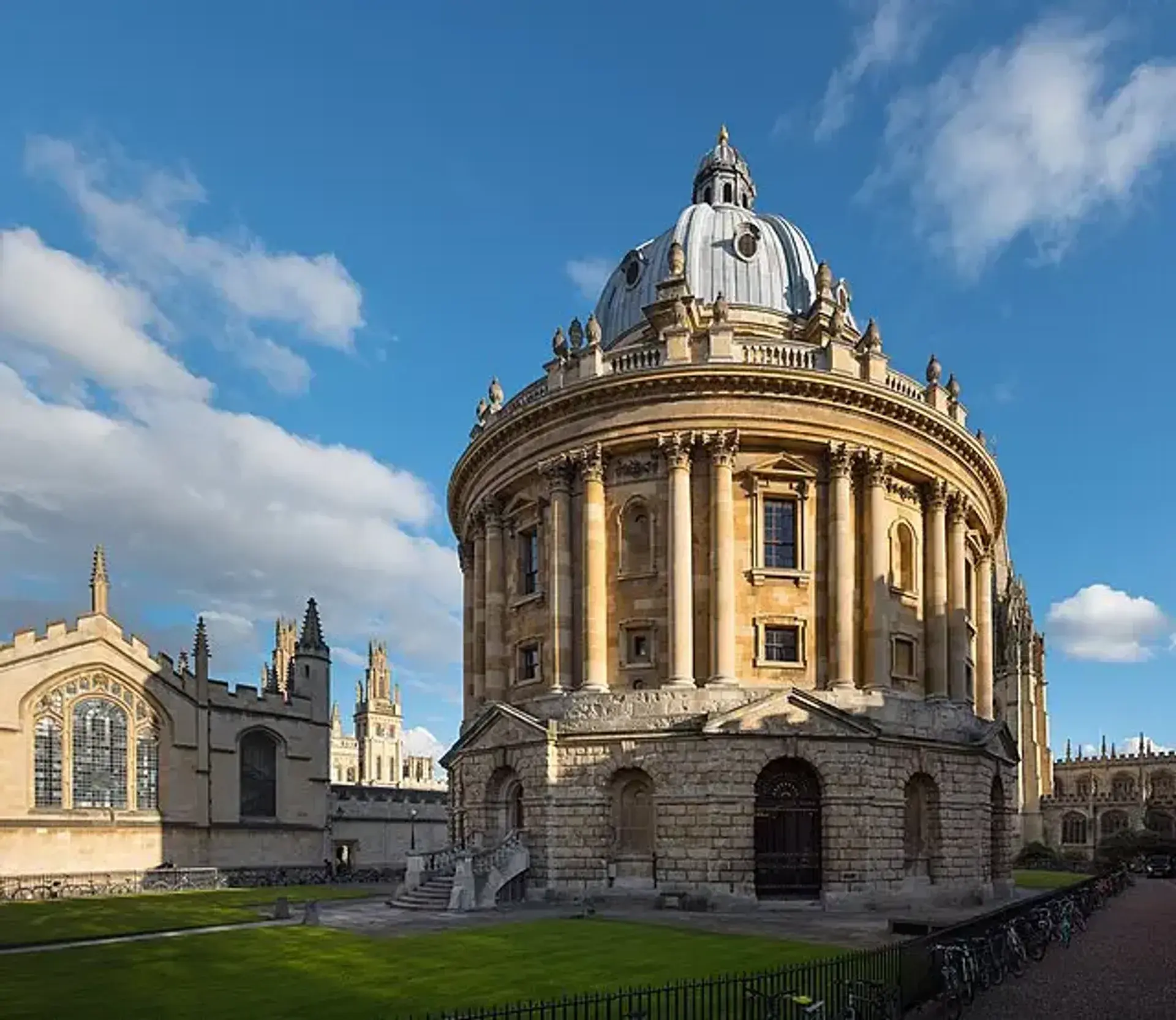
Standing at the center of Radcliffe Square, the Radcliffe Camera is one of the most recognizable landmarks of the University of Oxford. Encircled by the stone walls of Brasenose College, All Souls College, the Bodleian Old Library, and the University Church of St Mary the Virgin, the classical rotunda anchors the historic route linking High Street and Broad Street. Around the perimeter, cobblestones arranged in concentric radial circles create a distinctive tactile texture that audibly amplifies footsteps across the open plaza.
Commissioned as Britain’s first purpose-built circular library, the structure was funded through a £40,000 bequest from Dr. John Radcliffe, an Oxford alumnus and physician to King William III and Queen Anne. Following Radcliffe’s death in 1714, trustees spent over two decades reviewing proposals from prominent figures including Sir Christopher Wren, Sir John Vanbrugh, and Nicholas Hawksmoor. Hawksmoor drafted detailed plans and built a wooden model before his death in 1736, after which Scottish architect James Gibbs assumed responsibility for the design.
Oxford walking tour with audio and quizzes: town, gown and Wren
2 hours10 stopsAudio guideStart any day, at your own paceTicket on your phone · 30-day refundClassical Design and an Ingenious Compromise
Constructed between 1737 and 1748, the Radcliffe Camera officially opened on April 13, 1749. Gibbs harmonized English Palladianism with Roman Baroque influences, configuring the library into a three-tiered rotunda. Its foundation consists of a rusticated limestone basement base, supporting an upper drum framed with paired Corinthian-style columns and pilasters. The honey-colored Headington and Taynton limestones contrast with the dark patinated lead of the dome above.
While the monumental dome appears to be solid masonry from both inside and outside, it is actually an illusion of engineering. Gibbs initially envisioned a stone dome, but structural difficulties during construction forced masons to dismantle early stonework. In 1743, the design was replaced with a timber framework, sheathed in exterior lead sheeting and finished internally with decorative plasterwork, all capped with a stone cupola.
Nineteenth-Century Alterations
Originally home to the independent Radcliffe Library, the building’s collections shifted focus over time. In 1861, its scientific holdings were relocated to the newly constructed Radcliffe Science Library. Between 1862 and 1863, the building was formally incorporated into the Bodleian Libraries system as an additional reading room.
This administrative transfer prompted major physical modifications. The ground-floor level, initially an open-air arcade secured only by iron grilles, was enclosed with glass in 1863. Around the same time, a new formal northern doorway was carved into the stone, converting an existing circular window opening into the primary entrance. Another significant alteration to the surrounding landscape occurred in 1936, when decorative iron perimeter railings—installed in 1827 around the base of the rotunda—were removed to restore open pedestrian passage through Radcliffe Square.
Modern Reading Rooms and Underground Passages
Today, the Radcliffe Camera operates as a non-lending research facility within the Bodleian Libraries network. Its Upper and Lower reading rooms hold the History Lending Collection. The Upper Camera also houses a six-foot marble statue of Dr. John Radcliffe, sculpted by the Flemish-born artist John Michael Rysbrack.
Directly beneath the turf and cobbles of Radcliffe Square lies the Gladstone Link. This two-story subterranean library and book storage facility connects the Radcliffe Camera underground to the Bodleian Old Library, providing storage for hundreds of thousands of books while preserving the historic collegiate courtyard above.
FAQ
Can the general public enter the Radcliffe Camera?
Access to the reading rooms is restricted to University of Oxford students and registered Bodleian Reader cardholders. General visitors can only enter the interior by booking scheduled, fee-based Bodleian guided tours.
Is the dome of the Radcliffe Camera made of stone?
No. Although it resembles heavy stone masonry inside and out, the dome is built from timber framing sheathed in exterior lead and lined with interior decorative plaster. Architect James Gibbs revised the design from stone to timber in 1743 due to structural concerns.
What is the underground space beneath Radcliffe Square?
Beneath the square lies the Gladstone Link, a two-level subterranean book repository and study library that links the Radcliffe Camera to the Bodleian Old Library.