The Covered Market: Oxford's Historic Market Hall
Origins and the Oxford Mileways Act
The Covered Market originated as a solution to urban congestion and public hygiene concerns in 18th-century Oxford. Under the Oxford Mileways Act of 1771, civic authorities sought to clear messy, unhygienic butcher stalls, fishmongers, and street traders away from High Street and Butcher Row (now Queen Street) to widen streets and facilitate traffic flow.
To oversee the project, the 1771 Act established a joint committee composed of six University representatives and six City representatives. Architect John Gwynn, who also designed Oxford's Magdalen Bridge, was commissioned to design the new trading space. The Covered Market officially opened on 1 November 1774. Following the opening, municipal statutes banned open-street trading of meat, fish, and produce in central Oxford, and a subsequent Act in 1781 extended this prohibition to butter, eggs, and fruit, directing commerce inside the hall.
Oxford walking tour with audio and quizzes: town, gown and Wren
2 hours10 stopsAudio guideStart any day, at your own paceTicket on your phone · 30-day refundArchitectural Evolution and Historic Relics
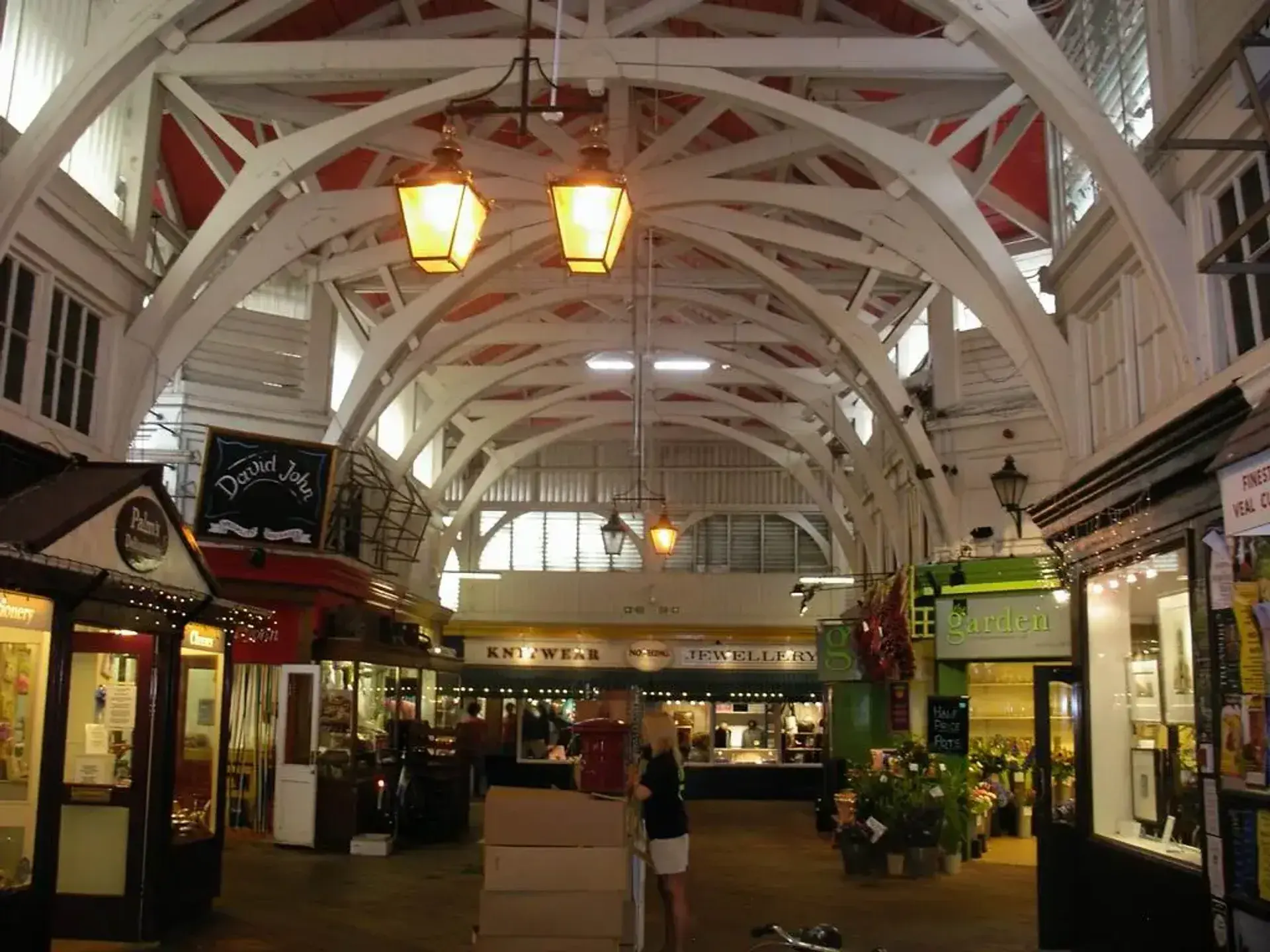
When it first opened, the market consisted of timber-framed butchers' stalls arranged around open-air courtyards. Between 1834 and 1900, the complex underwent substantial expansion, reconstruction, and enclosure, during which the open areas were roofed over using timber trusses and cast-iron fittings. In 2000, the historic structure received Grade II listed status.
Visible architectural remnants from early trading eras remain throughout the interior avenues. High-level steel rails and tiered, red-painted cast-iron meat hooks still project from the fascias of historic butcher units. These fixtures were once essential infrastructure for openly hanging unchilled animal carcasses in the unheated aisles before modern refrigeration. Today, historic details such as 18th-century stone flag floors, brick pathways, and vintage wooden shopboards sit alongside contemporary storefronts.
Commercial Heritage and Traditions
The Covered Market long served as a vital provisioning base for the collegiate university. Oxford University colleges routinely acquired supplies of game, venison, boar, and poultry directly from the market's butchers to cater formal hall dinners.
In addition to traditional victuallers, the hall has served as an incubator for modern businesses. In 1983, cookbook author Helge Rubinstein opened the first stall of what became the international bakery chain Ben's Cookies, using an illustrated logo designed by Quentin Blake. Having operated continuously without interruption since 1774, the Covered Market marked its 250th anniversary in 2024.
Modern Regeneration and Daily Life
Owned and managed by Oxford City Council, the Covered Market functions as a central pedestrian passage linking High Street with Market Street and Cornmarket Street. It houses roughly 50 to 60 independent vendors, including artisanal food sellers, florists, traditional butchers, craft retailers, and cafes. The hall trades daily from 8:00 AM (10:00 AM on Sundays), with extended evening trading until 10:00 PM or 11:00 PM on Thursdays through Saturdays featuring taprooms, dining, and live music.
To safeguard its future, Oxford City Council approved a £6.87 million regeneration masterplan designed by architects Gort Scott. The ongoing project includes upgrading entrances on High Street and Market Street, pedestrianising portions of Market Street, and establishing a new internal communal square, while conservation bodies like the Oxford Preservation Trust continue to restore the market's historic fabric.
FAQ
When did Oxford's Covered Market open?
The Covered Market was designed by architect John Gwynn and officially opened on 1 November 1774.
Why was the Covered Market originally built?
It was established under the Oxford Mileways Act of 1771 to clear congested, unhygienic butcher stalls and street vendors from High Street and Butcher Row to widen central streets.
What do the red hooks on the shopfronts represent?
The high-level steel rails and tiered, red-painted cast-iron hooks are preserved from earlier centuries when butchers displayed unchilled animal carcasses openly along the aisles.
Which international brand started in the Covered Market?
The international bakery chain Ben's Cookies was founded in the market in 1983 as a single stall by Helge Rubinstein, featuring a logo drawn by illustrator Quentin Blake.